A wall bracket’s finish gets specified far more casually than its load path, yet the finish decision determines whether the bracket looks correct beside its rail and wall finish, whether it survives its exposure, and whether a replacement part years later will actually match. Getting the finish brief right before fabrication avoids disputes that surface only after installation, when correction options are limited.
Interior and Exterior Exposure Inputs That Change the Finish Brief
Finish selection should begin with the bracket’s exposure, its visual intent, the cleaning regime it will receive, and its contact with adjacent materials. These four inputs interact: a bracket that looks correct in isolation can still fail its purpose if the exposure or cleaning regime was not considered alongside the visual intent.
Exposure is not a binary of indoor versus outdoor. An interior bracket near an entrance, a pool deck under a roof, or a kitchen pass-through carries different contamination and moisture conditions than an interior bracket in a dry corridor. Where the bracket sits in a marine-influenced or industrial-influenced atmosphere, even under cover, the exposure input changes and the finish brief must change with it. Visual intent covers how reflective or matte the surface should read against the rail and wall, and whether that appearance is expected to remain uniform across every bracket in the run. Cleaning regime matters because some finishes retain a maintained appearance more readily under frequent washing with certain agents than others, and because a finish chosen for its as-installed look may not hold that look under the cleaning schedule the space actually receives. Contact with adjacent materials, such as dissimilar metals, sealants, or masonry, can introduce localized reactions or staining that a finish decision made in isolation would not anticipate.
For exterior work, this same set of inputs expands. Material grade, fabrication condition, drainage, contaminants, and cleaning access must be considered together with the finish; a finish name alone does not predict corrosion performance. A bracket specified only by finish name, without confirming the grade beneath it and the drainage and contaminant conditions it will face, leaves the corrosion question unanswered regardless of how the surface was polished or brushed at fabrication.
| Project context | Inputs to establish | How they guide the finish decision |
|---|---|---|
| Interior or exterior | Bracket exposure; visual intent; cleaning regime; contact with adjacent materials | Consider the inputs together before specifying the finish. |
| Buitenkant | Material grade; fabrication condition; drainage; contaminants; cleaning access; finish | Evaluate these conditions together; a finish name alone does not predict corrosion performance. |
The practical consequence for the buyer is that the finish brief cannot be written from a swatch alone. It has to carry the exposure condition, the visual intent, the cleaning regime, and the adjacent-material contact forward into the specification, because each one can change which finish is appropriate even when the bracket’s dimensions and mounting method stay the same.
Appearance Samples for Grain Direction, Reflectivity, and Color Consistency
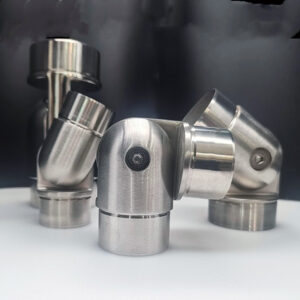
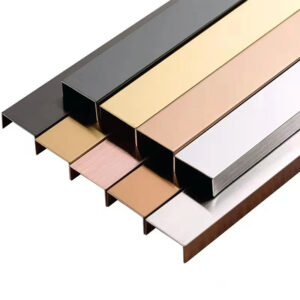
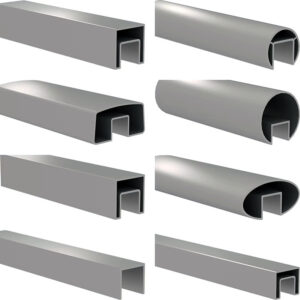
A finish name describes a category, not a guaranteed appearance. Brushed, satin, and mirror finishes each cover a range of grain depth, reflectivity, and directionality, and two brackets carrying the same finish designation can still read differently once installed if the sample approval step was skipped or done in isolation.
Interior approval samples should be viewed with the intended rail and wall finish so reflectivity, grain direction, and color variation are agreed before production. Reflectivity interacts with ambient lighting and with the finish of the surfaces around the bracket; a sample viewed under showroom lighting against a neutral background can look different once placed against the project’s actual wall finish and rail. Grain direction matters where the bracket has a visible face that will be seen in a fixed orientation from a corridor or stair approach; if the grain runs one way on some brackets and another way on others in the same sightline, the inconsistency becomes visible even though every bracket meets its finish name. Color and tone variation across a batch is a separate issue from grain direction, and stainless steel can show subtle variation between production runs, which is why the comparison needs to happen against the real adjoining materials rather than against a generic reference chip.
Once the sample review has produced agreement, that agreement needs to be captured, not left as a verbal understanding from a sample meeting. The agreed sample and the visible-face direction are identified so that fabrication has a fixed reference rather than a description open to reinterpretation.
| Control stage | Comparison or check | Agreed output |
|---|---|---|
| Sample review | View the bracket sample with the intended rail and wall finishes. | Reflectivity, grain direction, and color variation agreed before production. |
| Production record | Identify the agreed sample and visible-face direction. | Sample reference and visible-face direction recorded on drawings and inspection documents. |
Where a project’s brackets differ from its rail and wall finishes as separate purchases, coordinating this sample review across all three finishes catches mismatches before fabrication commits to a run, rather than after brackets already installed reveal a visible contrast against the rail beside them. This is the same reasoning that applies when comparing brushed, mirror, and satin options generally: the finish category name is a starting point for the conversation, not the end of it.
Material Grade, Fabrication Condition, and Finish as Separate Decisions
A finish sits on top of a material grade and a fabrication condition, and treating those three as one combined decision is where specification errors originate. The same finish can be applied to different stainless grades, and the same grade can leave fabrication in different conditions depending on how the bracket was welded, formed, or machined before finishing. None of these three decisions substitutes for the others.
Material grade governs the underlying corrosion resistance and mechanical behavior of the bracket independent of how its surface is finished. Where a project’s exposure conditions call for a higher-performing grade, applying a premium finish to a lower grade does not raise the grade’s corrosion resistance; it only changes the surface appearance. Fabrication condition refers to what happened to the material during forming and joining, including whether weld areas, heat-affected zones, or contaminant residues from tooling remain on the part before finishing is applied. A finish applied over an unaddressed fabrication condition can trap the very conditions that lead to localized surface breakdown later, even though the finish itself was applied correctly.
This separation matters most where the buyer is comparing brackets from different sources that appear identical in finish. Two brackets can share a finish name and still differ in grade or in how thoroughly fabrication residues were addressed before finishing, and neither of those differences is visible in a photograph or a showroom sample. The buyer’s question is not only “what finish is this” but “what grade sits under this finish, and what condition was the fabrication in before the finish was applied.” Where the project’s exposure or service life expectations are stated, that grade and fabrication condition need to be confirmed against those expectations independently of the finish conversation, because a satisfactory answer on finish does not answer the grade or fabrication question, and a satisfactory answer on grade does not answer the finish question.
Cleaning, Contamination, and Drainage Conditions Around Wall Brackets
A wall bracket’s finish is maintained or degraded by what happens around it after installation, not only by what was specified before it. Cleaning regime, contamination exposure, and drainage condition need to be considered together, because each one changes how the others behave in practice.
Cleaning regime is not just a frequency question; it is a question of what agents and methods are used and whether the finish tolerates them without accelerated wear or altered appearance. A cleaning method appropriate for one finish can dull or scratch another, which is why the cleaning regime the space actually intends to follow needs to be part of the finish conversation rather than an assumption made after installation. Cleaning access is a physical condition: a bracket mounted where it cannot be reached without disassembly or special equipment will not receive the same maintenance as one that is easily wiped down, regardless of what regime was intended on paper.
Contamination sources vary by project and location, and can include airborne salinity, industrial residues, cleaning chemical carryover from adjacent surfaces, or contact with dissimilar materials that introduce galvanic or staining effects. Where contaminants are present and not routinely removed, they can sit against the bracket’s surface longer than intended, and the finish’s ability to resist that condition depends on the grade and fabrication condition underneath it, not on the finish alone.
Drainage condition determines whether moisture and the contaminants it carries have a path away from the bracket or whether they pool and remain in contact with the surface. A bracket mounted where water can collect against it, rather than run off, faces a different exposure than the same bracket mounted where drainage is unobstructed, even though both are nominally in the same environment. This is a reason the finish and grade decision cannot be made from exposure classification alone; the bracket’s specific mounting condition and drainage path are part of what the finish has to withstand.
Drawing Notes and Sample References That Keep Production Consistent
Every agreement reached during finish selection needs a written home, or it does not survive from approval to fabrication to inspection. The agreed finish designation, the visible-face direction, the sample reference, and the touch-up boundary are recorded on drawings and inspection documents so that each party working from the documentation reaches the same understanding the sample meeting reached.
The finish designation on its own is not enough if it can be interpreted differently by different fabricators; recording it alongside the specific sample reference removes that ambiguity by pointing back to a physical or documented standard rather than a name. The visible-face direction matters wherever the bracket has an orientation-dependent appearance, since a correctly finished bracket installed with its grain or reflective face running the wrong way will not match its neighbors even though it meets every other part of the specification.
The touch-up boundary is a separate item worth recording deliberately: it defines what condition of surface marking, from handling or installation work, falls within acceptable field correction and what does not. Without this boundary written down, disagreements about a scuff or a scratch discovered during installation have no shared reference point to resolve against, and the discussion happens after the fact rather than being settled by a standard agreed in advance.
Keeping these four items, the finish designation, the visible-face direction, the sample reference, and the touch-up boundary, together on the same documents prevents the fragmentation that happens when finish intent lives in a sample room decision, the visible-face direction lives in a site conversation, and the touch-up boundary lives nowhere at all.
Project Acceptance Boundaries for Finish and Surface Condition
Where a finish dispute arises after installation, the resolution depends on what evidence the project can point to and what that evidence actually establishes. Atmospheric exposure classification and stainless surface treatment guidance answer different questions, and neither substitutes for the other.
ISO 9223 classifies atmospheric corrosivity using the first-year corrosion of standard specimens and environmental factors including time of wetness, sulfur dioxide, and airborne salinity. This gives a project a way to describe the exposure environment a bracket will sit in, which is useful context for the grade and drainage conversation. It does not select a stainless grade, predict how long a specific bracket will perform, or characterize every industrial atmosphere a project might encounter; the classification describes the environment, not the outcome for a particular component in it.
ASTM A380/A380M covers cleaning, descaling, pickling, passivation, surface-contaminant removal, weld-area treatment, and cleanliness assessment for stainless parts and systems. Where a project wants to specify how fabrication residues or contaminants are addressed before or after finishing, this standard gives the supplier and purchaser a shared procedural reference to agree on. The supplier and purchaser must agree which of its procedures apply to the specific parts, and the standard does not qualify weld strength or structural performance; it addresses surface cleanliness and treatment, not the mechanical adequacy of a weld or joint.
| Reference | What it supports | What it does not establish |
|---|---|---|
| ISO 9223 atmospheric corrosivity classification | Exposure context from first-year corrosion of standard specimens and environmental factors including time of wetness, sulfur dioxide, and airborne salinity. | It does not select a stainless grade, predict bracket life, or characterize every industrial atmosphere. |
| ASTM A380/A380M cleaning and passivation guidance | Agreed procedures for cleaning, descaling, pickling, passivation, surface-contaminant removal, weld-area treatment, and cleanliness assessment. | The supplier and purchaser must agree the applicable procedures; the standard does not qualify weld strength or structural performance. |
Where a project has documented its exposure classification under ISO 9223 and specified applicable cleaning and passivation procedures under ASTM A380/A380M, it has established the environmental context and the surface-treatment procedure, but it has not, by that documentation alone, established the specific grade, the fabrication condition, or the touch-up boundary agreed for the brackets in question. Wandmontagebeugels sourced for the project still need those project-specific inputs, gathered through the finish brief and sample approval process, entered into the supplier’s configuration and quotation review before an order proceeds, because the standards describe environment and procedure, not the finished, project-matched component itself.
Veelgestelde vragen
V: Can one finish designation be used for both interior and exterior wall brackets?
A: Use a common designation only after each location has been assessed for exposure, visual intent, cleaning regime, contact with adjacent materials, and, outdoors, grade, fabrication condition, drainage, contaminants, and cleaning access. If these conditions differ, separate the locations in the finish schedule and assign their own material, finish, and sample controls.
V: How should an appearance sample be approved when the bracket meets different rail or wall finishes?
A: Review the bracket sample beside the intended rail and wall finish for each distinct visual condition. Record the accepted reflectivity, grain direction, color variation, visible-face direction, and sample reference before production; if the surrounding finish changes, repeat that comparison for the affected location.
V: What should a buyer provide before an exterior finish recommendation is finalized?
A: Provide the exposure context, intended material grade, fabrication condition, drainage path, likely contaminants, cleaning regime and access, adjacent materials, and appearance intent. Mark any undecided item openly so the finish name is not treated as a substitute for the missing project decision.
V: Do ISO 9223 or ASTM A380/A380M establish the finished bracket’s service life or structural acceptance?
A: No. Use ISO 9223 to frame atmospheric exposure context and ASTM A380/A380M to agree applicable stainless cleaning and passivation procedures. Keep grade selection, predicted life, weld strength, and structural acceptance as separate project decisions supported by the appropriate evidence.
V: How should touch-up work be controlled at inspection?
A: Define the permitted touch-up boundary on the drawings or inspection documents and tie it to the agreed sample and visible-face direction. Inspect the treated area against that recorded appearance reference, while keeping any cleaning or passivation procedure separately agreed between purchaser and supplier.