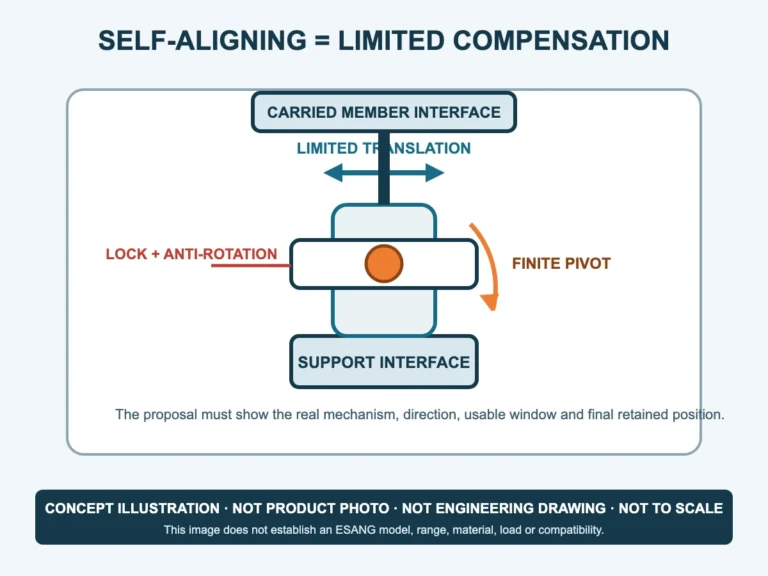
Define the mismatch before calling it self-aligning
A self-aligning bracket should provide limited, stated compensation between two components during fit-up. It does not automatically find the project datum, correct every direction or keep moving safely after installation. The buying task is to identify the actual mismatch, select the mechanism that moves in that direction, and confirm how the assembly is centred or positioned, locked and prevented from twisting.
Send a marked photo or sketch, the intended rail line, the direction and approximate size of the mismatch, support and carried-member shapes, and an estimated quantity. ESANG can use that to clarify the proposed compensation and interfaces before the order is frozen.
Request a self-aligning bracket quote on WhatsApp
Self-aligning describes behaviour, not one mechanism
The requested behaviour might come from a slot, pivot, floating seat, spherical contact, guided slide or a combination. Each option corrects a different kind of mismatch and has finite motion. Ask the proposal to show the mechanism rather than relying on the product name.

Separate four kinds of correction
| Mismatch | Possible requested function | What it does not prove |
|---|---|---|
| Horizontal or lateral offset | A guided slide or slotted fixing that translates toward the datum | It does not add vertical movement or angle change unless those functions are also shown. |
| Vertical offset | A height-setting interface with stated upward/downward allowance | It does not level the rail automatically or correct a support outside its travel. |
| Angular mismatch | A pivoting or seating interface in a defined plane | It does not correct lateral position and should not be assumed free-moving in service. |
| Contact-face variation | A limited seating feature that helps two faces bear as intended | It does not validate an uneven, damaged or structurally unsuitable support. |
Six controls keep compensation finite
- Datum: the rail centreline, finished face, post top or other project reference the assembly must reach.
- Compensation direction: each translation or rotation axis shown separately.
- Alignment window: nominal position and usable limits from the datum, not an undefined “self-adjusting” claim.
- Positioning method: whether the part is manually set, biased toward centre, seated by mating geometry or adjusted in another stated way.
- Lock and anti-rotation: parts, access and tightening sequence that hold the accepted position.
- Collision envelope: space for the moving parts, cover, rail/support, adjacent construction and tools at all permitted positions.
Limited compensation cannot replace engineering position
Use the bracket to manage documented fitting variation within the accepted window. Do not use it to hide an unknown support location, unsuitable anchor pattern, inadequate backing or an unreviewed load path. If measured variation exceeds the proposed window, the correct response is a revised support, adapter or bracket—not forcing the mechanism to an end position.
A self-aligning feature also differs from a variable-angle joint. Self-aligning focuses on limited compensation toward a required datum or contact. Variable-angle hardware is selected to hold a range of intentional route angles. A part may combine both functions, but only when the proposal identifies the independent movements and locks.
Follow the load path across adjacent parts
The connection still depends on the carried rail or component, saddle/contact piece, moving or seating element, lock, fixed bracket body, support plate or receiver, anchors/fasteners and substrate. A moving interface cannot be evaluated apart from those neighbours. Ask for contact faces, fastener engagement, locked position and included hardware to be shown together.
- On the support side, record shape, dimensions, hole pattern, edge distances, backing and anchor responsibility.
- On the carried side, record profile, dimensions, wall thickness where relevant, hole/weld request, centreline and finish.
- List covers, bushings, shims, rail fasteners, anchors, isolators and special tools as included or excluded.
Divide factory and site work clearly
The factory proposal should define the compensation axes, datum, alignment window, mechanism, final lock, mating interfaces, material/finish, supplied hardware and drawing revision. The site team supplies the real survey, verifies the structural support and fixing method, sets the project datum, brings the part into the allowed window, tightens and locks it, and checks the final line.
If later adjustment is required, state that at enquiry stage. An installation-alignment feature is not automatically a service joint. Access, retention, inspection and maintenance requirements may change when movement is expected after handover.
Use the same comparison fields for every offer
Compare compensation direction; nominal and limit positions; positioning method; lock and anti-rotation; support and carried interfaces; clearance; adjustment stage; material and finish by part; included hardware and exclusions; quantity and packaging; drawing revision; and any project-specific performance evidence required for acceptance. Any remaining assumption should be visible in the quotation.
Frequently asked procurement questions
Does self-aligning mean the bracket automatically centres itself?
Not necessarily. The mechanism may require manual positioning or may only allow limited seating. Ask exactly how the proposed part reaches and retains the datum.
Can one bracket correct height, position and angle together?
Only if the assembly provides each movement independently and has enough usable range and locking control. The drawing should show each axis rather than one combined range.
Can it compensate for inaccurate anchors?
Only within a documented interface and adjustment window. It cannot make an unsuitable anchor pattern, edge distance, substrate or backing acceptable.
Why not choose the largest compensation range?
Extra movement can increase the envelope, locked eccentricity and number of control points. Select enough controlled compensation for the measured variation.
Can a photo start a retrofit request?
Yes. Mark the intended datum and error direction, include approximate dimensions and show fixing access. Exact interfaces, window and lock still need confirmation before order.
Send the mismatch and target datum
Share what is out of line, in which direction, by approximately how much, and what the bracket must connect. Ask the proposal to return the compensation mechanism, alignment window, final lock, anti-rotation detail, interfaces and supply exclusions as separate fields.