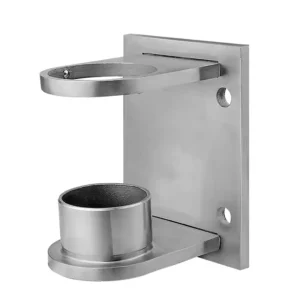
A wall bracket’s finish gets specified far more casually than its load path, yet the finish decision determines whether the bracket looks correct beside its rail and wall finish, whether it survives its exposure, and whether a replacement part years later will actually match. Getting the finish brief right before fabrication avoids disputes that surface only after installation, when correction options are limited.
影响饰面方案的室内外环境因素
Finish selection should begin with the bracket’s exposure, its visual intent, the cleaning regime it will receive, and its contact with adjacent materials. These four inputs interact: a bracket that looks correct in isolation can still fail its purpose if the exposure or cleaning regime was not considered alongside the visual intent.
Exposure is not a binary of indoor versus outdoor. An interior bracket near an entrance, a pool deck under a roof, or a kitchen pass-through carries different contamination and moisture conditions than an interior bracket in a dry corridor. Where the bracket sits in a marine-influenced or industrial-influenced atmosphere, even under cover, the exposure input changes and the finish brief must change with it. Visual intent covers how reflective or matte the surface should read against the rail and wall, and whether that appearance is expected to remain uniform across every bracket in the run. Cleaning regime matters because some finishes retain a maintained appearance more readily under frequent washing with certain agents than others, and because a finish chosen for its as-installed look may not hold that look under the cleaning schedule the space actually receives. Contact with adjacent materials, such as dissimilar metals, sealants, or masonry, can introduce localized reactions or staining that a finish decision made in isolation would not anticipate.
For exterior work, this same set of inputs expands. Material grade, fabrication condition, drainage, contaminants, and cleaning access must be considered together with the finish; a finish name alone does not predict corrosion performance. A bracket specified only by finish name, without confirming the grade beneath it and the drainage and contaminant conditions it will face, leaves the corrosion question unanswered regardless of how the surface was polished or brushed at fabrication.
| 项目背景 | 需确定的输入 | 它们如何影响最终决策 |
|---|---|---|
| 室内还是室外 | 托槽暴露;视觉意图;清洁方案;与相邻材料的接触 | 在确定表面处理方式之前,请综合考虑各项因素。. |
| 外观 | 材料等级;加工状态;排水;污染物;清洁通道;表面处理 | 应综合评估这些条件;仅凭表面处理名称无法预测腐蚀性能。. |
The practical consequence for the buyer is that the finish brief cannot be written from a swatch alone. It has to carry the exposure condition, the visual intent, the cleaning regime, and the adjacent-material contact forward into the specification, because each one can change which finish is appropriate even when the bracket’s dimensions and mounting method stay the same.
关于晶粒取向、反射率和颜色一致性的外观样本
A finish name describes a category, not a guaranteed appearance. Brushed, satin, and mirror finishes each cover a range of grain depth, reflectivity, and directionality, and two brackets carrying the same finish designation can still read differently once installed if the sample approval step was skipped or done in isolation.
Interior approval samples should be viewed with the intended rail and wall finish so reflectivity, grain direction, and color variation are agreed before production. Reflectivity interacts with ambient lighting and with the finish of the surfaces around the bracket; a sample viewed under showroom lighting against a neutral background can look different once placed against the project’s actual wall finish and rail. Grain direction matters where the bracket has a visible face that will be seen in a fixed orientation from a corridor or stair approach; if the grain runs one way on some brackets and another way on others in the same sightline, the inconsistency becomes visible even though every bracket meets its finish name. Color and tone variation across a batch is a separate issue from grain direction, and stainless steel can show subtle variation between production runs, which is why the comparison needs to happen against the real adjoining materials rather than against a generic reference chip.
Once the sample review has produced agreement, that agreement needs to be captured, not left as a verbal understanding from a sample meeting. The agreed sample and the visible-face direction are identified so that fabrication has a fixed reference rather than a description open to reinterpretation.
| 控制阶段 | 比较或核对 | 商定的产出 |
|---|---|---|
| 评论示例 | 查看带有预期轨道和墙面饰面的支架样品。. | 反射率、晶粒取向和颜色变化已在生产前达成一致。. |
| 生产记录 | 确定商定的样品及可见面的方向。. | 图纸和检验文件中记录的样本参考信息及可见面方向。. |
Where a project’s brackets differ from its rail and wall finishes as separate purchases, coordinating this sample review across all three finishes catches mismatches before fabrication commits to a run, rather than after brackets already installed reveal a visible contrast against the rail beside them. This is the same reasoning that applies when comparing brushed, mirror, and satin options generally: the finish category name is a starting point for the conversation, not the end of it.
材料等级、制造状态和表面处理作为独立的决策项
A finish sits on top of a material grade and a fabrication condition, and treating those three as one combined decision is where specification errors originate. The same finish can be applied to different stainless grades, and the same grade can leave fabrication in different conditions depending on how the bracket was welded, formed, or machined before finishing. None of these three decisions substitutes for the others.
Material grade governs the underlying corrosion resistance and mechanical behavior of the bracket independent of how its surface is finished. Where a project’s exposure conditions call for a higher-performing grade, applying a premium finish to a lower grade does not raise the grade’s corrosion resistance; it only changes the surface appearance. Fabrication condition refers to what happened to the material during forming and joining, including whether weld areas, heat-affected zones, or contaminant residues from tooling remain on the part before finishing is applied. A finish applied over an unaddressed fabrication condition can trap the very conditions that lead to localized surface breakdown later, even though the finish itself was applied correctly.
This separation matters most where the buyer is comparing brackets from different sources that appear identical in finish. Two brackets can share a finish name and still differ in grade or in how thoroughly fabrication residues were addressed before finishing, and neither of those differences is visible in a photograph or a showroom sample. The buyer’s question is not only “what finish is this” but “what grade sits under this finish, and what condition was the fabrication in before the finish was applied.” Where the project’s exposure or service life expectations are stated, that grade and fabrication condition need to be confirmed against those expectations independently of the finish conversation, because a satisfactory answer on finish does not answer the grade or fabrication question, and a satisfactory answer on grade does not answer the finish question.
墙壁支架周围的清洁、污染和排水状况
A wall bracket’s finish is maintained or degraded by what happens around it after installation, not only by what was specified before it. Cleaning regime, contamination exposure, and drainage condition need to be considered together, because each one changes how the others behave in practice.
Cleaning regime is not just a frequency question; it is a question of what agents and methods are used and whether the finish tolerates them without accelerated wear or altered appearance. A cleaning method appropriate for one finish can dull or scratch another, which is why the cleaning regime the space actually intends to follow needs to be part of the finish conversation rather than an assumption made after installation. Cleaning access is a physical condition: a bracket mounted where it cannot be reached without disassembly or special equipment will not receive the same maintenance as one that is easily wiped down, regardless of what regime was intended on paper.
Contamination sources vary by project and location, and can include airborne salinity, industrial residues, cleaning chemical carryover from adjacent surfaces, or contact with dissimilar materials that introduce galvanic or staining effects. Where contaminants are present and not routinely removed, they can sit against the bracket’s surface longer than intended, and the finish’s ability to resist that condition depends on the grade and fabrication condition underneath it, not on the finish alone.
Drainage condition determines whether moisture and the contaminants it carries have a path away from the bracket or whether they pool and remain in contact with the surface. A bracket mounted where water can collect against it, rather than run off, faces a different exposure than the same bracket mounted where drainage is unobstructed, even though both are nominally in the same environment. This is a reason the finish and grade decision cannot be made from exposure classification alone; the bracket’s specific mounting condition and drainage path are part of what the finish has to withstand.
确保生产一致性的绘图说明和样本参考
Every agreement reached during finish selection needs a written home, or it does not survive from approval to fabrication to inspection. The agreed finish designation, the visible-face direction, the sample reference, and the touch-up boundary are recorded on drawings and inspection documents so that each party working from the documentation reaches the same understanding the sample meeting reached.
The finish designation on its own is not enough if it can be interpreted differently by different fabricators; recording it alongside the specific sample reference removes that ambiguity by pointing back to a physical or documented standard rather than a name. The visible-face direction matters wherever the bracket has an orientation-dependent appearance, since a correctly finished bracket installed with its grain or reflective face running the wrong way will not match its neighbors even though it meets every other part of the specification.
The touch-up boundary is a separate item worth recording deliberately: it defines what condition of surface marking, from handling or installation work, falls within acceptable field correction and what does not. Without this boundary written down, disagreements about a scuff or a scratch discovered during installation have no shared reference point to resolve against, and the discussion happens after the fact rather than being settled by a standard agreed in advance.
Keeping these four items, the finish designation, the visible-face direction, the sample reference, and the touch-up boundary, together on the same documents prevents the fragmentation that happens when finish intent lives in a sample room decision, the visible-face direction lives in a site conversation, and the touch-up boundary lives nowhere at all.
项目验收标准:饰面及表面状况
Where a finish dispute arises after installation, the resolution depends on what evidence the project can point to and what that evidence actually establishes. Atmospheric exposure classification and stainless surface treatment guidance answer different questions, and neither substitutes for the other.
ISO 9223 classifies atmospheric corrosivity using the first-year corrosion of standard specimens and environmental factors including time of wetness, sulfur dioxide, and airborne salinity. This gives a project a way to describe the exposure environment a bracket will sit in, which is useful context for the grade and drainage conversation. It does not select a stainless grade, predict how long a specific bracket will perform, or characterize every industrial atmosphere a project might encounter; the classification describes the environment, not the outcome for a particular component in it.
标准 A380/A380M covers cleaning, descaling, pickling, passivation, surface-contaminant removal, weld-area treatment, and cleanliness assessment for stainless parts and systems. Where a project wants to specify how fabrication residues or contaminants are addressed before or after finishing, this standard gives the supplier and purchaser a shared procedural reference to agree on. The supplier and purchaser must agree which of its procedures apply to the specific parts, and the standard does not qualify weld strength or structural performance; it addresses surface cleanliness and treatment, not the mechanical adequacy of a weld or joint.
| 参考文献 | 支持哪些功能 | 它未能证明什么 |
|---|---|---|
| ISO 9223 大气腐蚀性分类 | 来自标准试样第一年腐蚀的暴露背景,以及包括湿润时间、二氧化硫和空气中盐分浓度在内的环境因素。. | 它既不选择不锈钢牌号,也不预测支架的使用寿命,更不会对每种工业环境进行特征描述。. |
| ASTM A380/A380M 清洁与钝化指南 | 关于清洗、除垢、酸洗、钝化、去除表面污染物、焊缝区域处理以及清洁度评估的约定程序。. | 供应商和采购方必须就适用的程序达成一致;本标准未对焊接强度或结构性能作出规定。. |
Where a project has documented its exposure classification under ISO 9223 and specified applicable cleaning and passivation procedures under ASTM A380/A380M, it has established the environmental context and the surface-treatment procedure, but it has not, by that documentation alone, established the specific grade, the fabrication condition, or the touch-up boundary agreed for the brackets in question. 墙壁安装支架 sourced for the project still need those project-specific inputs, gathered through the finish brief and sample approval process, entered into the supplier’s configuration and quotation review before an order proceeds, because the standards describe environment and procedure, not the finished, project-matched component itself.
常见问题
问: 一种规格的壁挂支架能否同时用于内墙和外墙?
A: 只有在对每个位置的暴露情况、视觉效果、清洁方案、与相邻材料的接触情况(若在室外,还包括地势、施工状况、排水情况、污染物及清洁可达性)进行评估后,方可使用通用标识。如果这些条件存在差异,应在饰面表中将这些位置区分开来,并为其分别指定材料、饰面及样品控制要求。.
问: 当支架与不同饰面的轨道或墙面相接时,应如何审批外观样品?
A: 针对每种不同的视觉条件,对照目标轨道和墙面饰面,检查支架样品。在生产前记录认可的反射率、纹理方向、颜色变化、可见面方向以及样品参考信息;如果周围饰面发生变化,请针对受影响的位置重复进行该对比。.
问: 在最终确定外墙饰面方案之前,买方应提供哪些信息?
A: 请提供暴露环境、预期材料等级、加工条件、排水路径、可能存在的污染物、清洁方案及操作条件、相邻材料以及外观设计意图。对于任何尚未确定的事项,请明确标注,以免饰面名称被视为替代缺失的项目决策。.
问: ISO 9223 或 ASTM A380/A380M 是否规定了成品支架的使用寿命或结构验收标准?
A: 不。应采用 ISO 9223 来界定大气暴露环境,并参照 ASTM A380/A380M 确定适用的不锈钢清洗和钝化工艺。应将钢级选择、预期使用寿命、焊接强度和结构验收作为独立的项目决策,并以相应的证据为依据。.
问: 在检验过程中,应如何控制修补工作?
A: 在图纸或检验文件中界定允许的修补范围,并将其与商定的样品及可见面方向相关联。应参照记录的外观基准对处理区域进行检验,同时,任何清洁或钝化程序均应由买方与供应商另行商定。.