Specifying a handrail profile before confirming route geometry is a sequencing mistake that surfaces late and costs more than the hardware. A product that passes the grip diameter check can still generate a rejected submittal if height is inconsistent along the run, bracket clearance falls short, or extensions at stair nosings and ramp landings are missing from the drawings entirely. That rejection typically arrives at plan review or during inspection, after brackets are anchored into finished walls and floor transitions are already complete — rework at that stage means more than reordering a fitting. The decisions that reduce that exposure happen earlier: confirming each dimensional threshold against the actual route, drawing the extensions and clearance conditions explicitly, and understanding what a supplier can and cannot certify before any product is specified.
ADA dimensions before product selection
Handrail selection is a geometry problem before it is a product decision. The dimensional thresholds that apply to accessible handrails — grip diameter, height, clearance from adjacent surfaces — are fixed inputs, not variables that can be adjusted around a preferred profile or supplier catalog. Treating product selection as the first step compresses the verification sequence in a way that is difficult to recover from without rework.
The grip profile requirements under the 2010 ADA Standards are specific: circular handrails must fall between 1.25 and 2 inches outside diameter; non-circular profiles must maintain a perimeter between 4 and 6.25 inches with a maximum cross-section dimension of 2.25 inches. A 1.5-inch Schedule 40 pipe is commonly used because it falls within range, but the nominal dimension and the actual outside diameter are not identical — that difference matters when a reviewer is checking drawings against the standard. Height must be maintained at 34 to 38 inches measured from the walking surface — from the stair nosing on stairs, from the ramp surface on ramps — and must be consistent along the entire run. A height that meets the range at the top and bottom but drifts in between still produces a non-compliant condition.
The 1.5-inch minimum clearance between the gripping surface and any adjacent surface is the dimension most often undersized by bracket selection rather than profile selection. A bracket that positions the handrail tube correctly at the centerline height can still pull the grip surface too close to the wall if the arm length is insufficient. That condition cannot be resolved by substituting a different handrail profile; it requires a different bracket or a modified wall condition. Confirming bracket arm geometry against the clearance requirement before product ordering avoids a situation where the hardware arrives on site and the wall geometry won’t support the required standoff.
| Dimension Requirement | ADA Specification | Waarom het belangrijk is |
|---|---|---|
| Circular handrail outside diameter | 1.25 – 2 in. | Core input for selecting a compliant handrail profile |
| Non-circular handrail perimeter & max cross-section | 4 – 6.25 in. perimeter; ≤ 2.25 in. max cross-section | Ensures grip dimensions meet ADA criteria |
| Handrail height (from walking surface) | 34 – 38 in. | Must be consistent along the run; variance creates non-compliance |
| Clearance between gripping surface and adjacent surface | ≥ 1.5 in. | Affects bracket and wall spacing; insufficient clearance can cause submittal rejection |
Gripping surface and clearance checks for stainless handrails
Continuity of the gripping surface is a distinct requirement from the grip profile dimensions, and it changes how brackets are specified and spaced. The top and sides of the gripping surface must remain unobstructed across the full run. The bottom can be obstructed — by a bracket, a support arm, or a structural fitting — but only for a cumulative 20% of the total handrail length. On a longer run, that 20% cap limits how many bottom-mounted brackets are acceptable and forces a bracket layout review that is independent of structural span calculations.
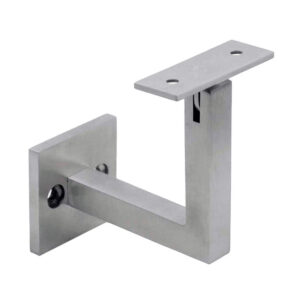
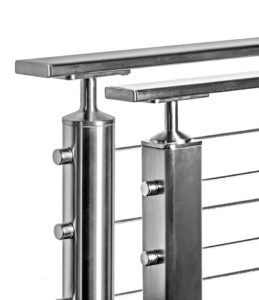
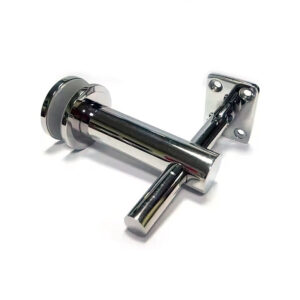
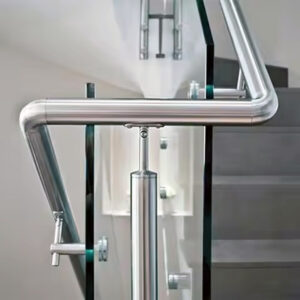
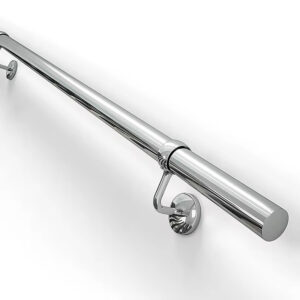
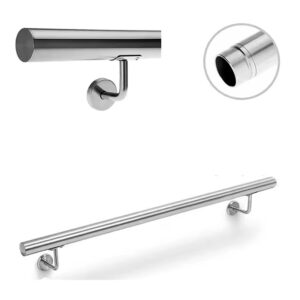
The clearance condition for brackets is equally specific: any horizontal projection must be positioned at least 1.5 inches below the bottom of the gripping surface. A bracket that wraps or clamps at the tube centerline without adequate offset below the grip surface fails this check regardless of whether it holds the rail at the correct height. This is a compliance condition that affects submittal acceptance, not merely an installation preference, so bracket geometry needs to be verified against the actual tube profile before the layout is finalized. When manufacturers publish bracket dimensions in elevation drawings rather than cross-section profiles, the specifier often cannot confirm compliance without requesting additional detail.
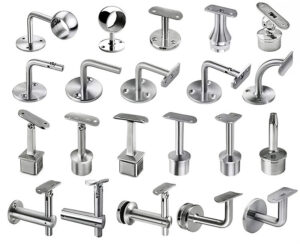
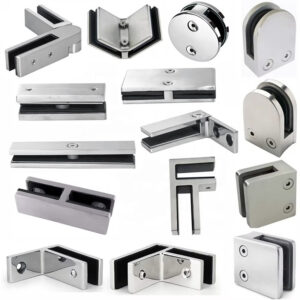
The practical failure pattern here involves sourcing brackets and handrail profiles from different suppliers without verifying cross-compatibility. A bracket designed for a 1.5-inch nominal tube may underperform the 1.5-inch clearance requirement when paired with a tube whose actual outside diameter is on the upper end of the specified range, or when a decorative cover or end cap adds material to the grip surface profile. Surface finish choices — brushed versus mirror on a circular profile — do not affect dimensional compliance, but weld-in fittings or inline connectors that interrupt the grip zone can contribute to the 20% obstruction total in ways that aren’t always accounted for during initial layout.
For projects referencing the 2010 ADA Standards and ICC A117.1-2017, reviewing the ADA-conforme roestvrij stalen leuning diameter en grip oppervlak normen alongside bracket elevation data helps confirm that profile and bracket selections are compatible before the submittal is assembled.
Extension details at stairs, ramps, and landings
Missing or undersized extensions are among the most documented reasons for accessibility submittal failures on stair and ramp projects, and they are the dimension category most likely to be omitted from early drawings because they don’t affect the handrail profile or bracket selection. Extensions are a route geometry condition, not a hardware condition — which means they must appear on the drawings before any product is specified or ordered.
On ramps, both the top and bottom landings require a horizontal extension of at least 12 inches beyond the point where the walking surface transitions. On stairs, the top extension must reach at least 12 inches horizontally beyond the first riser nosing. The bottom extension follows a different rule: it must continue at the slope of the stair for a distance equal to one full tread depth beyond the last riser nosing before returning. Both conditions require the extension to return to a wall, guard, or landing surface — an open-ended terminus does not satisfy the requirement. These figures are drawn directly from the 2010 ADA Standards and the Access Board’s Chapter 5 guidance on stairways; both sources treat these extensions as design requirements tied to transition support, not geometric preferences.
For switchback or dogleg stair configurations, the inside handrail must remain continuous between flights. This continuity requirement changes the structural and fabrication approach: a continuous inside rail at a stair reversal typically cannot be achieved with standard in-line connectors unless the geometry allows a consistent horizontal run at the landing level. Fabricated bends or custom transition fittings are often required, and those need to be dimensioned from the actual stair geometry before any fabrication begins. Ordering a standard handrail kit for a switchback stair without confirming inside continuity is a common procurement error that leads to on-site modifications.
| Voorwaarde | Extension Rule | Required Return |
|---|---|---|
| Ramps (top and bottom) | Extend horizontally ≥ 12 in. beyond landing | Return to wall, guard, or landing surface |
| Stair top | Extend horizontally ≥ 12 in. beyond first riser nosing | Return to wall, guard, or landing surface |
| Stair bottom | Continue at stair slope for one tread depth beyond last riser nosing | Return to wall, guard, or landing surface |
| Switchback / dogleg stairs | Inside handrail must be continuous between flights | Continuity across flight changes; no separate dimension given |
The extensions table maps each condition to its dimensional rule and required return. What it cannot show is whether those extensions conflict with adjacent wall conditions, door swings, or structural elements at the landing — that check belongs on the route drawing, not in the product specification.
Supplier limits around code compliance statements
A product listing that reads “Code Compliant: Yes” without specifying which code, which installed condition, and which dimensional assumptions support that claim is not submittal evidence. It is a marketing shorthand that shifts the entire verification burden to the buyer. Reviewers evaluating accessibility submittals are checking installed geometry — height consistency along the route, bracket clearance, extension lengths — not the presence of a product label. A handrail that meets grip diameter requirements will still fail a plan review if the submittal drawings don’t show 34-to-38-inch height maintained across the run, 1.5-inch bracket clearance, and extensions drawn to dimension.
The enforcement structure for ADA requirements is different from building code enforcement, and that distinction matters for how supplier claims should be read. State and local building codes are enforced through inspection — a building official checks the installed condition and issues approval or requires correction. ADA requirements are enforced through litigation. A project can pass local inspection and still carry ADA litigation exposure if the installed geometry doesn’t match the standard. Over 11,000 ADA-related suits were filed in 2019, and supplier disclaimers — including third-party evaluation reports and “check local code” language — transfer none of that exposure from the project team to the manufacturer. Evaluation reports from testing organizations can be submitted as supporting documentation in a dispute, but they are not approval instruments.
| Supplier Claim or Statement | Risico indien onduidelijk | Wat verduidelijken |
|---|---|---|
| “ADA compliant” without supporting detail | Reviewer may reject submittal if installed geometry not verified | Which dimensions, extensions, and clearances are assumed |
| “Code Compliant Yes” on product page | Implies product alone guarantees project approval; can mislead | Which code (ADA, IBC, local) and under what mounting conditions |
| Supplier disclaimer “check local code” | Shifts all verification burden to the buyer; may hide non-compliance | Whether product design meets dimensional requirements before installation |
| Assuming supplier claim replaces enforcement by inspection or litigation | State/local codes enforced by inspection; ADA enforced through litigation | Final compliance depends on installed condition, not just product label |
What a supplier can reliably support is dimensional data: confirmed outside diameter, verified bracket arm geometry, surface finish options that don’t affect gripping surface profile, and fabrication scope that matches the extension geometry drawn for the specific route. ADA compliant wall handrails specified with confirmed bracket dimensions and profile data give the specification team something to verify against the route drawing. That is the appropriate scope of a supplier’s contribution to the compliance process — dimensional support, not project approval.
Approval readiness after dimensions and drawings match the route
A complete drawing set is the condition for approval readiness, not a byproduct of it. The dimensions covered in the preceding sections — grip profile range, 34-to-38-inch height, 1.5-inch gripping surface clearance, 12-inch extensions, one-tread-depth stair bottom extension, inside rail continuity at switchbacks — must appear together on drawings that reflect the actual route before any product order or submittal is assembled. Each dimension checked independently without being resolved against the others can still produce a non-compliant installed condition.
One drawing requirement that frequently falls outside the standard handrail submittal is the children’s secondary rail. Where children are the primary users of a facility, a second handrail at a maximum height of 28 inches must be provided, and at least 9 inches of vertical clearance must be maintained between the upper and lower handrails. Both figures must appear on the drawings — the height of each rail measured from the walking surface and the vertical distance between them. Omitting this requirement from the submittal drawing is a known approval failure point when the facility type triggers it. It also affects bracket and wall spacing design: two rails with a 9-inch minimum separation on the same wall require a bracket layout that resolves clearance for both grip surfaces simultaneously.
Voor ADA compliant interior systems where the route includes both a primary and children’s rail, confirming the bracket geometry for both profiles before fabrication avoids a situation where the lower rail’s bracket arm conflicts with the upper rail’s clearance zone. That’s a coordination problem that is straightforward to resolve on a drawing and difficult to fix after brackets are installed.
The litigation exposure figure — more than 11,000 suits filed in a single year — is context for urgency, not a prediction for any specific project. What it reflects is that the gap between a passing inspection and an ADA-compliant installation is real, measurable in dimensional terms, and not covered by any supplier label. Drawing completeness before submittal, and verification of installed geometry before occupancy, are the two points where that gap closes.
Approval readiness for an accessible handrail project is not a function of which product was sourced — it is a function of whether the route geometry has been fully drawn and checked against each applicable dimension before anything is ordered or installed. The grip profile, height consistency, bracket clearance, extensions at every stair and ramp transition, and the children’s rail where required are not separate checklist items; they interact, and a drawing that resolves all of them against the actual route is the only reliable basis for a submittal that holds through plan review, inspection, and the separate litigation exposure that ADA enforcement carries.
Before issuing a product inquiry to any supplier, confirm that the route drawing shows every dimensional condition, that bracket specifications include arm geometry sufficient to verify the 1.5-inch clearance, and that extension lengths are drawn to scale against the actual stair nosing and ramp landing positions. What a manufacturer can provide is dimensional data and fabrication scope aligned to those drawings — what they cannot provide is a substitute for the drawing itself.
Veelgestelde vragen
Q: Does ADA enforcement apply differently to existing buildings being renovated versus new construction?
A: Yes, and the threshold affects how strictly each dimensional requirement must be met. New construction and alterations that affect accessibility features must fully comply with the 2010 ADA Standards. Existing buildings not undergoing alterations may be held to a lower “readily achievable” standard, but that exception narrows significantly once any alteration to the path of travel is made — at which point the handrail route serving that path typically must meet full dimensional compliance. Assuming an older building renovation carries blanket leniency is a planning error that surfaces at inspection or in litigation.
Q: Once the drawing set is complete and the submittal is approved, what should be verified before occupancy rather than left to the building inspection?
A: Height consistency along the full run is the condition most likely to pass drawing review but fail in the installed state. A plan reviewer checks dimensions on paper; the installed rail can drift outside the 34-to-38-inch range due to subfloor variation, nosing inconsistency, or bracket mounting tolerance — none of which appear on the submittal. Measuring height at multiple points along the actual run before occupancy, rather than only at the start and end, closes the gap between drawing approval and ADA litigation exposure.
Q: If a project uses a continuous top rail that also serves as the gripping surface for a guard system, does that change how ADA grip dimensions apply?
A: It adds a constraint rather than removing one. A dual-purpose top rail must satisfy both the guard height requirement and the ADA gripping surface profile simultaneously. If the guard height pushes the rail above 38 inches, it falls outside the ADA height range and a separate, dedicated handrail at 34 to 38 inches is required alongside the guard — they cannot be treated as interchangeable. This is a boundary condition the article’s dimensional guidance does not resolve on its own and should be confirmed against both the 2010 ADA Standards and the applicable building code for the jurisdiction.
Q: Is a round stainless steel tube always the safer profile choice compared to a non-circular section for meeting ADA grip requirements?
A: Not categorically. A circular profile simplifies the grip compliance check to a single outside diameter measurement, but a non-circular profile with a perimeter between 4 and 6.25 inches and a maximum cross-section of 2.25 inches is fully compliant and may offer structural or aesthetic advantages on a specific project. The practical difference is verification burden: circular profiles are faster to confirm dimensionally, while non-circular profiles require both a perimeter measurement and a cross-section check. If a project has tight submittal timelines or limited drawing review capacity, the simpler verification path of a circular tube reduces the risk of a documentation error — not a compliance deficiency in the profile itself.
Q: When a project involves multiple contractors — a general contractor, a stair fabricator, and a separate handrail supplier — who is responsible for confirming the extension geometry is correct before fabrication begins?
A: No single party defaults to that responsibility in most project structures, which is why extensions are among the most frequently missing items at submittal. The stair fabricator controls the nosing positions; the handrail supplier works from the dimensions provided to them; the general contractor coordinates both. In practice, the party who holds the route drawing and issues dimensional input to the handrail supplier carries the practical responsibility for confirming that extension lengths reflect the actual stair geometry — not the supplier’s standard kit dimensions. Establishing that coordination point explicitly before fabrication begins, rather than assuming it transfers automatically, is the step most often skipped.