Ordering a glass clamp because it fits the quoted glass thickness is how most commercial railing projects start the specification process — and how many of them generate a rejected shop drawing submittal four weeks before installation. The failure point is rarely the clamp itself. It is the absence of a documented load path, a gasket that does not match the actual panel thickness, or a stainless grade that cannot be defended in an outdoor environment. Each of those gaps surfaces at a different project stage: engineer review, field delivery, or a corrosion callback years later. What resolves the risk is treating clamp specification as a coordinated decision across glass thickness, gasket material, mounting configuration, stainless grade, and the structural role the clamp is expected to play. By the end of this, you should be able to define those variables before the order goes in, rather than after the shop drawings come back marked up.
Clamp specification begins with glass and gasket fit
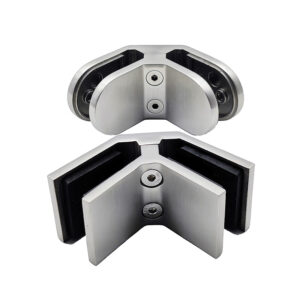
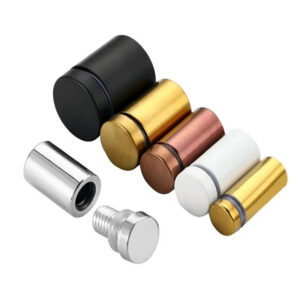
The clamp opening and the gasket thickness are not interchangeable variables — they are paired constraints that both need to be resolved against the actual glass panel before anything else is specified. Commercial railing projects commonly use 6 mm, 8 mm, 10 mm, 12 mm, 12.7 mm laminated, or 15 mm glass depending on height, span, and project tier. Specifying a clamp without confirming which of these the project is actually using — not which was specified in early drawings, but what the glass processor will actually cut and deliver — creates a mismatch risk that does not become visible until the panel is on site.
The gasket-to-glass relationship is where the mismatch does its damage. EPDM gaskets are the standard isolator between the glass edge and the clamp body, and they need to match the glass thickness exactly. A gasket that is undersized allows metal-to-glass contact under load; one that is oversized reduces clamping pressure to the point where the panel can move within the fitting. Neither condition is acceptable at a commercial railing infill, and the consequences — stress fractures, movement under lateral load, or engineer rejection — are not recoverable without replacing the glass, the clamps, or both.
| Glass Panel Thickness (mm) | Required EPDM Gasket Thickness (mm) | Risk if Mismatched |
|---|---|---|
| 6 | 6 | Glass-on-metal contact, stress fractures, shop drawing rejection |
| 8 | 8 | Glass-on-metal contact, stress fractures, shop drawing rejection |
| 10 | 10 | Glass-on-metal contact, stress fractures, shop drawing rejection |
| 12 | 12 | Glass-on-metal contact, stress fractures, shop drawing rejection |
The 12.7 mm laminated panel is worth separating from the rest of this list. Laminated glass is assembled from two glass lites bonded through an interlayer, and its actual thickness can drift slightly from nominal depending on interlayer type and processing. ASTM C1172 provides a process framework for laminated architectural flat glass composition, but it does not prescribe clamp geometry. What it does confirm is that laminated panels are not dimensionally equivalent to a single-lite panel of the same nominal thickness — which means clamps specified for 12 mm monolithic glass may not fit a 12.7 mm laminated panel without a corresponding gasket adjustment. Verify with the glass processor before the clamp order is placed.
Material grade, back shape and screw details in load transfer
Stainless grade is a planning decision, not a style option. The 304 versus 316 distinction carries real downstream exposure: 304 is appropriate for interior applications where humidity and cleaning agents are the primary concern, while 316 is the required choice for exterior use, particularly in coastal zones or wherever the railing is exposed to salt air, standing water, or de-icing chemicals. Substituting 304 in an outdoor installation to reduce unit cost is difficult to defend at submittal review and creates a corrosion callback risk that sits years out in the project lifecycle — typically after the installer has moved on.
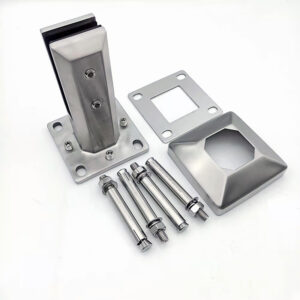
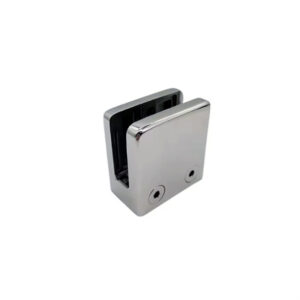
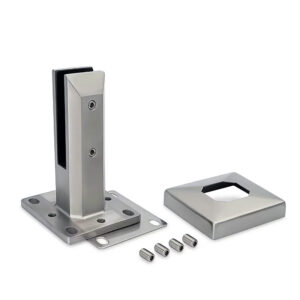
The back shape of the clamp determines how load is transferred from the glass panel to the supporting structure. A flat base clamp — the type used in guard rail infill configurations — distributes load across its mounting face and relies on its fastener set for structural integrity. For this configuration, the fastener specification matters: specifying the correct screw type (such as Z-Bolt38) and confirming that a steel pin is present to carry glass weight is not a detail that can be deferred. An undersized or substituted fastener in a flat base clamp does not visually announce itself — it only becomes apparent when the load path is reviewed at engineering sign-off, or worse, under load in the field.
Clamp count per panel also enters the load distribution calculation at this stage. As a design figure for a specific condition — a half-inch thick panel at 48 inches wide by 42 inches high — four clamps (two top, two bottom) is a representative arrangement for distributing load across the panel area. This should not be generalized as a minimum for all commercial panels; a wider span, taller panel, or heavier glass will change the required count and placement, and those conditions need to be resolved with the project engineer rather than extrapolated from a typical detail. Zware glasklemmen designed for structural infill applications provide greater bearing area and adjustment range, which is relevant when the panel count per clamp is under engineering scrutiny.
Decorative clamps versus engineered support points
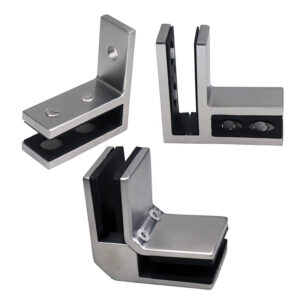
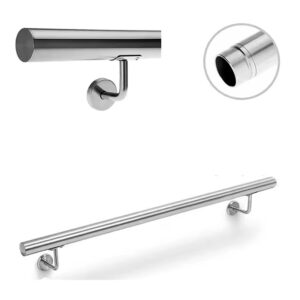
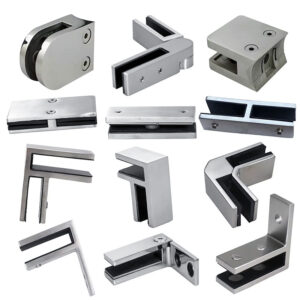
Not every clamp on a commercial railing carries structural load, and failing to distinguish between the two types at specification time is where aesthetic and engineering expectations diverge. Frameless D-clamps with a minimal profile are selected primarily for sightline reduction — they hold the glass, create a clean elevation, and are appropriate when the infill panel is framed by a continuous top rail or handrail that is carrying the structural loads. In that configuration, the clamp is a retention device, not a load path element, and its specification is governed primarily by glass thickness fit and corrosion resistance.
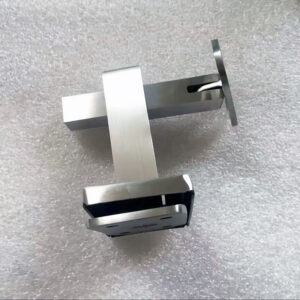
The problem arises when a decorative clamp is specified for a post-mounted frameless system where the clamp itself is the primary structural connection. In that condition, the clamp must carry lateral load from the glass panel to the post, and its capacity needs to be documented — not assumed from its visual weight or finish quality. ASTM E935-21 provides a testing framework for permanent metal railing system performance, and while it does not prohibit decorative clamp configurations, it establishes the performance baseline that any structural connection in a commercial railing system is expected to meet. A clamp that looks engineered but carries no engineering report is likely to be rejected at shop drawing review regardless of how well it fits the glass.
The trade-off between visual weight and structural margin is real and often underestimated. Smaller clamps reduce sightline impact but leave less room to absorb panel thickness variation or gasket compression change under sustained load. Heavier clamps provide bearing area and adjustment capacity at the cost of visibility. Neither choice is inherently compliant or non-compliant — the decision depends on the structural role the clamp is assigned and whether that role is documented before the submittal is prepared. More on this verification step is covered in the load testing discussion for stainless steel glass railing systems.
Glass processor tolerance as the hidden clamp risk
The tolerance gap between a glass processor and a clamp supplier is the most consistently underestimated risk in commercial glass railing procurement, and it almost always surfaces at field delivery rather than at the order stage. When glass panels and clamps are sourced from separate vendors — which is the standard commercial supply chain — the clamp opening is specified against nominal glass thickness while the processor works to their own dimensional tolerance. For monolithic panels, this drift is usually manageable. For laminated panels, where the interlayer contributes to total thickness, actual delivered thickness can vary enough from nominal to create a gasket fit problem that was never anticipated in the submittal drawings.
The finger notch is one specific coordination point where this tolerance risk concentrates. A 7/8-inch diameter notch in the glass panel is a common detail used to accommodate a clamp pin, and it requires precise coordination with the glass processor. If the notch is cut slightly off-center, undersized, or at the wrong edge location relative to the clamp body, the panel either cannot be installed without forcing the glass, or it seats in a position that creates a stress concentration at the notch edge. Neither condition is visible in the shop drawing until the processor’s fabrication tolerance is confirmed in writing.
Adjustable clamps with rubber pads that accommodate a range of glass thicknesses — such as those covering a 6–12 mm range — provide a practical buffer against processor variation, but they are not a substitute for specifying the correct glass thickness upfront. Using an adjustable pad range to compensate for an unresolved thickness discrepancy means the gasket may never be compressed uniformly, which undermines the glass-to-metal isolation that prevents edge stress under load. The adjustment range is a tolerance management tool, not a specification shortcut. Verstelbare glasklemmen are worth reviewing for applications where multi-thickness compatibility is a genuine project requirement, not a workaround for incomplete coordination.
Approval checks before ordering commercial glass clamps
Treating approval as a final administrative step before delivery is the mistake that converts a manageable specification gap into a schedule problem. By the time a shop drawing is rejected for a clamp that lacks load documentation, the order may already be placed, the glass may already be cut to coordinates that assume a specific clamp body size, and the lead time for a replacement may add weeks to the installation schedule. The approval check is only useful if it happens before any of those commitments are locked in.
The four checks that carry the most downstream consequence each address a different failure mode: corrosion resistance documentation protects against a field callback on an outdoor installation; a structural engineering report protects against shop drawing rejection; glass and insert compatibility protects against a site fit problem that requires recut panels; and manufacturer certification protects against manufacturing inconsistency that surfaces as dimensional variation across a large order. None of these checks are interchangeable — a clamp can pass three of them and still fail at shop drawing review because the fourth was skipped.
| Controleer item | Wat bevestigen? | Waarom het belangrijk is |
|---|---|---|
| Corrosiebestendigheid | Clamp passes ASTM B117 salt spray test (min 1000 hours) for outdoor use | Ensures long-term durability in exterior environments |
| Structureel draagvermogen | Supplier provides engineering report (e.g., CRL P-Series) verifying load capacity | Supplies documented proof for project engineer approval |
| Glass & Insert Compatibility | Clamp is graded for tempered or laminated glass; rubber inserts match exact glass thickness | Prevents shop drawing rejection and reordering |
| Manufacturer Quality Certification | Manufacturer holds IATF16949, ISO9001, or TUV certification | Assures consistent manufacturing and code acceptance |
Two points on the table warrant additional framing. The ASTM B117 salt spray test (1,000-hour minimum) is a useful corrosion resistance reference for outdoor applications, but whether it is a project requirement depends on what the project specification invokes — it should be treated as a defensibility benchmark rather than a universal code mandate unless the specification explicitly cites it. Similarly, manufacturer certifications such as ISO 9001 or IATF 16949 are indicators of production consistency and quality system discipline, but they do not substitute for a supplier-provided engineering report that documents the clamp’s specific load capacity. Both are relevant to project engineer confidence; neither alone is sufficient.
Clamp specification that resolves early — before shop drawings are submitted, before the glass processor finalizes fabrication coordinates, and before stainless grade is locked in at procurement — avoids the compounding sequence of rejected submittals, recut panels, and field fit problems that characterize late-stage discovery. The decision map is contained: glass thickness range, EPDM gasket match, stainless grade by environment, back shape and fastener configuration by structural role, and documented load capacity for any clamp that functions as a structural connection rather than a retention detail.
The clearest pre-order confirmation step is a sample fit check with actual glass specimens from the intended processor, using the production gasket set and the specified clamp body. If that fit cannot be confirmed before the order is placed, the specification is not complete — it is an assumption about fit that may or may not survive contact with delivered material. Define the glass thickness range, confirm the processor’s dimensional tolerance, and verify that the clamp supplier’s adjustment range covers the full expected variation before committing to quantity.
Veelgestelde vragen
Q: What happens if the project switches from monolithic to laminated glass after the clamps are already ordered?
A: The order needs to be re-evaluated before fabrication proceeds, not after delivery. Laminated panels at nominally equivalent thicknesses — such as 12.7 mm laminated versus 12 mm monolithic — are not dimensionally interchangeable at the clamp opening, because the interlayer contributes to total thickness in a way that nominal sizing does not capture. If the clamp was sourced against monolithic glass dimensions, the gasket set will almost certainly need to change, and the clamp opening itself may fall outside the adjustment range. Confirm the processor’s actual delivered thickness for the laminated specification before treating the existing clamp order as valid.
Q: At what point does a decorative clamp become inadequate for a post-mounted frameless system, and is there a clear threshold?
A: There is no single dimension threshold — the adequacy of any clamp in a post-mounted frameless configuration depends on whether it has a documented load capacity that satisfies the project engineer for the specific panel height, span, and code-required lateral load. A clamp that functions correctly as a retention device in a top-rail-carried system transfers its structural obligation to the rail; in a post-mounted frameless system, that obligation shifts entirely to the clamp-to-post connection. The distinction is not aesthetic — it is whether the clamp carries an engineering report that covers the actual loading condition. If that report does not exist or was not provided by the supplier, the clamp is not specifiable for a structural connection regardless of its visual weight or finish quality.
Q: Once the sample fit check confirms the clamp works with the actual glass specimen, what is the immediate next step before placing the quantity order?
A: Lock in the processor’s fabrication tolerance in writing and confirm that the clamp supplier’s adjustment range covers the full expected dimensional variation across the production run — not just the single specimen used in the sample check. A sample fit confirms a point-in-time condition; it does not guarantee that every panel in a large order will arrive within the same tolerance band. The pre-order commitment should include the processor’s documented thickness tolerance for the panel specification, the gasket set confirmed against that range, and the clamp supplier’s confirmation that the adjustment capacity covers the full spread. Only after those three items are aligned in writing is the specification stable enough to support a quantity commitment.
Q: Is specifying 316 stainless always worth the cost premium over 304 for covered exterior applications, such as a railing under a deep soffit?
A: Yes, for any exterior installation where the long-term corrosion exposure cannot be fully controlled, 316 remains the defensible specification even under cover. A deep soffit reduces direct rain exposure but does not eliminate condensation cycling, salt air migration in coastal zones, or cleaning chemical contact — all of which are the actual corrosion drivers that differentiate 316 from 304 in practice. The cost premium is marginal relative to the liability exposure of a corrosion callback on a commercial project, where replacement involves not just hardware but potentially recut glass and mobilization costs. If the project specification already invokes 316 for exterior use, a covered condition does not create an exemption unless the specification explicitly states one.
Q: If a manufacturer holds ISO 9001 certification but cannot provide a structural engineering report for the clamp, is that sufficient for commercial submittal?
A: No. ISO 9001 certification documents production process consistency and quality system discipline; it does not establish or verify the load capacity of a specific clamp under a specific loading condition. A project engineer reviewing a commercial railing submittal needs documented proof that the clamp can carry the loads assigned to it in the structural role specified — typically expressed as a test report or engineering calculation tied to the actual clamp model and configuration. A quality certification from the manufacturer addresses how the product is made, not what it can structurally withstand. Both are relevant to project confidence, but only the engineering report resolves the load path question that governs shop drawing acceptance.