A batch of post-mounted handrail components arrives against a purchase order, a set of approved drawings, and a component schedule — but what the receiving team does in the first hour determines whether a later defect can be traced to a specific item and batch, or whether it becomes an unresolvable dispute with the supplier. Incoming inspection is not a formality before storage; it is the point where the paper record and the physical delivery are reconciled while the evidence is still fresh and the batch identity is still intact.
Documents and Approved Samples Needed at Receiving
| Receiving reference | Use at receiving | Boundary |
|---|---|---|
| Purchase order or inspection agreement | Confirm the ordered scope, quantities, and any defined sampling or acceptance criteria | Do not invent sampling or acceptance rules at receipt |
| Approved drawings | Check ordered rail and post profiles and specified dimensional characteristics | Dimensions alone do not establish system performance |
| Component schedule | Reconcile the delivered component identities and completeness | A matching schedule entry does not by itself prove physical conformity |
| Agreed finish sample | Compare the delivered finish with the approved reference | The sample supports the finish comparison, not material-grade or performance conclusions |
The receiving check has to start from the documents that define what was actually agreed, not from general assumptions about what a handrail batch should contain. The purchase order or inspection agreement establishes the ordered scope, the quantities, and — where one was defined — the sampling or acceptance criteria that apply to this delivery. If no sampling plan was agreed in advance, the receiving team has no basis to invent one at the dock; doing so creates a standard that the supplier never accepted and that cannot be enforced later.
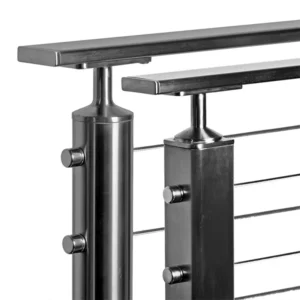
Approved drawings serve a different purpose. They define the rail and post profiles and the dimensional characteristics that the delivered parts are supposed to match. A drawing tells the receiver what a correct part looks like dimensionally; it does not, by itself, tell the receiver whether the installed system will perform as intended, because dimensional conformity and structural performance are separate questions answered by different evidence.
The component schedule exists to let the receiver check completeness — whether the right identities and quantities of parts have arrived for the batch — rather than to confirm that each physical item is sound. A schedule entry that matches a delivered part’s description confirms that the right item was shipped under that description; it does not confirm that the item itself is free of damage, correctly finished, or dimensionally within tolerance. Those are physical findings that still have to be made with eyes and instruments.
The agreed finish sample plays a narrow, specific role: it is the reference against which delivered finish is judged. Where no finish sample was agreed before the order was placed, the receiving team is comparing the delivery against an assumption rather than an approved reference, and any finish objection raised at that point is weaker for having no documented baseline.
Where a project substitutes catalogue photographs or general marketing images for these references, the comparison loses its evidentiary value. A photograph shows one example of a finish or profile; it was never intended to serve as a tolerance reference, and using it as one invites disputes that an approved sample or drawing would have avoided.
Batch Identity, Quantities, and Component Completeness
| Receiving question | Comparison basis | Decision value |
|---|---|---|
| Can each delivered item be tied to its batch? | Batch and item identification on the delivery | Keeps later findings traceable to the affected item and batch |
| Do delivered quantities match the order? | Purchase order quantity compared with received quantity by item and batch | Identifies a shortage without mixing it with other deviations |
| Is the component set complete? | Delivered components compared with the component schedule | Identifies which scheduled components are missing |
| Is hardware mixed within the delivery? | Delivered hardware identities compared with the scheduled items for each batch | Isolates a hardware-mix finding for batch-specific follow-up |
Before any physical measurement is taken, the receiving team needs to establish whether each delivered item can be tied back to a specific batch. This matters because later findings — a dimensional deviation, a finish variation, a piece of transit damage — are only useful to the supplier if they can be located within a specific batch and item. A defect reported against an untraceable mass of parts gives the supplier nothing to investigate; a defect reported against an identified batch and item gives them a starting point.
Quantity verification compares what the purchase order specified against what was actually received, broken out by item and batch rather than as a single combined count. Where a shortage exists in one batch but not another, treating the delivery as a single pool obscures which batch actually has the problem and can lead to a follow-up request that the supplier cannot act on precisely.
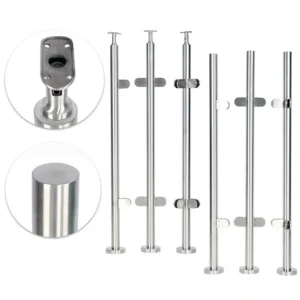
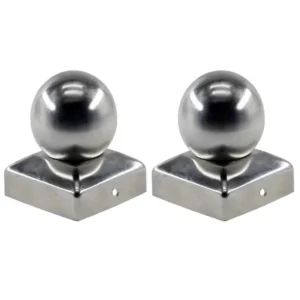
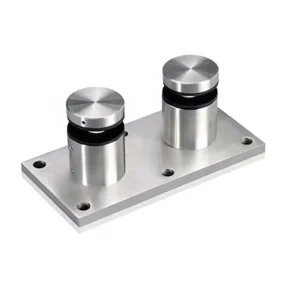
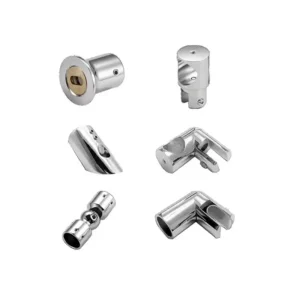
Completeness is a related but distinct question. A batch can arrive with correct quantities of the wrong components, or correct component types with missing accessory hardware, and either condition shows up only when the delivered items are checked against the component schedule entry by entry. For post-mounted handrail systems, this matters particularly at the interface points — where terminal post handrail components 和 intermediate post handrail connectors need to be present in the right numbers and types for the posts they’re meant to serve, since a shortfall in connector hardware can leave an otherwise complete rail and post delivery unable to be assembled as specified.
Hardware mixing is the finding that most depends on batch-level sorting. If a delivery contains components from more than one batch, or if fittings intended for one post type are commingled with another, a quantity count alone will not reveal this — only a direct comparison between the delivered hardware identities and what the schedule calls for, batch by batch, will surface it. Where the receiver skips this comparison and simply confirms that total quantities tie out, a hardware-mix condition can pass through unnoticed and surface later during installation, when it is harder to trace back to the original delivery.
Material Records and Their Evidence Limits
| 参考文献 | Supported use | Does not establish |
|---|---|---|
| ISO 10474:2013 | Identify types of inspection documents supplied with steel-product deliveries according to order requirements | Traceability, test validity, grade conformity, or certificate authenticity for a named delivery |
| ISO 1127:1992 | Check stainless-steel tube diameters, tolerances, other dimensional parameters, and conventional masses where applicable | Railing load capacity, finish, weld quality, or project-code compliance |
| UFGS 05 52 00 Metal Railings | Structure project-specific railing specifications, submittals, drawings, and construction scope | A universal code requirement or an ESANG product requirement |
| Delivery inspection paperwork | Identify the declared basis of the delivery | Proof that every delivered item physically conforms |
Material documentation accompanying a handrail delivery answers a narrower question than many receiving teams assume. Inspection documents issued with a steel-product delivery, as described under ISO 10474:2013, identify what type of document was supplied against the order’s requirements — a statement of compliance, a specific test report, or another defined document type. What that document type represents is itself informative, because different document types carry different levels of supplier-generated testing versus independent verification. But the standard that defines the document type does not verify that the particular certificate accompanying a particular delivery is authentic, that the material it describes is actually traceable to the parts in hand, or that the test results reported actually apply to the delivered batch. Confirming those things requires a separate traceability check against the batch identification established at receiving, not a reading of the document category alone.
Dimensional standards carry a similarly bounded role. ISO 1127:1992 sets out stainless steel tube diameters, tolerances, and conventional masses, which gives the receiver a basis for checking whether a delivered tube’s measured dimensions fall within the stated tolerance for its nominal size. This is useful and necessary for confirming that the tube itself was manufactured within its dimensional specification. It says nothing about whether a rail assembled from that tube will carry the loads the project requires, whether its weld quality is adequate, or whether the finished railing meets any project code — those are determined by the complete assembly and its own governing specification, not by the tube’s dimensional conformity.
Project specifications written in a guide-specification format, such as UFGS 05 52 00 Metal Railings, illustrate how a submittal and drawing structure for metal railings can be organized on a given project. Where a project has adopted a specification in that format, it supplies the actual submittal requirements, drawings, and scope for that job. Where it has not, the guide-specification structure is informative only as an example of how such a specification can be organized — it is not a universal code requirement and does not substitute for whatever specification the project actually adopted.
The practical consequence is that no single document — certificate, dimensional standard, or specification format — closes the inspection on its own. Each supports one part of the evidence chain, and the receiving team has to know which part before relying on it.
Dimension, Fit, Finish, and Damage Checks
| Check area | Check against | Recordable outcome and limit |
|---|---|---|
| Rail and post profiles and dimensional characteristics | Relevant approved drawing and agreed inspection method | Record any dimensional deviation by item and batch; do not infer system performance from tube dimensions |
| Component fit and completeness | Approved drawing and component schedule | Record a mismatch or missing component by item and batch |
| 完成 | Agreed finish sample | Record finish variation by item and batch |
| Transit condition | Physical condition at receiving | Record transit damage by item and batch |
Physical checks turn the document review into a judgment about the actual delivered items. For rail and post profiles, this means measuring the dimensional characteristics called out on the approved drawing, using whatever inspection method the order or inspection agreement specifies, and recording any deviation against the item and batch where it was found. A tube that measures outside its specified tolerance is a dimensional deviation; it is not, on its own, evidence about how the assembled railing will perform once installed, because system performance depends on more than any single component’s dimensions — it depends on how that component interfaces with the rest of the assembly.
This distinction matters most at connection points. A post or rail profile can be dimensionally correct in isolation and still fail to fit correctly if the mating component — a bracket, a connector, a terminal fitting — is from a different batch or a different revision of the drawing. Fit checks therefore have to be made at the assembly level, not just at the single-component level, comparing the delivered components against both the drawing and the component schedule together.
Finish checks depend entirely on having an approved reference sample, as established earlier. Where that sample exists, the comparison is a direct one: does the delivered finish match the sample within whatever variation the project has agreed is acceptable. Where no sample was agreed, any finish observation the receiver records is a general comment rather than a documented deviation, because there is no approved basis to call it nonconforming.
Transit damage is assessed at the physical condition observed at the point of receiving, independent of whether the item is otherwise dimensionally or cosmetically conforming. A dimensionally correct, correctly finished component can still carry transit damage, and a component with a finish variation can be entirely undamaged — the two findings do not substitute for each other and should not be merged into a single disposition note.
In every one of these checks, the condition that changes the interpretation is whether an approved reference existed before the delivery arrived. Where a drawing, sample, or inspection method was agreed in advance, the physical finding is a measurable deviation from an approved basis. Where no such reference was established, the same physical observation is only a general note, carrying less weight in any later conversation with the supplier about disposition.
Deviation Records for Supplier Disposition
| Deviation category | Evidence to carry forward | Supplier question the evidence supports |
|---|---|---|
| Shortage | Ordered and received quantities, identified by item and batch | What quantity is missing from the identified delivery? |
| Mixed hardware | Delivered hardware identity and the corresponding component-schedule entry, identified by item and batch | Which hardware differs from the scheduled component? |
| Finish variation | Delivered finish compared with the agreed finish sample, identified by item and batch | What finish difference requires disposition? |
| Transit damage | Observed receipt condition, identified by item and batch | Which delivered items are affected by damage? |
| Dimensional deviation | Drawing characteristic, observed measurement, and agreed inspection method, identified by item and batch | Which measured characteristic differs from the approved drawing? |
Once physical checks are complete, the value of everything recorded depends on how well it can be carried forward into a supplier conversation. A deviation noted without reference to its item and batch identity is difficult for a supplier to investigate, because they cannot isolate which part of their production or shipment is implicated. A deviation noted with that identity attached gives the supplier a specific, bounded question to answer.
Each deviation category calls for a different kind of supporting evidence. A shortage finding needs the ordered and received quantities set against each other for the specific item and batch involved, so the supplier can be asked precisely what quantity is missing from that identified delivery. A hardware-mix finding needs the delivered hardware identity set against the corresponding component-schedule entry, so the supplier can be asked which specific hardware differs from what was scheduled. A finish-variation finding needs the delivered finish set against the agreed sample, batch by batch, so the question to the supplier is about a specific, demonstrable difference rather than a general impression. Damage and dimensional deviations follow the same logic — each needs the specific measurement, observation, or condition tied to its item and batch, not aggregated across the delivery.
This structure matters because a supplier’s disposition decision — replace, rework, accept with concession, or something else — depends on understanding the scope of the problem. A finding presented as “some parts had issues” gives the supplier no way to assess scope. A finding presented as isolated deviations, each tied to its item and batch, lets the supplier determine whether the issue is confined to one production run or spread across the delivery, which materially changes what disposition is reasonable.
When this evidence is assembled and sent back through a project’s procurement channel, it also becomes part of what a supplier like ESANG works from when reviewing a claim or preparing a revised quotation for replacement parts — the specificity of the batch and item identification in that record determines how precisely the supplier can respond, whether that response is a corrective shipment, a credit, or a revised specification for the next order.
常见问题
问: Can a handrail batch be accepted because its inspection documents are complete?
A: No. Complete paperwork identifies the delivery’s declared basis, but physical conformity still needs to be checked against the purchase order, approved drawings, component schedule, agreed finish sample, and any inspection terms defined for the order.
问: What should the receiving team do if the order does not define a sampling plan or acceptance criteria?
A: Do not create rules at the receiving dock. Record the gap, keep items and batches identifiable, and obtain a project-specific decision on the inspection basis before treating sampled results as grounds for accepting the batch.
问: Should one damaged or incorrect item cause the entire delivery to be rejected?
A: First trace the finding to the affected item and batch, then use the order or inspection agreement to determine the scope of disposition. Keep shortages, mixed hardware, finish variation, transit damage, and dimensional deviations separate so evidence for one issue does not automatically decide unrelated parts of the delivery.
问: Can matching tube dimensions confirm that the assembled railing will meet project performance requirements?
A: No. A dimensional check can show whether specified characteristics match an approved drawing or an applicable dimensional reference, but it does not establish system performance. Identify the separate project evidence required for performance before drawing that conclusion.
问: How should the receiver handle a finish that looks different from the approved sample?
A: Record the comparison by item and batch, including which visible difference was observed. Apply any finish acceptance rule already agreed for the order; if none exists, obtain a project-specific disposition rather than inventing a threshold during receipt.
问: What should be prepared before asking the supplier to resolve a deviation?
A: Prepare one traceable record for each issue: the affected item and batch, the relevant approved reference, the observed condition or measurement, and the specific difference. This lets the supplier address the identified shortage, hardware mismatch, finish variation, damage, or dimensional deviation without relying on a general complaint about the shipment.