Specifying a stainless steel handrail for an exterior application without first stating the exposure zone, anchor substrate, and drainage conditions is one of the more reliable ways to generate a corrosion complaint six months after installation — even when the rail tube itself is the correct grade. The failure usually starts at the base plate or the fasteners, not the tube, because the installer matched the tube specification but not the hardware. Recovering from that requires removing posts, re-treating substrates, and in some cases replating mounting surfaces that were not designed for field repair. The decisions that prevent this — grade selection, fastener compatibility, connector geometry, and finish class — all need to be locked before ordering, not resolved on site.
Route classification before grade and mounting selection
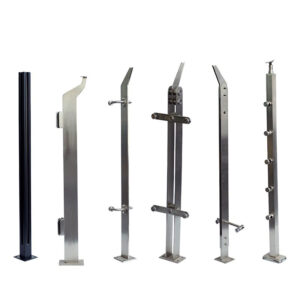
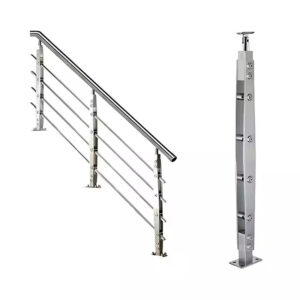
Grade and finish decisions follow route geometry, not the other way around. Before a project team can confirm tube profile, connector type, or base plate specification, they need to know what kind of surface the handrail will follow — a flat deck perimeter, an inclined stair run, a continuous ramp, or a stepped entrance approach. Each of those routes creates different load angles, connection geometry requirements, and substrate conditions that directly affect fastener selection and post spacing.
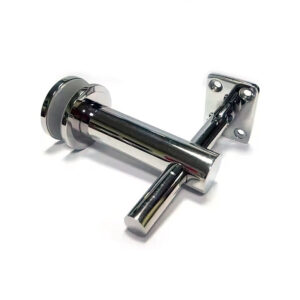
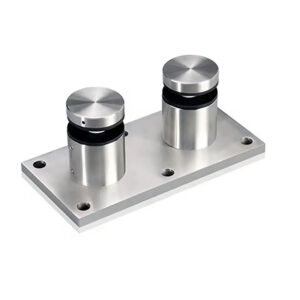
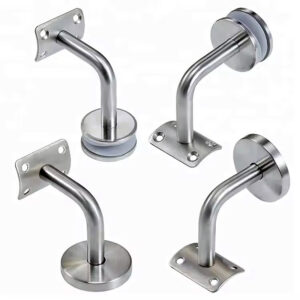
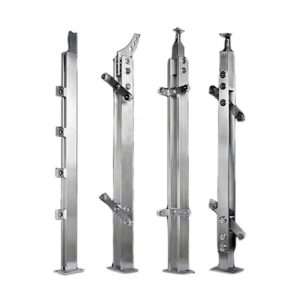
The substrate beneath the base plate drives fastener type. A wood deck frame takes lag bolts; a concrete landing or brick curb takes anchor bolts. In both cases, a 4″ × 4″ × 1/4″ base plate with four 7/16″ holes is a common design input for post-mount systems, but the fastener going into that plate has to match what the substrate can actually hold. Using an anchor bolt pattern sized for concrete on a wood ledger board, or using lag bolts into a mortar bed without anchor sleeves, are anchorage failures waiting to emerge under load — not during installation, but during the first real lateral force event.
| 基质 | 紧固件类型 | Base Plate Specification |
|---|---|---|
| 木材 | 制作螺栓 | 4″ × 4″ × 1/4″ with four 7/16″ holes |
| 混凝土 / 砖 | 地脚螺栓 | 4″ × 4″ × 1/4″ with four 7/16″ holes |
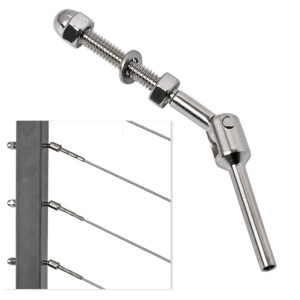
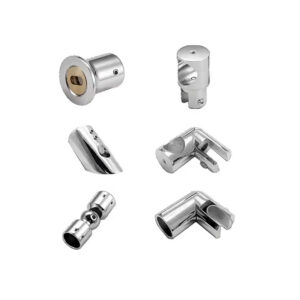
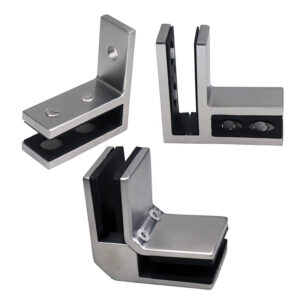
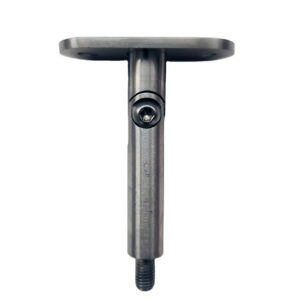
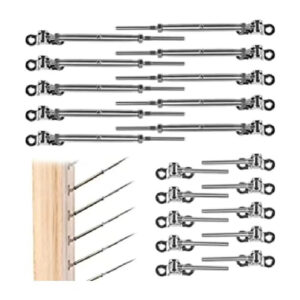
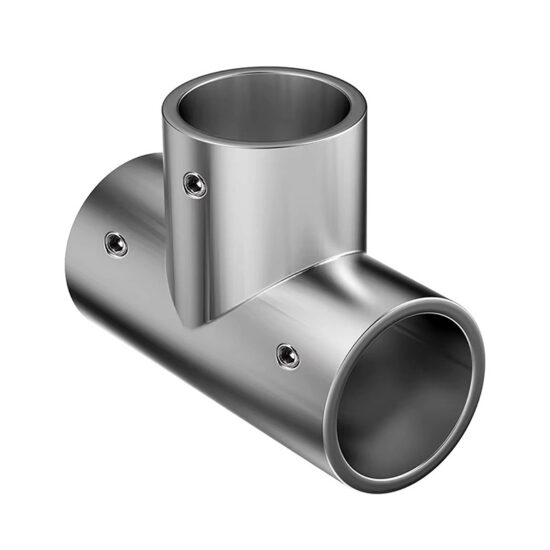
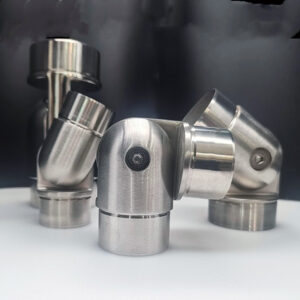
Connector geometry is determined by the same route map. A flat deck perimeter with 90-degree corners needs corner connectors. A ramp or sloped walkway needs level pivot connectors that can adjust through a horizontal range. A stair run needs vertical pivot connectors that bridge the incline angle between posts and handrail tube. Selecting connectors from a catalogue without referencing the actual pitch and turn angles of the route produces gaps at transitions that require field modification — and any field cut or rework on a stainless system breaks the surface finish and creates a corrosion initiation point.
| 连接器类型 | Angle Range | 典型应用 |
|---|---|---|
| Corner connector | Fixed 90° | Direction changes at corners on straight pathways |
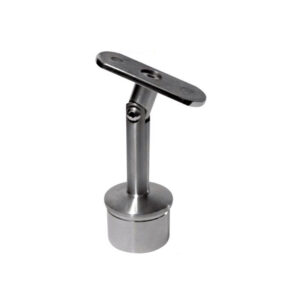
| Level pivot connector | 90° – 180° | Ramps and horizontal transitions |
| Vertical pivot connector | 0° – 90° | Stair incline connections |
The practical implication is that route geometry should be documented before any product inquiry. A simple plan sketch showing substrate type, incline or stair pitch, and corner transitions gives a supplier enough to confirm fastener class, connector type, and whether custom cutting will be needed — all of which affect lead time and package contents.
Deck, balcony, ramp, and entrance step differences
These four application types share a material category but not a design condition. Treating them as interchangeable during specification is the most common source of mismatched hardware and failed site checks.
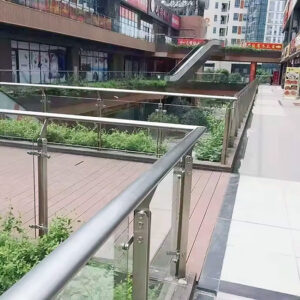
A deck railing is typically a perimeter guardrail on a horizontal surface. Its primary structural demand is lateral load resistance at the post base, and its drainage condition is usually exposed from above with a flat or slightly pitched deck surface beneath. Trapped water at the post base — particularly where a base plate sits flat against a composite or wood surface without a standoff or drainage gap — is the most common corrosion initiation point on deck systems, even when the tube and fittings are 316. A balcony railing operates under similar geometry but often with a concrete or tile substrate and, in urban or coastal environments, significantly higher humidity and salt exposure. The substrate is harder and the anchor detail is more consequential; a failed anchor bolt in a cantilevered concrete balcony is a structural problem, not just a corrosion one.
Ramps introduce an angled continuous run that must maintain a consistent grip height above the walking surface across the full incline. This means the post heights and connector angles need to be calculated for the specific ramp pitch rather than assumed from a standard stair configuration. A ramp that also serves as an accessible route adds grip-profile and height requirements that are separate from the structural ones — a point covered more directly in the code section below.
Entrance steps present the most condensed challenge: a short stair run that may serve both residential and public-access users, often with a decorative finish expectation, mounted to masonry or concrete with limited anchor depth, and frequently exposed to de-icing chemicals in cold climates. Chloride from road salt and calcium chloride de-icers is aggressive enough to challenge 304-grade hardware even in inland locations. This is a context where 316 is the appropriate grade consideration, not because it is mandated, but because the chemical exposure at the anchor and fitting level is materially higher than at a standard deck railing on the same property.
The friction point across all four types is that project buyers and specification teams often use a single catalogue item for deck, balcony, ramp, and step applications on the same project. The tube profile may be identical, but the connector type, post height, fastener class, and finish suitability differ between locations. Confirming those differences at the quotation stage prevents substitution errors during fabrication and avoids the scenario where a ramp connector arrives configured for a flat-deck angle and has to be returned.
Exposure and anchor choices for outdoor stair railing systems
The grade decision matters most at the connection points, not the tube. A 316 marine-grade tube paired with standard 304 or zinc-plated fasteners in a coastal environment will still corrode at every base plate and connector — the tube remains intact while the anchor hardware fails. This is the most persistent misunderstanding in outdoor stainless specification: grade selection has to apply to the full hardware assembly, not just the visible rail profile.
The threshold for 316 is driven by chloride and acid exposure level. Coastal environments, pools, marinas, and any location where de-icing chemicals are applied regularly carry enough chloride load to challenge 304-grade hardware. For general outdoor use away from those conditions — a suburban residential deck with no salt exposure and adequate drainage — 304-grade systems typically provide sufficient corrosion resistance across a reasonable service life. ISO 9223:2012 defines the atmospheric corrosivity classifications and salt deposit rate thresholds that underpin this distinction; ISO 9227:2022 describes the salt spray test methods used to evaluate finish and material performance against those classifications. Neither standard prescribes grade selection directly, but the corrosivity categories they define are the technical basis for grade recommendations in exposed environments.
| 环境 | 建议等级 | Preferred Finish Option |
|---|---|---|
| Coastal / High-chloride / Salt spray | 316 船舶级 | Powder-coated black for extra corrosion resistance |
| General outdoor (low salt/acid exposure) | 304 等级 | Standard mill finish typically sufficient |
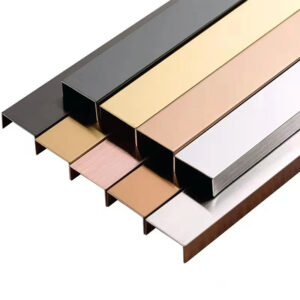
Powder-coated black finish reduces surface exposure to moisture and chloride at the tube and fitting level and is a useful mitigation layer in coastal or high-humidity applications. It is not a substitute for selecting the correct base grade — coating over inadequate base material delays rather than prevents corrosion. The more important question for finish selection is whether the coating is applied to the correct grade substrate and whether the fasteners and anchors are also coated or are themselves 316. A powder-coated 316 assembly with matching marine-grade anchor hardware represents a coherent approach to coastal installation; a powder-coated 304 tube with zinc anchor bolts does not.
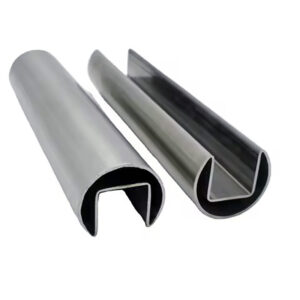
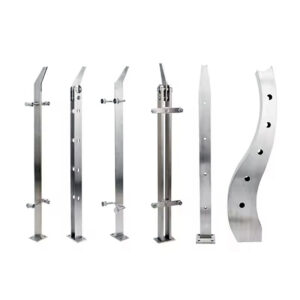
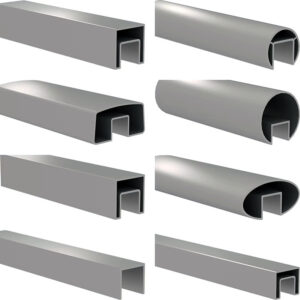
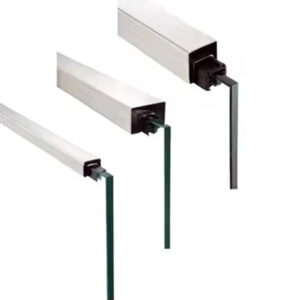
A common planning input for 316 outdoor systems is a 1.5″ × 1.5″ × 1/8″ square tube profile. This dimension affects anchor sizing, connector bore compatibility, and base plate proportioning, so it should be confirmed as a design input early — not assumed to be interchangeable with round or different-gauge profiles when ordering connectors or end fittings. For coastal and high-chloride applications, the 沿海安装五金件 selection from Esang addresses the full assembly — not just the tube — which is the correct unit of analysis for exposure-driven procurement.
Code and accessibility issues around public entrance routes
Height and load thresholds differ by application and occupancy type, and a system that passes a residential deck inspection may fail at a public entrance ramp that serves the same building. These are not interchangeable requirements, and a single catalogue specification applied across all locations on a project is a reliable path to a failed inspection somewhere in that project.
Under the 2018 International Residential Code, handrail height above stair nosing must fall between 34 and 38 inches, residential guardrails must meet a minimum of 36 inches, and all handrails and guards must support a concentrated load of 200 pounds and a linear load of 50 pounds per linear foot. IRC 2018 governs residential applications; commercial occupancy and OSHA thresholds carry different requirements and should not be inferred from IRC figures alone. OSHA’s stair rail system requirements for industrial stairways installed on or after January 17, 2017 set a minimum height of 42 inches — the same minimum that applies to commercial guardrails — with a provision that a top rail serving dual handrail function must fall between 36 and 38 inches to satisfy grippability requirements simultaneously.
| 要求 | 规格 | 适用范围 |
|---|---|---|
| Handrail height (above stair nosing) | 34 – 38 inches | Residential & commercial stairs |
| Guardrail minimum height (residential) | ≥ 36 inches | Residential decks, balconies, ramps |
| Guardrail minimum height (commercial) | ≥ 42 inches | Commercial decks, balconies, entrances |
| OSHA stair rail system height (post-2017) | ≥ 42 inches; top rail may serve as handrail if 36–38 in | Industrial stairways |
| Concentrated load capacity | 200 lb | All handrails and guards |
| 线性负载能力 | 50 lb / linear foot | All handrails and guards |
| Non-circular grip perimeter | 4 – 6.25 inches | Accessibility & code compliance |
| Non-circular cross-section dimension | ≤ 2.25 inches | Accessibility & code compliance |
| Minimum edge radius | ≥ 0.01 inch | Safety & grip comfort |
The non-circular grip profile adds a layer that specifiers often overlook. Square and rectangular tube profiles — including the 1.5″ × 1.5″ profile common in 316 systems — are subject to grip perimeter requirements of 4 to 6.25 inches, a maximum cross-section dimension of 2.25 inches, and a minimum edge radius of 0.01 inch. A 1.5″ × 1.5″ tube with sharp-break corners may not meet the edge radius requirement and may fall below the 4-inch perimeter minimum without a rail cover or graspable profile applied over it. This is a meaningful design check for any public entrance route and is worth confirming with the local authority having jurisdiction before installation.
The downstream consequence of height noncompliance is not simply a reinspection — it means unbolting posts, adjusting or replacing them, and potentially re-anchoring into substrates that were not designed for a second round of anchor installation. On masonry landings or pre-cast concrete steps, that kind of remediation carries real structural risk beyond the inconvenience. For exterior stair railings in 316, confirming that post heights and rail profiles are selected against the correct height threshold — residential, commercial, or OSHA — before fabrication is the most direct way to avoid that outcome. For systems that also need to satisfy accessibility grippability requirements, the profile shape and edge condition should be confirmed at the specification stage, not resolved after the tube arrives on site.
Package readiness after grade, route, and anchor method are fixed
Once grade, geometry, and fastener class are confirmed, the remaining source of project delays is component-level omission — items that appear minor in the quotation but create real installation problems when they are missing.
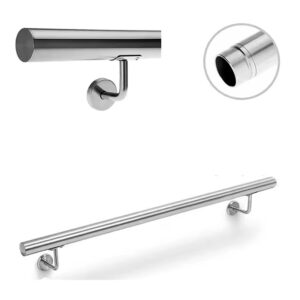
End plugs are the most consistent gap. A handrail tube ordered without pre-installed end plugs or finished end caps arrives with open tube ends that create sharp edge conditions, allow debris and moisture ingress into the tube, and are not code-compliant as a finished installation. If end plugs must be ordered separately, they need to be on the same purchase order as the tube and fittings — not requisitioned after the handrail is already on the job site. For custom-cut lengths, the matching end cap profile also needs to be confirmed at the cut dimension, not assumed to be included.
| 组件 | 需要确认的事项 | 为何重要 |
|---|---|---|
| End plugs | Whether end plugs are pre-installed and finished ends are included, or must be ordered separately | Missing plugs lead to sharp edges, debris ingress, and last-minute reordering |
| Custom cutting | If custom lengths are needed and whether complementary end caps and connectors are supplied | Avoids field cutting and ensures a seamless appearance without extra modification |
Custom cutting introduces a related check: any field cut made after delivery breaks the mill finish or powder-coat edge at the cut face, which is both a corrosion risk and, on visible interior-facing ends, an aesthetic defect. Ordering to confirmed cut lengths with complementary end caps and pre-matched connectors eliminates the need for field cutting and maintains a consistent finish across all visible surfaces. For projects where multiple sections meet at non-standard angles — particularly on ramp transitions or stair-to-landing intersections — confirming that the connector angle range accommodates the actual route geometry before the order ships prevents the most common package mismatch: a connector ordered at a fixed angle for a route that requires a pivot range.
For projects that combine deck and stair sections, it is worth reviewing 316材质的甲板栏杆系统 alongside stair-specific hardware to confirm that connector and post specifications align across both segments. A mismatch in post profile or base plate specification between the flat deck run and the stair run on the same project requires separate hardware sets and can complicate the installation sequence if not identified in advance.
The most defensible outdoor handrail specification is one where grade, fastener class, connector geometry, finish, and package contents are all confirmed against the same exposure and route conditions — not assembled from separate decisions made at different project stages. Corrosion failures in outdoor stainless systems almost always trace back to a mismatch at the hardware level rather than a defect in the tube itself, which means the tube grade alone is not a reliable proxy for system performance.
Before finalizing an order, confirm: which grade applies to the full assembly including anchors and connectors, not just the visible tube; whether post heights satisfy the correct threshold for the occupancy type at each installation point; whether the route geometry has been translated into the correct connector angle selections; and whether end plugs, end caps, and cut-length matching are explicitly included in the package. These are the variables that, if left unresolved at quotation, become field problems that stainless hardware is not designed to absorb after installation.
常见问题
Q: What happens after the order is placed — is there anything to confirm before the hardware ships?
A: Yes — verify that post heights, connector angle selections, and end plug or end cap inclusion are explicitly confirmed against the finalized route geometry before the order ships, not after. A package that leaves the supplier without pre-matched connector angles for a ramp transition or without end caps for custom-cut lengths will require field modifications that break the finish and introduce corrosion initiation points.
Q: Does the 316 grade requirement apply only to the tube, or does it extend to the fasteners and base plates as well?
A: It applies to the full hardware assembly. A 316 tube paired with zinc-plated or 304-grade anchor bolts and base plates in a coastal or de-icing environment will still corrode at every connection point — the tube survives while the anchors fail. Grade selection is only meaningful when it covers fasteners, connectors, and base plates, not just the visible rail profile.
Q: At what point does a suburban residential deck railing specification become inadequate for a public entrance ramp on the same property?
A: The moment the ramp serves a commercial or public-access occupancy, residential IRC thresholds no longer apply. A residential guardrail at 36 inches satisfies IRC but fails a commercial or OSHA inspection requiring 42 inches. Load thresholds, grip-profile requirements, and height minimums all change with occupancy classification, so each installation point on a mixed-use project needs to be checked against the correct standard independently.
Q: How does a 1.5″ × 1.5″ square tube profile hold up against code grip requirements on an accessible entrance route?
A: It may not satisfy graspability requirements without modification. A square tube at that dimension can fall below the 4-inch minimum grip perimeter and may not meet the 0.01-inch minimum edge radius if corners are sharp-break rather than eased. For any route that must comply with accessibility grip standards, the edge condition and perimeter should be confirmed with the local authority having jurisdiction before installation — not assumed to be compliant based on tube profile alone.
Q: Is powder-coat finish on a 316 assembly enough to justify using lower-grade anchor hardware in a high-humidity coastal environment?
A: No. Powder-coat on the tube and fittings reduces surface exposure to moisture and chloride at the visible level, but it does not protect anchor bolts and base plates that are embedded in or in contact with a wet substrate. Coating over inadequate base material or mismatched fastener grade delays corrosion rather than preventing it. A coherent coastal specification means 316-grade substrate throughout — tube, connectors, and anchors — with powder-coat as an additional mitigation layer, not a substitute for correct grade selection at the connection points.