304 与 316 不锈钢扶手:户外、沿海及室内选型指南

Specifying a stainless grade before the exposure environment is fully named is where most grade-related failures originate — not in fabrication, and not in installation. A railing system priced and approved on 304 that gets installed on an exterior stair in a northern climate with winter road salt exposure can show rust complaints within a single season, triggering warranty disputes and replacement freight costs that routinely exceed whatever was saved on material at bid time. The decision that prevents this is straightforward in principle — name the exposure condition first, then select the grade — but the friction in practice is that grade is often locked in at the proposal or procurement stage, before cleaning schedules, drainage geometry, joint details, and finish specifications are even on the table. What follows gives specifiers, project buyers, and supply-side teams a working framework for matching grade selection to exposure conditions and for understanding what happens downstream when that match is wrong.

Exposure environment before 304 versus 316 selection

Grade selection without a named exposure condition is not a neutral starting point — it is a deferred risk. The two environments most consistently misspecified are coastal salt air and deicing salt, and the failure pattern in both cases follows the same trajectory: 304 is accepted because it appears adequate at spec time, and corrosion complaints arrive after installation when the aggressive element is already present and irreversible without replacement.

The coastal salt air threshold most commonly cited in practitioner guidance is approximately 50 miles from saltwater. Within that range, airborne chloride concentrations are sufficient that outdoor 304 handrails carry meaningful corrosion risk — not because salt is visible or measurable at every site, but because periodic salt-laden wind events create cumulative chloride loading on metal surfaces, especially in sheltered joints and crevice areas where moisture retention is highest. The more underrecognized exposure is deicing salt in inland winter climates. Road salt splash and spray on exterior stairs, entry ramps, and parking structure railings can create chloride concentrations that exceed what most coastal installations experience. Specifiers who limit 316 to a proximity-to-shoreline rule and don’t apply the same logic to deicing salt exposure are leaving a meaningful gap in the specification.

Exposure ConditionTypical Specification GapWhy 316 Is Critical
Coastal salt air (within 50 miles of saltwater)Often specified for 316 only within a few hundred feet of shore, missing the extended airborne salt zoneSalt in air makes 316 a must-have for outdoor handrails
Deicing salt (road salt splash/spray, inland winter areas)Rarely specified; deicing salt exposure can be more aggressive than coastal salt304 can develop rust after first winter; 316 is required to avoid corrosion failures

The consequence of misreading either environment is not cosmetic degradation alone. In a crevice-rich system — base flanges, post-to-handrail joints, undersurface of cap rail profiles — chloride concentration accelerates localized pitting faster than on open tube surfaces. ISO 9223 classifies atmospheric corrosivity in categories (C1 through CX) based on chloride deposition rate and time-of-wetness, and outdoor coastal or deicing-salt environments typically fall in the C3–C5 range where 304’s passive film is more vulnerable to breakdown. That classification is not a compliance trigger here, but it gives procurement teams a reference frame for why the exposure naming step cannot be skipped.

Interior projects where 304 can control cost

For interior dry environments — enclosed staircases, mezzanine guardrails, loft barriers, interior lobby handrails — 304 is a defensible and cost-effective specification. In the absence of chloride exposure, cleaning chemistry aggressive enough to compromise the passive film, or significant humidity cycling, 304’s chromium oxide layer remains stable and the grade performs reliably over the building lifecycle. Industry guidance consistently positions 304 as the baseline grade for these conditions, where the primary concerns are appearance, finish consistency, and component uniformity rather than corrosion resistance.

The cost control benefit of 304 in interior applications is real, but it depends on the condition set remaining controlled. Interior pool enclosures, spa areas, and food service environments are exceptions: chlorine off-gassing and chloride-bearing cleaning chemicals in those spaces can attack 304 at concentrations that would not occur in a standard interior stairwell. If the interior classification includes any of those environments, the grade decision shifts. For cleanroom, food processing, or chemical-adjacent interiors, the same exposure-first logic applies regardless of whether the project is indoors.

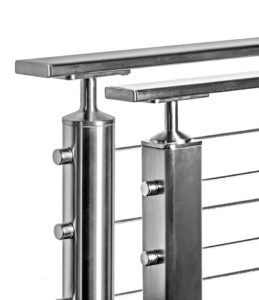
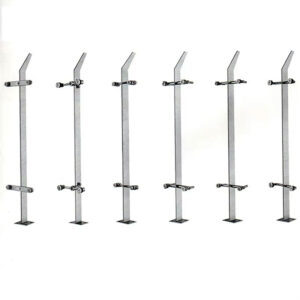
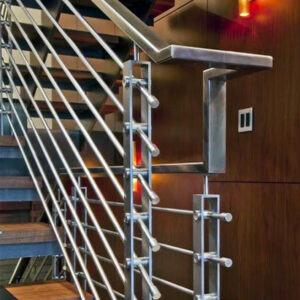
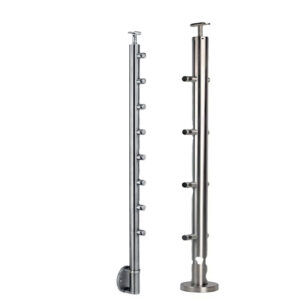
商用室内栏杆 configured in 304 with a consistent brushed or mirror finish work well in controlled indoor environments, and the grade uniformity across tube, fittings, and mounting hardware is easier to maintain cost-effectively at 304 than at 316.

The procurement check here is straightforward: confirm that the interior classification actually holds. Projects where the interior designation is applied broadly — including covered but unenclosed walkways, partially open atriums, or spaces with seasonal ventilation — may have enough humidity cycling and airborne contamination to warrant a more careful review before defaulting to 304.

Outdoor and coastal projects where 316 reduces corrosion risk

316 stainless steel’s corrosion performance advantage over 304 in chloride environments comes primarily from its molybdenum content, which stabilizes the passive layer against chloride-induced pitting. In outdoor and coastal applications, that difference in pitting resistance is the specification justification — not a marginal improvement, but a meaningful change in how the material responds to sustained chloride loading on exterior surfaces and in concealed joint geometry.

What practitioner experience reinforces is that grade alone does not determine outcome. A documented case from coastal pier installation using 316 with a smooth polished finish (≥320 grit) and sealed crevice joints showed no corrosion after six years of combined coastal and deicing salt exposure. That result should be read as a best-practice illustration, not a performance guarantee — but it clearly frames what makes 316 effective in practice: finish quality that prevents chloride retention on the surface, and joint design that prevents chloride accumulation in concealed areas where passive film repair is restricted. A bead-blasted 316 system with unsealed base flanges in the same environment would carry materially higher corrosion risk, even though the grade is identical.

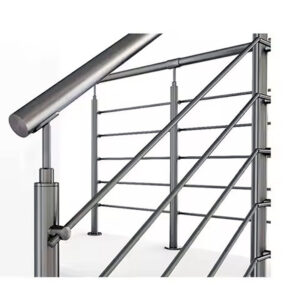
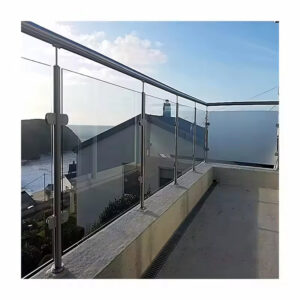
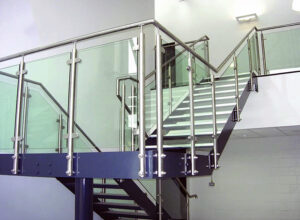
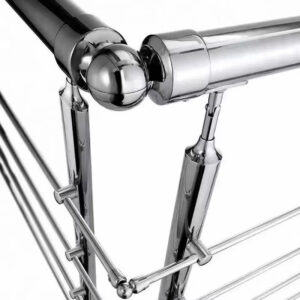
For exterior stair, deck, and balcony railing applications in coastal or salt-adjacent climates, exterior stair railings 316deck railing systems 316 represent the appropriate material baseline. The grade selection at that point is the minimum condition; finish specification and joint sealing details determine whether the grade’s corrosion resistance is actually realized in the installed system.

Sourcing 316 components through a single supply chain that maintains grade consistency across tube, post, bracket, flange, and fastener is a procurement priority that often gets overlooked until a system is partially assembled. Mixed-grade systems — 316 tube with 304 or lower-grade fittings — introduce galvanic exposure at the joints that can initiate faster than corrosion on the primary tube would.

Lifecycle tradeoffs between lower initial cost and callback exposure

The material price differential between 304 and 316 is real and project-budget-visible in a way that the downstream cost of a wrong specification is not. That asymmetry is where the tradeoff gets underestimated. At bid time, 316 costs more per linear meter of tube and per fitting. The callback, replacement freight, and warranty resolution costs that follow a 304 failure in an aggressive chloride environment are not visible in the original line item, which makes the upfront saving look cleaner than it is.

Practitioner sources document 304 showing rust within the first winter when exposed to deicing salt, with annual spring cleaning required at minimum and refinishing or component replacement if pitting has progressed. Against that maintenance burden, 316 with a smooth finish and sealed joints is described as more forgiving of missed cleaning cycles — a meaningful operational difference for commercial or multi-unit residential properties where maintenance schedules are variable and appearance complaints generate management-level responses. The lifecycle cost comparison is structural, not incidental.

Material & Usage ContextUpfront Material Cost维护负担Expected Service Life in Aggressive ExposureCallback/Replacement Risk
304 Stainless used in aggressive outdoor/chloride conditions较低Annual cleaning required; pitting leads to refinishing or replacementRust issues after first winter; early replacement likelyHigh: warranty conflict, replacement freight costs outweigh initial savings
316 Stainless with smooth finish and sealed joints更高Minimal; more forgiving of missed cleaningStructurally sound for hundreds of yearsLow: acts as insurance against callbacks
Carbon steel or aluminumNot specified (likely lower)Replacement cycle dictates maintenance5–10 yearsVery high: frequent replacement needed

The reputational dimension of a callback is harder to quantify but materially relevant for contractors and distributors. Rust staining on an exterior handrail is visible, attributable, and difficult to defend as acceptable performance. Warranty conflict over a grade specification that was arguably insufficient for the installation environment creates a dispute that consumes time regardless of how it resolves. The 316 premium, framed correctly, is an insurance cost against a known failure mode — not an arbitrary upgrade.

For buyers and project supply teams evaluating lifecycle cost, the relevant comparison is not 304 price versus 316 price. It is total system cost including maintenance cycles, early replacement probability, and contractor re-engagement cost, evaluated against the exposure environment that was identified at the start of this specification process.

Grade decision after chloride, maintenance, and finish conditions are defined

Once the exposure environment and grade are confirmed, the remaining decisions determine whether the selected grade actually performs at its rated capability. This is where specifications that stop at “316” without defining finish, joint treatment, component matching, and post-weld handling leave meaningful performance on the table.

The clearest way to frame this: 316 specifies the alloy chemistry. It does not specify the surface state, the joint geometry, the fitting grade, or the weld zone condition — all of which affect whether the chromium-molybdenum passive layer functions as intended in service. A system with correct grade selection but rough bead-blasted finish, unsealed flanges, and unpassivated weld zones can corrode at a rate closer to an inferior grade than to well-executed 316 in the same environment.

These implementation conditions are what the final specification review should confirm before supply orders are finalized.

Condition or Detail需要确认的事项为何重要
表面处理Smooth polished (≥320 grit or mirror); avoid bead-blastedSmooth finish prevents chloride trapping, improving corrosion resistance
Joint crevicesSealed after installation; design allows rain to wash away saltUnsealed crevices allow chloride ingress, leading to crevice corrosion
Fittings compatibilityAll flanges, bases, connectors, screws must match the handrail tube material grade; avoid mixing 304 tube with 201 fittingsMixed grades cause galvanic corrosion, accelerating rust
Welding processProfessional TIG welding followed by pickling and passivationRestores corrosion resistance at weld zones; prevents weld decay
Material standardSpecify ASTM A554 Grade 316 (or 316L for welded assemblies)Ensures chemical composition and mechanical properties; reduces risk of substandard material
Cleaning tolerance316 more forgiving of missed cleaning than 304 in tough environments; maintenance planning supports appearance longevityReduces risk of appearance failures, especially in coastal or deicing salt settings

On material procurement, specifying ASTM A554 Grade 316 (or 316L for welded assemblies) provides a reference that reduces substandard material risk by tying the order to a recognized chemical composition and mechanical property benchmark. It does not replace supplier verification, but it gives procurement teams a defensible specification anchor and a basis for rejecting non-conforming material. For welded assemblies, 316L’s lower carbon content reduces sensitization risk at weld zones — a relevant distinction when field welding or fabricated connections are part of the installation scope. The companion post-weld requirement is pickling and passivation to restore the passive film at heat-affected zones; without it, weld decay creates localized corrosion initiation points that undermine the system regardless of base material grade.

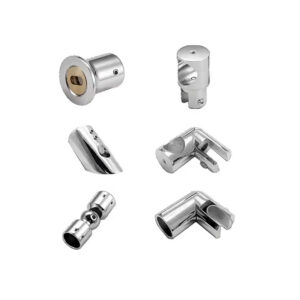
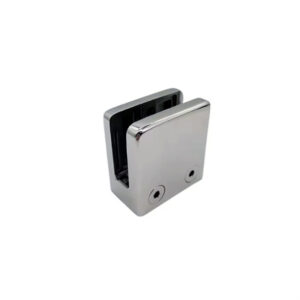
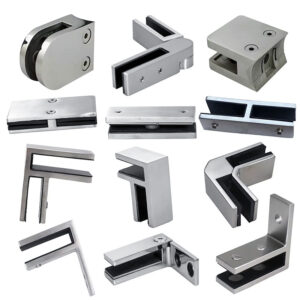
Component matching across the full system — tube, post, base flange, bracket, cap fitting, fastener — is a procurement discipline, not just a technical preference. Mixing 304 tube with 201-grade fittings, or 316 tube with unverified fasteners, introduces galvanic and composition risks at every joint in the system. For OEM and project supply orders, confirming grade consistency across all SKUs in the order before production runs is more efficient than investigating a corrosion complaint after installation. More on how grade selection interacts with industrial and chemical-adjacent environments is covered in the material grade selection guide for industrial use.

The practical output of this specification process is a grade decision that is defensible at both the material supply and the long-term performance stage. Before procurement is finalized, the exposure environment should be named — interior controlled, exterior urban, coastal within 50 miles, deicing salt-adjacent, or poolside/chemical cleaning — and the grade, finish, and joint detail should be confirmed as a matched set rather than evaluated independently. Grade alone is not a complete specification.

Where the environment places the project in a chloride-adjacent category, the question is not whether 316 costs more than 304 at order time. The question is whether the exposure condition, the maintenance schedule, and the appearance lifespan requirement can be met by the lower-cost material — and in most outdoor chloride or deicing salt contexts, that case is difficult to support once the callback and maintenance cost is included in the comparison.

常见问题

Q: Does the 50-mile coastal threshold still apply if the project site is inland but regularly exposed to ocean fog or prevailing onshore winds?
A: Yes — distance alone is an incomplete proxy for chloride exposure. Projects downwind of coastal air masses can receive intermittent but cumulative chloride loading even beyond the 50-mile guideline, particularly on surfaces with sheltered joints or low drainage. The more reliable test is whether the site experiences measurable salt deposition events rather than its map distance from shoreline. When that is uncertain, defaulting to 316 with sealed joints is the lower-risk position.

Q: After confirming 316 as the grade and placing the supply order, what should be verified before installation begins?
A: Confirm grade consistency across every component in the system — tube, post, base flange, bracket, cap fitting, and fasteners — before any fabrication or field work starts. Mixed-grade assemblies introduce galvanic risk at joints regardless of the primary tube specification. If field welding is in scope, verify that pickling and passivation are part of the post-weld process, since unpassivated weld zones create localized corrosion initiation points that undermine the system even when the base material is correct.

Q: At what point does the corrosion risk in a covered but unenclosed outdoor space justify 316 over 304?
A: When the space experiences regular humidity cycling, airborne salt infiltration, or chloride-bearing cleaning chemicals — even if it is not directly rain-exposed — the exposure condition is closer to outdoor than interior, and 304’s passive film is under similar stress. Covered walkways, partially open atriums, and seasonally ventilated structures do not reliably meet the controlled interior condition that makes 304 defensible. If the enclosure cannot be confirmed as dry and chloride-free year-round, the specification should be reviewed against the outdoor criteria rather than defaulted to the interior classification.

Q: Is a bead-blasted 316 finish acceptable in coastal or deicing salt environments if the grade is otherwise correctly specified?
A: No — bead-blasted finishes retain significantly more chloride on the surface than smooth polished finishes and increase corrosion risk even when the alloy chemistry is correct. Practitioner evidence from a six-year coastal installation specifically attributes the absence of corrosion to a smooth polished finish at ≥320 grit combined with sealed crevice joints. A bead-blasted 316 system with unsealed flanges in the same environment carries materially higher risk. Grade selection and finish specification need to be confirmed together, not independently.

Q: If the project budget cannot accommodate 316 across the full system, is it worth specifying 316 on the tube only and sourcing fittings in 304 to reduce cost?
A: No — partial upgrading introduces the failure mode it is trying to avoid. Mixing 316 tube with 304 or lower-grade fittings creates galvanic exposure at every joint in the system, and those joints are typically the highest-risk locations for chloride accumulation and crevice corrosion regardless of grade. If the budget cannot support full-system 316 in a chloride-adjacent environment, the more defensible path is to reassess the exposure classification honestly, or to present the lifecycle cost — including early replacement and callback risk — as part of the material selection conversation rather than absorbing it into a grade compromise that is unlikely to hold.

相关职位:

Ivy Wang 的图片

Ivy Wang

Ivy Wang 是 esang.co 的技术撰稿人和产品专家,在不锈钢栏杆系统方面拥有 6 年经验。现年 29 岁的她已经参与了 200 多个定制五金项目,帮助客户解决从船舶级安装到商业合规要求等各种问题。Ivy 的工作方法侧重于以客户为中心的实用解决方案,而不是 "一刀切 "的建议。她擅长将复杂的技术规格转化为建筑师、承包商和业主的可行建议。.
立即联系我们 !