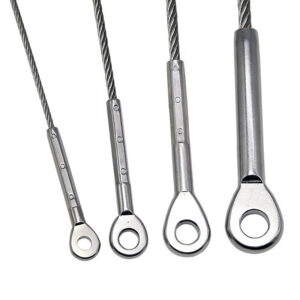
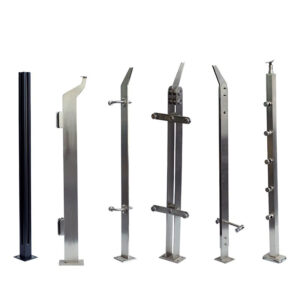
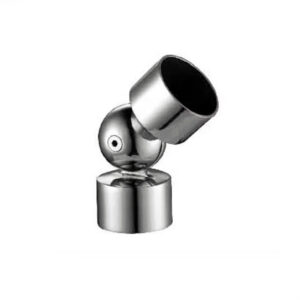
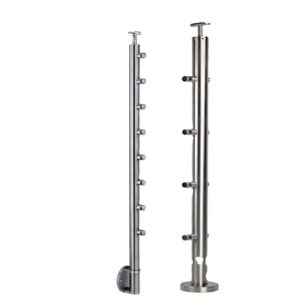
A cable railing takeoff built from a generic hardware kit count will underorder terminations on raked and corner runs and overorder them on simple straight runs, because the run geometry — not the overall footage — determines which fitting goes where. Before pricing or ordering anything, the estimator has to turn the approved drawing into a run-by-run schedule that assigns tensioning method, termination type, and post interface to each segment individually.
Run Schedule Before Counting Hardware
| Drawing run | Run form | Tensioning end | Fixed end | 帖子界面 | 电缆结构 | Terminal type |
|---|---|---|---|---|---|---|
| Project run identifier | Straight, raked, corner, interrupted, or returned | Project-specific location | Project-specific location | Project-specific interface | Named cable construction | Named terminal type |
A cable railing system is not one continuous quantity problem; it is a set of discrete runs, and each run form changes what terminates it and how. A straight run between two fixed posts behaves differently from a raked run following a stair stringer, which behaves differently again from a run that turns a corner, stops and restarts at an opening, or returns back on itself along a perimeter. Treating all of these as variations on the same generic run produces a hardware count that does not match what the drawing actually requires.
The reason this matters structurally is that termination hardware exists to manage the angle, tension path, and post condition at each end of a run, not simply to close off a cable. A straight run commonly needs only a fixed end and a tensioning end. A raked run introduces an angle change that affects how the terminal seats against the post or fitting. A corner run interrupts the cable path entirely, requiring the run to be treated as ending and restarting rather than continuing through the corner. An interrupted run — one broken by a gate, a post offset, or a structural obstruction — needs the same ending-and-restarting logic applied mid-span rather than only at the perimeter. A returned run, where the cable path doubles back along the same framing, duplicates termination conditions that a simple straight-run assumption would miss.
Where the takeoff starts from a drawing-derived run count instead of a linear footage estimate, the estimator can see immediately how many terminations the project actually needs, because each run contributes its own termination pair regardless of how short or long it is. A short raked run at a stair nosing requires the same termination logic as a long straight run along a flat guard, even though the footage differs sharply. Conflating footage with termination count is where quantity errors begin.
This is also the point at which the estimator should decide how each run will carry its cable construction and terminal type forward, since those assignments depend on the run form established here and get carried into every later takeoff step. A run misclassified at this stage — a raked run logged as straight, or a corner treated as continuous — propagates its error through tensioning location, fitting count, and spare definition without any later step catching it.
Termination Functions at Straight Raked and Corner Runs
Once runs are separated by form, the next judgment is what each termination is actually doing mechanically, because a straight run, a raked run, and a corner run ask different things of the hardware at their ends even when the visible fitting looks similar.
At a straight run, the termination hardware manages tension along a single axis. The fixed end anchors the cable against the post or structural interface, and the tensioning end takes up slack along that same line. Because the load path stays linear, the post interface at each end only needs to resist force in one direction, which simplifies what the estimator has to confirm about that connection.
A raked run changes this by introducing an angle between the cable’s tensioned axis and the post or baluster it terminates against. The termination hardware at a raked end has to accommodate that angle without inducing a bending load the fitting was not designed to carry. Where the drawing shows a rake, the estimator needs to confirm that the assigned terminal type is the one documented for angled conditions in that system, rather than assuming the straight-run terminal will seat correctly at a different angle.
A corner run removes the single-axis assumption entirely. Because the cable path does not continue through the corner, the run has to be read as two separate runs meeting at a shared post, each with its own tensioning and fixed-end assignment. The corner post itself becomes a termination point for both runs rather than a passthrough, which is why corner conditions need their own hardware assignment and cannot be covered by extending a straight-run count across the turn.
Where a project combines these forms — a stair rake transitioning into a straight guard, or a straight run interrupted by a corner post at a landing — the estimator has to treat each transition point as its own termination event. The judgment the drawing calls for is not “how much cable” but “how many distinct termination conditions exist,” since that is what determines fitting selection at each end, not the overall run length.
Tensioning Locations and Tool Access
Assigning a tensioning end to a run is only half the decision; the estimator also has to confirm that the location chosen for tensioning is one where a tool can actually reach and operate. A tensioning end that is correct on the drawing but inaccessible in the field forces a field change that the original takeoff did not anticipate.
Tensioning location depends on which post or fitting interface the system’s tensioning hardware is designed to engage, and that interface has a physical footprint — clearance in front of, behind, or around the fitting — that the tool needs in order to turn, pull, or otherwise take up the cable. Where a tensioning end is placed against a wall return, a tight corner condition, or a post crowded by adjoining hardware, the clearance the tool needs may not exist even though the structural interface itself is sound.
This is a planning check that belongs in the takeoff stage rather than at installation, because moving a tensioning end to a more accessible location changes which end of the run is fixed and which is adjustable, and that reassignment can ripple into terminal type if the fixed-end and tensioning-end fittings in the named system are not identical parts. Where the system uses different fittings for each role, swapping which end tensions is not a cosmetic change — it changes the SKU required at both ends of that run.
The estimator should also confirm whether a run’s tensioning location was chosen for one-time setup only or needs to remain accessible for ongoing adjustment, since a location that is reachable during initial installation is not automatically reachable once adjacent finishes, furnishings, or landscaping are in place. A tensioning end tucked behind a post cap or below a stair nosing may be fine at turnover and effectively inaccessible afterward. Where the project expects the cable to be re-tensioned over the life of the installation, the access check has to account for the finished condition, not just the condition during construction.
Cable Length Versus Fitting Quantity
| Takeoff input | Record as | Quantity boundary |
|---|---|---|
| Cable cut length | Length for each drawing run | Keep separate from fitting quantity |
| 配件 | Quantity by assigned terminal type and termination function | Count from run-specific assignments, not a generic kit multiplier |
| Insertion allowance | Named-system allowance | Add only as defined by the named system |
| Adjustment allowance | Named-system allowance | Add only as defined by the named system |
| Fabrication allowance | Named-system allowance | Add only as defined by the named system |
Cable cut length and fitting quantity answer two different questions, and a takeoff that merges them into a single combined figure loses the ability to show where either number came from. Cut length is a function of run geometry — the physical distance the cable travels within each run, run by run. Fitting quantity is a function of how many termination events that run geometry creates, which was established by separating runs by form and assigning tensioning and fixed ends to each one.
Where these are tracked separately, an estimator can check one against the other: a project with many short interrupted runs will show a high fitting count relative to total cable footage, while a project dominated by long straight runs will show the opposite ratio. Collapsing both into one number removes this check entirely, because a generic per-foot or per-kit multiplier cannot distinguish between a run that needed two terminations and one that needed four.
Beyond the raw cut length, the named cable system typically defines allowances that have to be added on top of the measured run distance — allowance for the cable to insert into the terminal fitting, allowance for adjustment range at the tensioning end, and allowance related to how the system’s terminals are fabricated onto the cable. These allowances are not general rules of thumb; they are specific to the system named in the project documentation, and a different system may define different insertion, adjustment, or fabrication allowances for what looks like the same physical cable diameter. Applying one system’s allowance to another system’s hardware produces cut lengths that are wrong in either direction — too short to reach the tensioning hardware’s adjustment range, or long enough to bind at the fitting.
SKU-Specific Spare Definition
Spare hardware is where a takeoff either preserves the assembly as designed or quietly introduces a substitute the original design never reviewed. A spare that is specified only by appearance or general category — a tensioner, a terminal, a post bracket — gives the field crew no way to confirm that a replacement part will actually thread, seat, or finish-match the run it is going into.
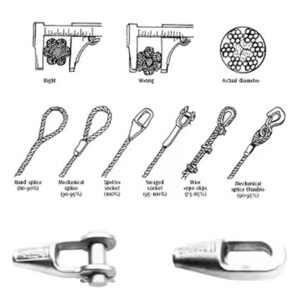
The reason this needs to be exact rather than general is that cable railing hardware carries several independent attributes that do not all vary together. Thread hand is one: a tensioning fitting threaded in one direction will not engage a cable end prepared for the opposite hand, even if the two parts look identical and share a diameter. Material and finish are another: two fittings in the same stainless steel family can differ in grade or surface treatment in ways that affect corrosion performance in the project’s specific environment, and a finish mismatch is also a visible defect in an exposed railing run. Compatible cable construction is a third: a terminal fabricated for one cable construction may not be rated or dimensioned for a different construction that happens to fit through the same fitting body.
Because these attributes are independent, a spare listed only by a visual or generic description leaves each of them unconfirmed. Listing spares by exact SKU, together with thread hand, material, finish, and the cable construction the part is compatible with, closes that gap — anyone pulling a spare from stock can confirm, before installation, that it matches the run it is replacing rather than approximating it. Where a spare is pulled without that confirmation, the replacement may function in isolation while still changing the terminal-to-cable relationship the original design specified, which is an assembly change even if no one intended it as one.
Quote Package Reconciliation
| Reconciliation item | Check before the quote request | Unresolved boundary |
|---|---|---|
| Drawing runs | Every straight, raked, corner, interrupted, and returned run is represented in the schedule | Hardware quantity has no complete run basis |
| Termination assignments | Each run identifies its tensioning end, fixed end, post interface, cable construction, and terminal type | Hardware selection and quantity remain project-specific and unconfirmed |
| Tensioning access | The assigned tensioning location is checked against its access constraint | Tool access remains unconfirmed |
| Cable and fitting totals | Cable cut length is separated from fitting quantity | A combined figure cannot show the basis for length and count |
| Cable allowances | Insertion, adjustment, and fabrication allowances follow the named system | A generic allowance is not supported |
| Spares | Each spare states exact SKU, thread hand, material, finish, and compatible cable | Substitution could introduce an unreviewed assembly change |
Before a quote request goes out, the run schedule, the termination assignments, the access checks, the length-versus-quantity separation, and the spare definitions need to agree with each other, because each of these was developed somewhat independently and none of them is reliable in isolation.
The run schedule only has value if every run form the drawing shows — straight, raked, corner, interrupted, returned — is represented; a schedule missing a run form leaves the hardware count without a complete basis, regardless of how carefully the represented runs were handled. The termination assignments only have value if tensioning end, fixed end, post interface, cable construction, and terminal type are stated per run rather than assumed from a dominant run type; an assignment carried over from a different run form is a project-specific judgment that remains unconfirmed until someone checks it against that run’s actual geometry. The access check only has value if it was performed against the tensioning location actually assigned, not a generic assumption about where tensioning happens. The length and quantity separation only has value if cable cut length and fitting count can each be traced to their own basis, and if insertion, adjustment, and fabrication allowances were added according to the named system rather than a general rule. The spare list only has value if each entry carries its SKU, thread hand, material, finish, and compatible cable so a later substitution does not become an unreviewed change to the assembly.
This reconciliation step is also where the project information the buyer has assembled enters ESANG’s configuration and quotation review — the run schedule, termination assignments, and spare definitions give a basis for matching project hardware to the systems ESANG supplies, including cable tensioner systems, cable end fittings, and corner post cable hardware, rather than quoting against a generic description. Where any one of these reconciliation items is incomplete, the open point is not a reason to delay the whole quote request — it is a specific piece of information to resolve, such as confirming a tensioning location’s access condition or a corner run’s termination pair, before that part of the order is finalized.
常见问题
问: Can I estimate one cable tensioner kit for every drawing run?
A: No. Divide the drawing into straight, raked, corner, interrupted, and returned runs, then assign the termination functions and terminal types for each run. A generic kit multiplier can miss hardware changes created by different run forms and terminations.
问: What should I do if the preferred tensioning end has limited tool access?
A: Treat access as an unresolved design input rather than confirming the hardware quantity. Mark the proposed tensioning location and its access constraint for that run, then reconcile it with the named system before finalizing the end assignments.
问: Should cable length and fitting quantity be combined in one takeoff total?
A: No. Record cable cut length for each run separately from fitting counts, and keep insertion, adjustment, and fabrication allowances as named-system values. If an allowance is not defined, flag it for verification instead of applying a generic factor.
问: When is a spare fitting specific enough for procurement?
A: When its exact SKU, thread hand, material, finish, and compatible cable are recorded. Matching only the general fitting type is insufficient because a substitution could introduce an unreviewed assembly change.
问: What should the quote package show if some project choices are still open?
A: Show confirmed run-by-run assignments and clearly mark unresolved termination, access, cable construction, terminal, allowance, or spare details. Keep provisional items identifiable so the quotation has a visible basis rather than hidden assumptions.
问: Does a completed cable tensioner takeoff confirm that the railing design meets its load and deflection requirements?
A: No. The takeoff establishes the quantity basis for cable, fittings, tensioners, and spares; it does not replace project-specific review of the applicable railing design and load or deflection requirements.