When a glass panel arrives on site with holes drilled for brand A standoffs but the wall substrate is later found to be hollow plaster over gypsum, the sequence has already collapsed. The offset that gave the design its floating look now becomes the lever arm that will pull the anchors out. What should have been resolved before any glass order gets released—the structural backing, the working standoff length, the hole diameter, and the tool path for tightening—instead becomes a remedial negotiation that eats into schedule and budget. Every downstream installation or approvals question traces back to whether those few variables were locked or left as assumptions. The sections that follow identify where those assumptions carry the most cost and what to confirm before fabrication begins.
Standoff selection starts with wall backing and offset
The type and condition of the wall substrate should be treated as the first input to standoff selection, not as a later validation step. If the backing is assumed to be solid concrete or structural steel but turns out to be a partition with intermittent studding, all offset and anchor decisions built on that assumption become unreliable. The connection load path changes: a standoff that would perform well in shear against a solid masonry wall becomes a bending-moment problem when bolted into a thin shelf angle or unreinforced block. That discovery, made after glass fabrication, often forces a destructive opening to install a continuous steel backing plate or an engineered bracket—work that could have been avoided with a single inspection report at the layout stage.
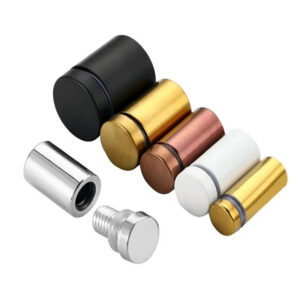
Offset distance functions as both an aesthetic variable and a structural multiplier. A short standoff keeps the glass close to the wall, loads are transferred predominantly in shear, and minor substrate irregularities can be absorbed with reasonable anchoring. As the offset increases, the visual separation may satisfy the design intent, but the tensile demand on the top fixings rises sharply. Hardware such as adjustable glass standoffs can help manage small on‑site deviations in wall flatness or reveal depth, but they cannot compensate for a substrate that lacks the capacity to carry the induced moment. The offset should be fixed only after the wall’s load‑bearing capability at the actual fastener positions has been reviewed, not simply drawn from a catalogue dimension.
Hole schedule and sleeve details before fabrication
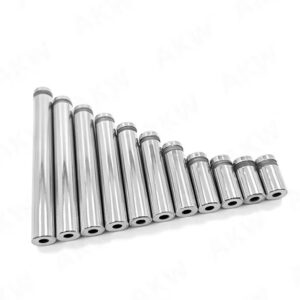
Even when the wall condition and offset are settled, releasing glass for production requires that the hole schedule is matched to the exact standoff hardware—barrel diameter, sleeve or gasket type, and edge distance for the installed glass panel. Fabrication friction occurs when holes are drilled from a preliminary general arrangement that later shifts: a change in standoff supplier, a field adjustment to the offset, or an overlooked sleeve thickness can render the glass incompatible with the hardware that actually arrives on site.
| What to Lock Before Drilling | 为何重要 | Risk If Drilled Without Locking |
|---|---|---|
| Wall offset distance | Determines glass hole position relative to edge | Hole misalignment; glass may need redrilling or replacement |
| Standoff barrel diameter | Glass hole must match standoff for proper fit | Oversized or undersized holes; sleeve or gasket may not compensate |
| Sleeve detail (gasket, bushing) | Affects hole diameter tolerance and glass protection | Glass-to-metal contact or poor load distribution |
The consequence is not merely a misfit; it is often a situation where redrilling is impossible because the new hole would overlap the existing one or the glass edge margin would fall below safe limits. Oversized holes may rely on the gasket to take up the slack, but if the clearance exceeds the gasket’s compression range, the glass can contact metal under load. Undersized holes prevent hardware insertion entirely. Locking the hole schedule to the confirmed standoff part number, including its sleeve detail, is a practical prerequisite for any glass order—treating it as an after‑the‑fact co‑ordination item routinely causes panel replacement costs that far exceed the hardware line item.
Leverage risk created by longer offsets
The floating‑glass aesthetic that extended standoffs deliver also introduces a leverage profile that runs through the anchors into the wall itself. A long standoff acts as a cantilever arm; horizontal forces from wind or crowd pressure are multiplied by the offset distance, and the resulting bending moment at the wall face can exceed the withdrawal resistance of a fixing that was sized only for direct shear.
| Offset Distance | Floating Visual Effect | Leverage on Anchors | Alignment Sensitivity |
|---|---|---|---|
| Short (minimal standoff) | Subtle | Low — anchors mostly in shear | Easier alignment |
| 中型 | Noticeable | 中度 | Requires careful layout |
| Extended (long standoff) | Strong floating appearance | High — increased bending moment | Highly sensitive; small errors magnified |
These effects do not imply that long standoffs are inherently unsafe, but they shift the connection design from a largely shear‑controlled case to one where bending governs. ASCE/SEI 7‑22 requires that all applicable lateral and gravity load combinations be satisfied for the structure and its attachments, which for standoffs means the induced moment must be carried by the anchor group. The standard does not prescribe a maximum offset length; the assessment remains project‑specific and depends on glass weight, imposed loads, substrate strength, and anchor embedment. When the offset is extended without re‑evaluating the anchor capacity, the system may pass a visual review but remain undefended under load.
Alignment sensitivity compounds the risk. A small angular error at the wall—tolerance in anchor placement, a shim stack that drifts the barrel—translates into a proportionally larger displacement at the glass plane. For a 200 mm standoff, a 2 mm misalignment at the base can put the glass edge out of position by several millimetres, making panel‑to‑panel joints uneven and forcing the installer to over‑stress the glass by bending it into alignment. Specifiers who value the floating effect benefit from factoring in adjustment allowance at the standoff‑to‑glass connection, and from requiring a dry‑fit mock‑up when offsets exceed typical ranges.
Tightening access as a maintenance constraint
The final torque on a standoff cap or the lock‑nut behind the glass is often discussed as an installation detail, but the real constraint is whether anyone can reach that fastener after the glazing is in and adjacent finishes are complete. In a recessed wall niche, at the end of a run where the standoff is tight to a corner, or behind a large fixed panel, the wrench path can disappear entirely. The design may look clean on paper, but if the installer cannot seat a socket or hex key squarely, the connection may be left under‑tightened or over‑tightened by an improvised tool—neither condition meets the manufacturer’s assembly specification.
The maintenance dimension is equally critical. Standoffs exposed to vibration, thermal cycling, or regular cleaning can lose preload over time. If no access path is preserved, retightening requires partial disassembly of glass, which is rarely scheduled and often ignored until a panel becomes loose. This is not a code‑dictated requirement, but it is a practical serviceability test: before approving the standoff configuration, the team should confirm that a standard hand tool can reach every fastener with the glass in its installed position. Where access cannot be provided, the design should document that fact and accept the risk, or the hardware choice should move to a connector that allows front‑only tightening with a captive locking mechanism.
Approval inputs for wall-mounted glass standoffs
Approval is the last step where the wall condition, offset, hole schedule, and access path can still be challenged without paying for rework. Treating it as a paperwork exercise misses that each unchecked item becomes irreversible once glass is cut.
| Approval Item | 需要确认的事项 | Risk If Approved Without Confirmation |
|---|---|---|
| Structural backing | Substrate type and condition can support anchor loads | Standoff may pull out; destructive opening or additional support required |
| 偏移距离 | Exact standoff length required for design intent | Mismatch with glass fabrication; rework or field modifications |
| Hole schedule | Glass hole diameter, position, and tolerance align with standoff | Holes misaligned; installation delays or glass replacement |
| Access path for maintenance | Tool access for final tightening and future servicing | Cannot secure or maintain standoffs; long-term safety risk |
The practice of confirming structural backing before anchorage is consistent with the intent of ASTM E894‑88, which addresses permanent metal railing systems and expects that anchors are installed into verified supporting construction. Applying that principle to glass standoffs means the substrate must be known, not inferred from architectural drawings, and the anchoring method must be appropriate for the substrate’s actual condition. An approval package that includes a backing inspection report, the locked offset dimension, the glass hole drawing correlated to the standoff data sheet, and a field‑measured clearance for tightening tools reduces the chance of discoveries that trigger remedial work. None of these checks adds regulatory burden; they simply close the gap between what the design assumes and what the site will deliver.
Once these items are confirmed and the approval is recorded, the fabrication window opens with a defensible baseline. If the standoff hardware is sourced from a supplier that provides documented component dimensions and consistent lot‑to‑lot production, the risk of field mismatch drops further because the glass shop can work to a stable reference. The project then carries the installation sequence forward on a foundation of co‑ordinated details, not on the hope that the wall will be stronger than it looks or that the hole pattern will somehow fit.
The hinge point in glass standoff projects is always informational, not technical: whether the substrate, offset, hole schedule, and tool path are treated as prerequisites before fabrication or as problems to resolve after delivery. When those four items are locked and confirmed in the approval stage, the installation becomes an assembly exercise rather than a test of the installer’s ability to compensate for mismatched details. The next step for specifiers and buyers is to embed those confirmation points into the submittal review process and to reject any shop drawing that advances glass production without them.
常见问题
Q: What if the wall substrate cannot be verified before the fabrication deadline?
A: Fabrication should not be released until the substrate is confirmed — missing this step is precisely the condition that forces destructive remediation after glass is delivered. If the schedule cannot accommodate a backing inspection, the safer path is to delay the glass order rather than assume a substrate that may require a continuous steel backing plate or engineered bracket once the wall is opened. The cost of that remediation consistently exceeds the time saved by releasing early.
Q: Once the offset, hole schedule, and substrate are all confirmed and approval is recorded, what is the immediate next step?
A: The confirmed approval package — backing inspection report, locked offset dimension, hole drawing correlated to the standoff data sheet, and tightening-access clearance — should be formally transmitted to the glass fabricator as the release document. No glass cutting or hole drilling should proceed against a preliminary general arrangement; the approval record itself is the production trigger, and the fabricator should be required to acknowledge receipt of the final standoff part number before work begins.
Q: Is there a point at which the floating-glass aesthetic is no longer structurally justifiable, regardless of anchor capacity?
A: There is no universal maximum offset defined by ASCE/SEI 7-22 or ASTM E894-88 — the limit is project-specific and depends on glass weight, lateral loads, substrate strength, and anchor embedment. However, the practical boundary is reached when the bending moment induced by the offset cannot be resolved by any anchor group the substrate can accept without reinforcement. At that point, the offset is no longer an anchorage-sizing question but a substrate-rebuilding question, and the design should be reconsidered before fabrication, not after.
Q: How do adjustable glass standoffs compare to fixed standoffs when wall flatness is inconsistent across a long run?
A: Adjustable standoffs are the better choice when wall flatness varies, because they allow small corrections to reveal depth and alignment at the point of installation without requiring the glass to be stressed into position. Fixed standoffs offer no on-site correction once the anchor is set, so any accumulated tolerance error across a long run must be absorbed by the glass itself or resolved by shimming at the anchor — both of which carry risk. The trade-off is that adjustable hardware introduces more components at the connection, which increases the importance of confirming that every adjustment point has an accessible tightening path before the design is approved.
Q: Does this level of pre-fabrication coordination make sense for smaller residential installations, or is it primarily justified for commercial projects?
A: The coordination is justified on any project where the glass cannot be redrilled or replaced without significant cost — which applies to residential work as much as commercial. The scale is smaller, but the failure modes are identical: a hollow plaster wall discovered after glass delivery, or a standoff cap that cannot be retightened because the panel sits tight to a corner, carries the same remediation logic regardless of project type. The minimum viable checklist — substrate verification, locked offset, confirmed hole schedule, tool-access review — takes less time on a small residential job than on a commercial run, so the proportional cost of doing it is lower, not higher.