Cable railing holds its line through tension, not through the rigidity of any single part, which means the order in which tensioners are adjusted determines how the finished run looks and performs. Tightening without a defined sequence can seat one end of a run correctly while leaving the rest of the cables uneven, or push load into posts and terminals before the frame is ready to receive it. The decision a fabricator or installer faces before touching a single turnbuckle is not how tight the cable should be, but what sequence and checks the assembly requires.
Assembly Conditions That Control the Tensioning Pattern
A tensioning sequence is not a generic procedure applied the same way to every railing. It is a response to how a specific assembly is built: how long each run is, whether the run is straight or turns a corner, how stiff the posts are, and where the terminals sit relative to the span. Each of these conditions changes how tension travels through the system once a tensioner is adjusted.
Where a run is short and straight with stiff end posts, tightening at one terminal transmits load predictably along the cable with limited effect on intermediate posts. Where a run is long, includes corners, or relies on posts with less resistance to lateral load, tightening at a single point can pull posts out of alignment before the cable reaches its intended tension, because the frame itself absorbs part of the adjustment before the cable does. The same tensioner hardware can behave differently depending on the stiffness and spacing of the posts it is anchored to.
This is why the tightening pattern has to be defined by the approved system instructions for the named assembly rather than assumed from general cable railing practice. A sequence that works for a straight run between two fixed posts does not necessarily transfer to a run that changes direction, because corner posts and corner hardware carry load differently than an in-line post. Where a project uses 角柱电缆硬件, the approved instructions need to account for how that hardware distributes tension into both adjoining runs, not just the run being tightened at that moment.
The practical consequence for the buyer is that the tensioning pattern is project-specific information, not a universal default. Before tightening begins, the installer needs the approved sequence for that assembly, including which terminals are adjusted first, how straight runs and corner runs are sequenced relative to each other, and how post stiffness along the run was accounted for when that sequence was set. Treating a different project’s sequence, or a generic rule of thumb, as transferable to a new assembly introduces the same risk as skipping sequencing altogether, because the conditions that made the first sequence correct may not be present in the second.
Terminal Access Before the First Adjustment
Before any tensioner is turned, the terminal has to be reachable with the tool the adjustment requires. This sounds self-evident, but terminal access can change between the moment a run is designed and the moment it is tightened, particularly where adjoining finish work, enclosures, or other trades have closed in space around the post or baluster.
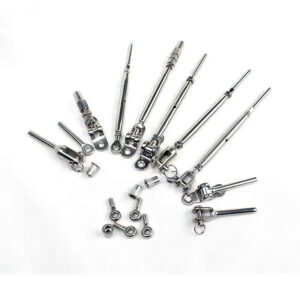
Checking access before the first adjustment serves two purposes. It confirms that the installer can complete the full tightening sequence without interruption, and it establishes whether the terminal will remain reachable later, when the run needs to be re-tensioned or inspected. A tensioner that can be reached once, during initial installation, but not afterward, limits the assembly’s maintainability regardless of how well it performs on day one. Where 缆索张紧系统 are specified with recessed or enclosed terminal positions, confirming tool clearance before tightening avoids discovering mid-sequence that the selected tool cannot engage the fitting at the angle available.
This check also matters because lost access partway through a sequence is one of the conditions that should stop tightening rather than prompt a workaround. If a terminal becomes inaccessible after adjacent components are set or adjusted, continuing to tighten other points in the run without resolving that access gap leaves an incomplete record of what tension was actually achieved at that terminal. Confirming access first, rather than discovering its absence mid-sequence, keeps the tightening pattern intact and avoids a gap in the final tensioning record.
Staged Tightening Across Straight and Corner Runs
Tightening a cable run in a single pass, end to end, can consume all the available travel in the terminal reached last, because early adjustments at other points along the run shift tension before the final terminal is touched. Staged or alternating tightening addresses this by moving tension incrementally across multiple points rather than fully setting one point before moving to the next.
The value of staging is general: by returning to each terminal in stages, the installer distributes the work of bringing the run to its final tension across all the adjustment points involved, rather than relying on the last point to absorb whatever the earlier points left behind. This matters more as run length increases and as more terminals participate in a single continuous cable path, because each additional terminal is another point where travel can be consumed unevenly if the sequence moves through the run only once.
Where a run includes a corner, staging interacts with the corner hardware’s role in splitting tension between two directions. A corner post does not simply pass tension through; it anchors the cable ends of two separate runs that meet at that point. Staged tightening across a corner, then, has to account for how adjustment in one run affects the post’s position and, in turn, the starting condition for the adjoining run’s terminals. 通柱电缆硬件, where cable passes continuously through a post rather than terminating at it, introduces a different consideration, because tension changes in the run on one side of the post can shift the cable’s position relative to the post on the other side.
None of this establishes a fixed staging pattern that applies across projects. The number of stages, the order in which terminals are revisited, and how corner runs are sequenced relative to straight runs all depend on the same assembly conditions that determine the overall tensioning pattern. What staged tightening supports, generally, is avoiding a single-pass approach that leaves the sequence vulnerable to uneven travel consumption; the specific staged sequence still has to be confirmed for the named assembly before work begins.
Frame Alignment and Base Movement Checks
Tensioning a cable run applies load not just to the cable and its terminals but to the posts and bases that anchor the entire frame. A post that appears plumb and a base that appears fixed before tightening begins are not guaranteed to remain that way once cumulative tension from multiple cables is applied across a run.
This is why baseline conditions need to be recorded before the first adjustment, not estimated afterward from memory or assumption. Recording post alignment and tensioner position before tightening gives the installer a reference point against which any change observed during tightening can be judged. Without that baseline, it becomes difficult to distinguish a post that has rotated under load from a post that was already slightly out of alignment before work began, or to separate a tensioner’s normal seating travel from a base that has actually shifted.
The condition that changes the interpretation here is timing: a check performed only after tightening is complete cannot distinguish cause from pre-existing condition, while the same check performed before and during tightening can. A base that shifts during adjustment indicates the anchorage is responding to load in a way the design did not anticipate, which is a different problem from a tensioner that simply takes up expected slack as it is turned. Both can look similar in isolated observation; only a recorded baseline separates them.
This has a direct bearing on how corner assemblies are read during tightening. Because a corner post carries tension from two directions, any base movement at that post has a compounding effect on both adjoining runs rather than one. Monitoring frame alignment at corner posts during staged tightening, rather than only at the end of the sequence, allows the installer to catch a base or post response early, while it is still attributable to a specific stage of adjustment rather than to the finished, fully tensioned run.
Stop Conditions for Uneven Seating or Lost Travel
| Observed condition | 待核查的证据 | Immediate decision |
|---|---|---|
| A post rotates | Compare current post alignment with the recorded baseline | Stop tightening; further adjustment can conceal a geometry or anchorage problem |
| A base shifts | Check for movement at the base during adjustment | Stop tightening; further adjustment can conceal a geometry or anchorage problem |
| Cables seat unevenly | Check whether cable seating remains even across the run | Stop tightening; the assembly needs correction before more adjustment |
| Tool access disappears | Confirm that the terminal can still be reached with the required tool | Stop tightening rather than continue without usable terminal access |
Not every observation made during tightening calls for the same response. Some conditions are expected as part of normal fitting travel, and others indicate that continuing to tighten will not resolve the underlying issue and may obscure it instead. Distinguishing between these two categories is the判断 the installer has to make in real time, using the baseline recorded earlier as the reference.
A post that rotates relative to its recorded baseline, a base that shifts during adjustment, cables that seat unevenly across the run, and a terminal that becomes inaccessible to the required tool all share a common feature: each is evidence that the frame or the assembly is responding to tension in a way that further tightening will not correct. Continuing past any of these points does not bring the run closer to its intended final tension; it risks forcing the frame into an apparent alignment that conceals a geometry or anchorage problem underneath.
The reasoning that connects these conditions is that cable tensioning assumes a fixed, stable frame into which tension is introduced. Where the frame itself is moving, rotating, or losing the ability to be adjusted as intended, the tensioning process is no longer isolated to the cable and terminal; it has become entangled with an unresolved structural or installation issue. Stopping at that point preserves the ability to diagnose the cause, whether that is a post that was not adequately anchored, a base connection that needs correction, or a run geometry that does not match the approved sequence. Continuing to tighten past the stop condition removes that diagnostic opportunity, because the visible symptom may be pulled into temporary alignment even though the underlying cause remains.
Final Positions and Inspection Records
| Record item | Before tightening | Final record | What the comparison shows |
|---|---|---|---|
| Post alignment | Baseline post alignment | Final post alignment | Whether a post moved during tightening |
| Tensioner position | Baseline position of each tensioner | Final position of each tensioner | How fitting travel changed during adjustment |
Once a run reaches its intended tension without triggering a stop condition, the final step is comparing the finished state against the baseline recorded before tightening began. This comparison is what allows the installer, and anyone reviewing the work afterward, to distinguish ordinary fitting travel from an unresolved movement that was not caught during the sequence.
Final post alignment compared against the recorded baseline shows whether any post moved over the course of tightening, and by how much relative to where it started. Final tensioner position compared against its baseline shows how much travel each terminal actually used to reach its final tension, which is informative beyond the single run being inspected. Where one terminal consumed noticeably more travel than others in the same run, that asymmetry is useful information for evaluating whether the tightening pattern distributed tension as intended or whether one point absorbed more than its share, consistent with the staging considerations that shaped the sequence.
This record also supports the project conversation that follows installation, including the design and termination questions that shaped the assembly in the first place. The specifications and tensioning requirements established for the system, together with the corner and termination hardware decisions made before shop drawings were finalized, set the conditions this final record is checked against. Where the finished positions align with what those upstream decisions anticipated, the record confirms the assembly performed as the sequence intended. Where they diverge, the record identifies which terminal or post needs further review before the run is considered complete, rather than leaving that determination to visual inspection alone.
常见问题
问: Do ASTM E985 or ISO 2408 establish the field tightening order for a cable railing run?
A: No. ASTM E985 provides railing design and load/deflection criteria, while ISO 2408 addresses steel wire-rope requirements within its scope; neither defines the installation-specific tensioning sequence. Use the approved instructions for the named assembly together with the project criteria.
问: What project information should be confirmed before choosing a tightening pattern?
A: Confirm the run length, corners, post stiffness, terminal layout, and tool access against the approved system instructions. These conditions affect how load enters the frame and whether the terminals remain accessible throughout adjustment.
问: Is alternating adjustments between terminals always the correct approach?
A: No. Alternating or staged adjustments can help prevent one end from using all available travel, but the exact pattern must be confirmed for the named assembly. Do not turn that general technique into a universal sequence.
问: What should be checked if one tensioner is using much more travel than the others?
A: Pause and compare the current tensioner positions, cable seating, post alignment, and base position with the recorded baseline. Uneven travel may indicate that the sequence or assembly geometry needs correction before tightening continues.