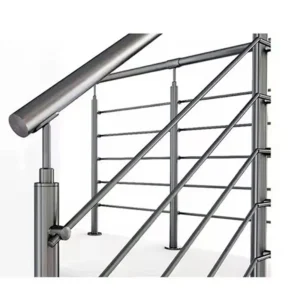
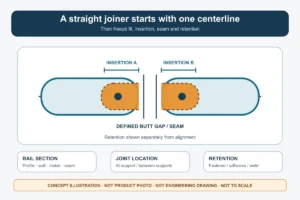
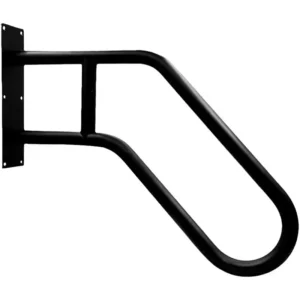
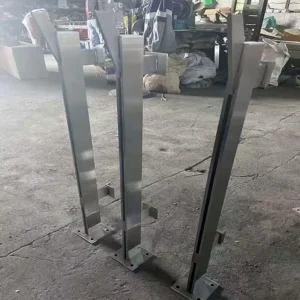
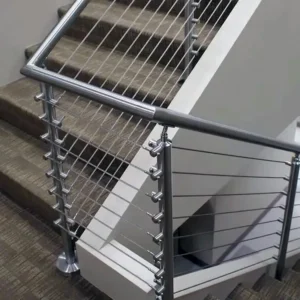
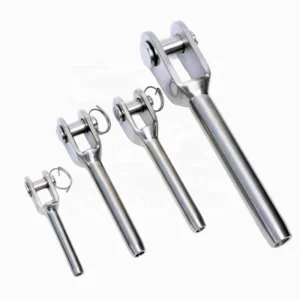
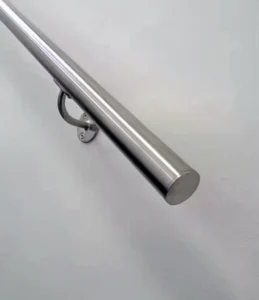
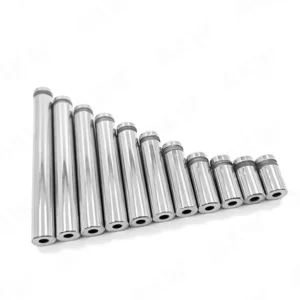
Every handrail end belongs to one of three categories: a return that redirects the rail toward adjacent construction, an end cap that closes an exposed tube profile, or an intentionally open coordination point where the adjoining condition is not yet resolved. Choosing the right category before you select hardware matters because handrail returns vs end caps answer different questions — one addresses the geometry of a gripping path, the other addresses the physical closure of a tube. Conflating them produces details that look finished on a drawing but leave gaps or compliance questions in the field.
Assign a Function to Every Handrail End
Every handrail end has a function before it has a fitting.
When a handrail reaches the end of a route segment, the first question is not which end fitting to order. It is whether the gripping path terminates at that point, whether it returns toward a wall, guard or floor, or whether it continues into another segment that has not yet been detailed. Those three conditions call for different hardware, different coordination steps, and in some cases different regulatory treatment. Conflating them under a single unqualified “end-cap item” is a common mistake — it delays recognition of a missing junction until the rail is on site.
Related Products
- Capuchons de poteaux et embouts (ronds, carrés, décoratifs) — Compare profile-closing components; a cap is separate from a required handrail return.
- Composants du rail de la borne d'alimentation — Check components at the end of a post-supported rail segment.
- Systèmes de mains courantes à paroi continue — Review a wall-supported continuous-route option before selecting its ends and joints.
- Manchons pour connecteurs de rails — Check a candidate section joint against actual mating dimensions and assembly access.
- Connecteurs universels de rails — Compare connector candidates for a route junction; the product name leaves compatibility to confirmation.
Work through every end on the route before you open a component catalogue. Mark each end with its function: termination, return or continuation. A termination means the gripping surface stops there and the tube needs to be closed. A return means the tube direction changes to approach an adjacent surface and the geometry of that approach is a design decision. A continuation means another segment connects here and the geometry of that connection has not been released yet.
The function of the end determines the relevant detail. A tube closure and a coordinated termination are not interchangeable, and they should not share one line item on a schedule.
That discipline protects the schedule as much as it protects the detail. Once each end has a declared function, you can release the portions of the route that are fully resolved and hold only the ends that still have open conditions.
Distinguish Returns from End Caps
A return changes the direction of the handrail toward an adjacent surface; an end cap closes the open cross-section of a tube — and each does only the thing it is designed to do.
A return redirects the gripping path. At a stair or ramp termination subject to accessibility guidance, the purpose of the return is to prevent the end of the rail from projecting into the circulation path and to maintain a continuous gripping surface to the point where a user releases the rail. The US Access Board stairway guide discusses returns and horizontal extensions at applicable covered stairways. Its scope is US federal accessibility requirements; it is not a universal instruction to specify a particular end product on every project. Whether that guidance applies to your project — and which specific geometry it requires — needs confirmation against your project’s regulatory context before you assign a return type to a termination.
Compare the Physical Supply Interfaces
| Option | Physical scope | Check before release |
|---|---|---|
| Return | Turns the rail to a receiving wall, guard or floor | Direction, receiving face and applicable termination detail |
| Embout | Closes the tube profile | Profile fit, attachment and finish; termination remains separate |
| Point de coordination | Final interface is unresolved | Location and withheld final work; not a service-ready end |
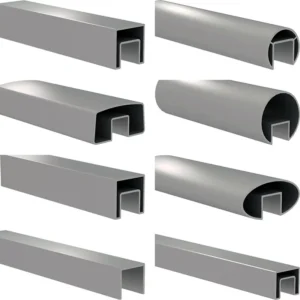
An end cap does something narrower. It closes the exposed cross-section of a tube to keep the profile clean, prevent moisture ingress and protect anyone who contacts the end. When the task is only to close an exposed tube end, select the cap by the tube profile, the fit tolerance and the finish. That is the complete scope of the cap decision. The cap does not resolve where the rail returns, whether the gripping route is continuous or whether the termination meets an accessibility requirement. A closed tube should not appear on a drawing or schedule as the answer to a termination requirement that calls for a return.
Finish and profile matching matter in both cases. A cap with the right nominal description but a slightly different outer diameter or a different surface treatment will not match an installed rail under inspection lighting. Confirm the actual mating dimensions and finish specification — not just the catalogue name — before you commit to a fitting.
Coordinate Ends with Adjacent Construction
An end that meets another trade’s work is not finished until both sides of the junction are described.
When a handrail end meets a wall, a guard panel or a post supplied by another party, the drawing needs to show what the rail end looks like, what the receiving surface looks like and who supplies the connection between them. A line drawn to an approximate neighboring boundary is not coordination — it is a deferred decision that will produce a gap or an interference when the two parts are installed. The physical receiving face and the end geometry of the rail need to match each other, not just appear near each other on a plan.
Name the responsible party for each mating component on the schedule. If the wall bracket is supplied by the handrail fabricator, say so. If the wall flange is part of an architectural finish supplied by another contractor, say that too, and identify who makes the final connection. That distinction matters because the tolerance at the junction — the gap, the overlap or the cover plate — belongs to whoever controls both sides.
Projections into circulation areas need particular attention. A return or end that sits adjacent to a door or a high-traffic corridor occupies real space. Before accepting an end detail in that location, review its full projection into the adjacent route and check it against any extension requirements that apply. The US Access Board guide discusses hazards from projections in alteration projects within its scope. A project decision to use a shorter rail or a different return geometry in that condition needs to be supported by a confirmed applicable exception, not by a preference for a neater drawing.
Consider a project where a stair handrail at the bottom landing approaches a glazed screen supplied by the curtain wall package. The handrail end is detailed to the face of the screen, but the connection hardware, the edge distance into the glass and the cover cap are unresolved because the glass thickness is not yet confirmed. That end cannot be fabricated to its final cut length until the screen geometry is fixed. It should be carried as a coordination point, not released as a finished end.
Related Reading
- Pièces pour mains courantes en acier inoxydable : Tubes, supports, embouts, poteaux et connecteurs — Use the component overview to identify which parts belong in the purchase boundary.
- Systèmes de mains courantes en acier inoxydable sur mesure pour l'approvisionnement en matériel de garde-corps dans le cadre de projets — Prepare the project information and supply scope before requesting a coordinated package.
- Systèmes de garde-corps en acier inoxydable : Ce que les acheteurs doivent confirmer entre la tolérance des tubes, la qualité de la finition et la compatibilité des connecteurs — Check the neighboring tube, finish and connector interfaces before accepting a substitution or final package.
Manage Unresolved End Interfaces
An open end condition is a release boundary, not a finished open handrail waiting for installation.
When the adjoining construction or the continuation geometry at a handrail end is not yet resolved, the right action is to identify that end explicitly as a coordination point and withhold its final cut length and end fabrication. Marking it clearly serves two purposes. First, it protects the unaffected portions of the route — segments whose ends are fully resolved can proceed to fabrication and supply without being held back by one unresolved junction. Second, it prevents the unresolved condition from disappearing into the schedule as a generic end fitting that looks complete but is not.
An unresolved end is a named, located, open item on the schedule — not an approximation to be refined on site.
The practical implication is that the schedule needs a status column, not just a fitting type. Each end gets its location, its declared function, its fitting (if selected), its mating face and its current status: released, pending coordination or held. When a coordination point resolves, the end moves from held to released with the confirmed geometry. That movement is a fabrication trigger.
Withholding final fabrication on a held end does not mean ignoring it. It means keeping it visible. The common failure mode is to absorb the unresolved end into a catch-all quantity — “miscellaneous end fittings, allow two” — that makes the missing junction invisible until the rail is on site and nothing fits.
Schedule Terminations for Supply and Inspection
A termination schedule connects each end to a specific location, function, fitting, mating face, finish and release status.
Build the schedule before you place the order, not after. Work from the handrail route and assign a row to every end: the location by reference (stair S1, upper end; landing L2, wall end), the function (termination/return/continuation), the fitting selected (cap type, return type or held), the mating face (wall, floor, guard panel, continuation segment), the finish and grade, and the resolution status.
That structure does three things for supply and inspection. It connects the order quantity to the actual count of route ends, so a return at one stair and a cap at another are ordered as distinct items rather than combined into an ambiguous total. It gives the inspector a checklist — each received fitting can be matched to a specific end before installation begins. And it makes the unresolved coordination points visible as a named list, so they do not disappear behind a nominal completion status.
Returns, caps and open coordination points need different checks on receipt. A cap is verified against the tube profile and finish. A return is verified against the tube profile, the return geometry, the finish and the connection detail for its receiving surface. A coordination point is verified as still correctly held — not accidentally released with an approximated geometry.
ESANG’s component range covers both tube closures and return configurations across the handrail profiles it supplies. When you bring a termination schedule to the supplier conversation, the useful inputs are the tube profile and nominal size, the selected end function at each location, the mating surface material and edge distances, the finish and grade required for the exposure, and the current resolution status of any held ends. With those in hand, candidate fittings can be matched to actual interface geometry rather than to nominal descriptions, and held ends can be identified for follow-up once the adjoining construction is confirmed.
References
- Access Board Guide – Chapter 5: Stairways — Review the stairway-specific continuity and end provisions where US accessibility requirements apply.
- UFGS 05 52 00 Garde-corps métalliques — See an editable metal-railing specification example for drawings, assembly and supply interfaces; adapt it to the project.
- ISO 1127:1992 Stainless Steel Tubes – Dimensions, Tolerances and Conventional Masses — Check the dimensional scope for stainless tube; it supplies no assembly compatibility or load rating.
- ASTM A380/A380M-25 Cleaning, Descaling, Pickling, and Passivation of Stainless Steel — Review cleaning and surface-treatment scope when joints or cutting create fabrication work; agree the applicable procedures.
Questions fréquemment posées
Q : Can a temporary cap close a coordination point during construction?
A : Treat temporary protection separately from the permanent termination decision. Record the unresolved junction and required final work; a temporary closure should not be counted as completion of the handrail route.
Q : How should identical-looking caps for different rail profiles be packed?
A : Separate them by the mating profile and part reference. Visual similarity is a poor receipt check when round, square or differently sized rails occur in the same shipment.
Q : What if the adjoining guard arrives after the handrail?
A : Keep that end’s receiving geometry and responsibility visible in the release schedule. Coordinate the final junction with the guard revision before completing the end, rather than using the earlier approximate location as a final fit.