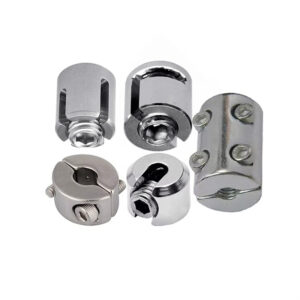
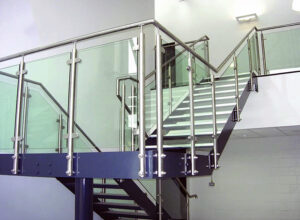
Raccords d'extrémité de câble
Raccords d'extrémité de câble
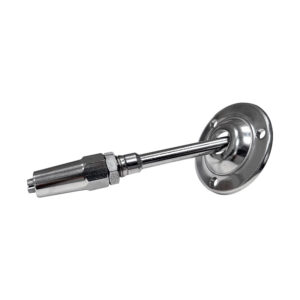
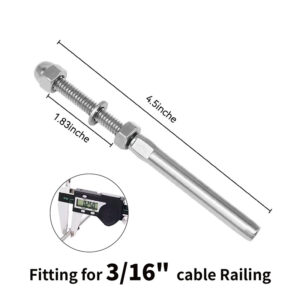
ESANG cable end fittings are used to terminate stainless steel cable at end posts, terminal posts, tensioning points, wall connections, or other fixed connection points in cable railing systems. They help complete the cable run and connect the cable to the surrounding railing structure.
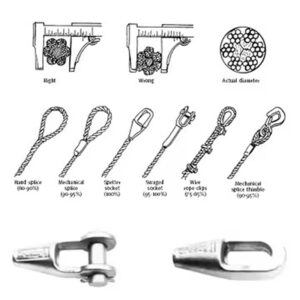
Cette catégorie comprend Cable End Stops, Swaged Cable Terminals, Threaded Cable End Fittings, Cable Ball End Terminals, Fork End Cable Terminals, et Eye End Cable Fittings.
For contractors, distributors, fabricators, and project buyers, cable end fitting selection should consider cable diameter, end post design, terminal method, swaged or threaded assembly, cable direction, tensioning requirement, material grade, finish, and installation environment. ESANG can supply and manufacture cable end fittings according to drawings, cable size, thread detail, material grade, finish requirements, and project installation conditions.
Cable End Fitting Options
| End fitting option | Utilisé de préférence pour | Questions clés de la sélection |
|---|---|---|
| Cable End Stops | Stopping or retaining cable ends at designated terminal points | What cable diameter, stop style, post condition, and fixing method are required? |
| Swaged Cable Terminals | Cable ends prepared by compression, factory assembly, or suitable swaging tools | What cable diameter, terminal type, swaging method, and finished length are needed? |
| Threaded Cable End Fittings | Cable ends requiring threaded adjustment, connection, or assembly with other hardware | What thread size, cable diameter, adjustment range, and mating component are required? |
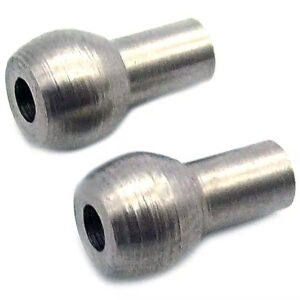
| Cable Ball End Terminals | Terminal points that use a ball end connection or retaining feature | What cable size, ball diameter, receiving detail, and terminal condition should match? |
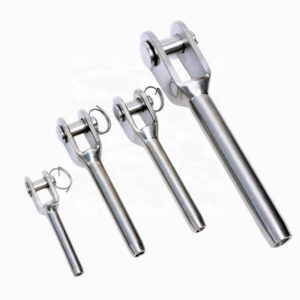
| Fork End Cable Terminals | Cable ends connecting to tabs, plates, brackets, or pin-style connection points | What fork width, pin diameter, connection plate, and cable angle are required? |
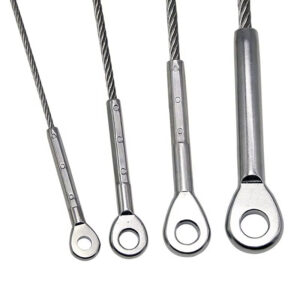
| Eye End Cable Fittings | Cable ends connecting to bolts, pins, hooks, or closed-loop connection points | What eye size, cable diameter, connection hardware, and alignment are required? |
How to Choose Cable End Fittings
Cable end fittings should be selected according to how the cable terminates. The end fitting must match the cable diameter, post or bracket condition, tensioning method, and installation sequence.
| État du projet | Orientations recommandées | Pourquoi c'est important |
|---|---|---|
| The cable needs a simple retaining end | Use cable end stops | End stops help retain the cable at a designated terminal point. |
| The cable will be factory-prepared or tool-compressed | Use swaged cable terminals | Swaged terminals require correct cable diameter, compression method, and finished length. |
| The end connection needs threaded adjustment or assembly | Use threaded cable end fittings | Threaded fittings can connect to nuts, tensioners, posts, or other threaded hardware. |
| The connection uses a tab or clevis-style detail | Use fork end cable terminals | Fork ends should match the plate thickness, pin size, and cable angle. |
| The connection uses a pin, bolt, or loop point | Use eye end cable fittings | Eye ends should match the connection hardware and alignment. |
| The terminal detail is project-specific | Use ball end terminals or custom end fittings as required by the design | Special terminal designs should be confirmed with drawings or samples. |
End Fitting Types and Their Roles
Cable end fittings complete the cable run. They are not the same as pass-through fittings or spacer bars, and they should not be selected without reviewing the terminal post or connection point.
| End fitting type | Fonction principale | Considérations générales |
|---|---|---|
| Butées d'extrémité de câble | Retain or stop the cable end at a defined point | Cable diameter, stop shape, receiving detail, and installation method |
| Swaged terminals | Create a fixed cable end using compression or factory preparation | Cable size, swaging process, terminal shape, and finished cable length |
| Threaded end fittings | Connect cable ends to threaded hardware or allow adjustment | Thread size, nut or tensioner compatibility, adjustment range, and post detail |
| Ball end terminals | Provide a rounded retaining or terminal feature | Ball diameter, receiving hole, cable size, and end condition |
| Fork end terminals | Connect cable to a tab, plate, clevis, or pin-style support | Fork width, pin diameter, bracket thickness, and cable angle |
| Eye end fittings | Connect cable to a bolt, pin, hook, or closed-loop point | Eye size, fixing hardware, cable direction, and alignment |
Terminal Posts and End Connection Planning
Cable end fittings should be planned together with terminal posts and end connection details. A fitting that works on one post layout may not work on another if the hole, plate, thread, or cable direction is different.
| Point à l'ordre du jour | Ce qu'il faut vérifier | Related hardware |
|---|---|---|
| Terminal post type | Round, square, rectangular, side-mounted, or custom terminal post | End fittings, tensioners, through-post hardware, post holes |
| Cable diameter | Cable size and construction used in the railing system | Swaged terminals, threaded fittings, end stops, fork ends, eye ends |
| Finished cable length | Distance between terminal points and adjustment allowance | Swaged terminals, threaded fittings, tensioners |
| Cable angle | Straight, stair, angled, or corner condition | Fork ends, eye ends, multi-angle fittings, terminal hardware |
| Tensioning location | Whether tensioning occurs at the same end or another point | Cable tensioners, threaded fittings, turnbuckles, terminal posts |
Matériaux, finitions et fabrication sur mesure
ESANG cable end fittings can be supplied or manufactured according to project requirements, including cable diameter, terminal shape, thread detail, fork width, eye size, ball end design, material grade, surface finish, and packaging requirements.
| Matériau ou finition | Utilisation courante | Notes |
|---|---|---|
| Acier inoxydable 304 | Interior cable railing systems, commercial interiors, residential stairs, and dry environments | A common option for many indoor cable railing projects. |
| Acier inoxydable 316 | Outdoor cable railings, coastal projects, poolside areas, decks, terraces, and humid environments | On le privilégie généralement lorsqu'une meilleure résistance à la corrosion est requise. |
| Acier inoxydable 316L | Projets nécessitant une meilleure soudabilité ou des performances anticorrosion plus élevées | Convient lorsque le cahier des charges exige de l'acier inoxydable à faible teneur en carbone. |
| Finition brossée ou satinée | Commercial cable railings, decks, balconies, and most architectural cable railing projects | Helps reduce the visibility of minor handling marks and fingerprints. |
| Polissage miroir | Decorative or selected premium applications | Il confère un aspect plus brillant, mais nécessite une manipulation et un nettoyage plus minutieux. |
For non-standard cable railing projects, customers can provide drawings, cable diameter, terminal post details, thread requirements, fork or eye dimensions, finish requirements, and project environment. ESANG can review the requirements and manufacture cable end fittings to match the project specification where feasible.
Compatibility with Cable Railing Components
Cable end fittings should be selected together with tensioners, cable fittings, posts, and pass-through hardware. The end fitting is only one part of the complete cable railing assembly.
- For tension adjustment, coordinate cable end fittings with Tensioners and Turnbuckles.
- For general assembly and routing, review Cable Hardware Fittings.
- For cable passing through intermediate posts, coordinate with Quincaillerie pour poteaux traversants.
- For end post conditions, coordinate with Poteaux en acier inoxydable and terminal post components.
- For longer runs or spacing control, review Barres d'écartement des câbles where needed.
Personnalisation en fonction des exigences du projet
Many cable end fitting projects are customized according to cable diameter, end post design, thread detail, terminal shape, cable angle, material grade, and installation environment. ESANG can support custom end stops, swaged cable terminals, threaded cable end fittings, ball end terminals, fork end terminals, and eye end fittings.
When a project has standard-oriented requirements related to guardrail height, cable spacing, opening limitations, material grade, corrosion resistance, or installation method, customers should provide the required drawings and specifications. ESANG can manufacture cable end fittings to match those provided details, while final compliance depends on the complete installed system, structural design, installation method, and applicable local code.
Considérations relatives à l'installation et au projet
Cable end fittings should be reviewed before cable cutting, swaging, or assembly. Terminal post design, cable length, end fitting type, and tensioning method should be confirmed together.
- Cable diameter and cable construction
- Terminal post type and end connection detail
- Swaged, threaded, ball, fork, eye, or stop-style end fitting
- Finished cable length and adjustment allowance
- Tensioning location and compatible tensioner type
- Cable angle, stair run, corner condition, or straight run layout
- Post hole, bracket, tab, plate, or receiving detail
- Matériau adapté aux environnements intérieurs, extérieurs, côtiers ou au bord d'une piscine
- Exigences du code local du bâtiment et du cahier des charges du projet
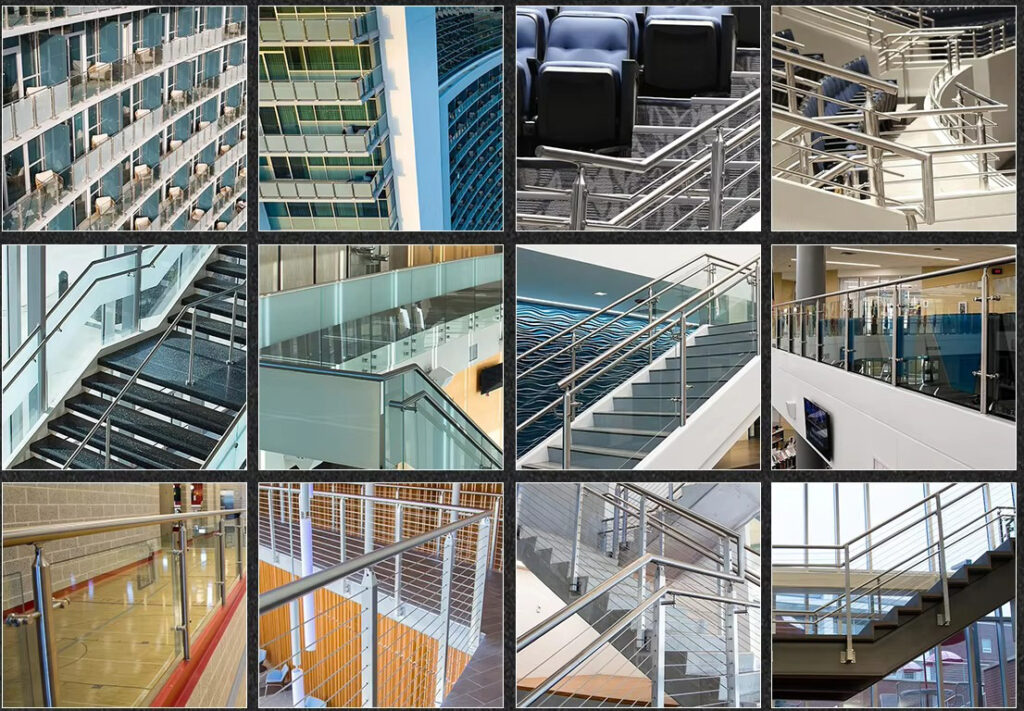
For cable railing projects on decks, balconies, stairs, terraces, and public-access areas, the complete installed system should be reviewed by the project designer, engineer, contractor, or local authority. ESANG can manufacture end fittings to match provided requirements, but final compliance depends on the full assembly and site conditions.
Scénarios d'application
Deck and Balcony Cable Railings
Cable end fittings are commonly used at terminal posts in deck and balcony railing systems. Cable diameter, post type, terminal location, and tensioning method should be confirmed before ordering.
Stair Cable Railings
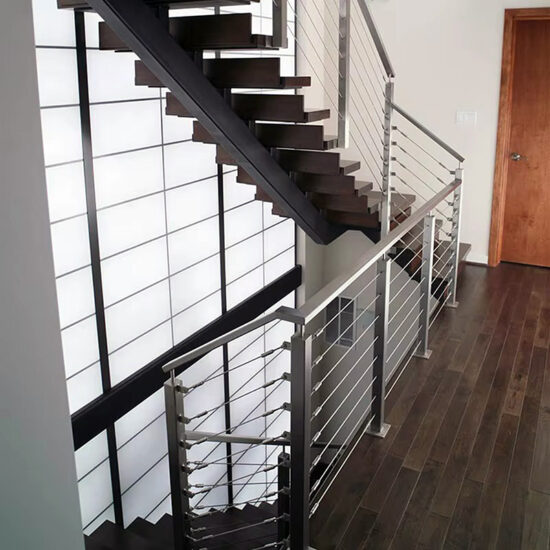
Stair cable railing systems may require fork ends, eye ends, threaded fittings, or angle-compatible terminal details. Stair pitch, cable angle, and terminal post design should be reviewed together.
Commercial Cable Railing Systems
Commercial buildings, offices, public spaces, and hospitality projects may require repeatable cable end fittings with consistent finish, reliable assembly, and clear compatibility with posts and tensioners.
Outdoor and Coastal Cable Railings
Outdoor, poolside, coastal, and humid environments require more attention to material grade, cleaning, and corrosion resistance. 316 or 316L stainless steel may be considered for more demanding exposure conditions.
Custom Cable Assemblies
Custom cable assemblies may require special thread sizes, fork dimensions, eye sizes, ball ends, or end stop details. Drawings, samples, and cable diameter help confirm the correct fitting design.
Catégories de produits connexes
- Cable End Stops
- Swaged Cable Terminals
- Threaded Cable End Fittings
- Cable Ball End Terminals
- Fork End Cable Terminals
- Eye End Cable Fittings
- Tensioners and Turnbuckles
- Cable Hardware Fittings
- Quincaillerie pour poteaux traversants
Questions fréquemment posées
What are cable end fittings used for?
Cable end fittings are used to terminate stainless steel cable at end posts, terminal posts, brackets, tensioning points, or other fixed connection points in cable railing systems.
What is the difference between cable end fittings and cable tensioners?
Cable end fittings terminate or connect the cable at the end of a run. Cable tensioners adjust and maintain cable tension. Some cable railing assemblies may use both end fittings and tensioners together.
When should swaged cable terminals be used?
Swaged cable terminals are used when the cable end is compressed onto the fitting using suitable tools or factory preparation. Cable diameter, swaging method, and finished cable length should be confirmed before production.
When should threaded cable end fittings be used?
Threaded cable end fittings are useful when the cable end needs to connect to threaded hardware, nuts, tensioners, or adjustable components. Thread size and mating parts should be confirmed before ordering.
What are fork end cable terminals used for?
Fork end cable terminals connect cable to tabs, plates, brackets, or pin-style connection points. Fork width, pin diameter, and bracket thickness should be matched to the project detail.
What are eye end cable fittings used for?
Eye end cable fittings connect cable to bolts, pins, hooks, or closed-loop points. Eye size, cable diameter, connection hardware, and cable alignment should be confirmed.
Can ESANG customize cable end fittings?
Yes. ESANG can manufacture cable end stops, swaged terminals, threaded fittings, ball end terminals, fork ends, and eye ends according to cable diameter, drawings, material grade, finish, and project requirements.
Should I choose 304 or 316 stainless steel cable end fittings?
L'acier inoxydable 304 est couramment utilisé pour les environnements intérieurs et secs. L'acier inoxydable 316 est généralement privilégié pour les environnements extérieurs, côtiers, au bord d'une piscine, humides ou présentant un risque élevé de corrosion. Le type d'acier à retenir doit être choisi en fonction de l'exposition du projet et des spécifications techniques.
What information is needed for a cable end fitting inquiry?
Useful information includes cable diameter, end fitting type, terminal post detail, thread size if required, fork or eye dimensions, material grade, finish, quantity, drawings, and project environment.
How should stainless steel cable end fittings be maintained?
Le nettoyage courant s'effectue généralement à l'aide d'un détergent doux, d'eau claire et d'un chiffon doux. Évitez les produits nettoyants à base de chlorure, la laine d'acier et les outils abrasifs. Les installations situées à l'extérieur, au bord d'une piscine ou en bord de mer doivent être nettoyées plus régulièrement afin de réduire la contamination des surfaces et de préserver leur aspect.
Articles connexes :
Exigences en matière de passivation pour les éléments de fixation, les supports et les accessoires d'ancrage en acier inoxydable
Précisez le traitement en fonction de l'état de la pièce, du procédé de fabrication et de l'exposition, plutôt que d'appliquer une seule instruction générique de passivation à tous les composants.
Nettoyage des éléments de fixation des garde-corps en câble et en verre en acier inoxydable 316 dans les environnements marins
Nettoie les bornes de câbles, les colliers de serrage en verre, les éléments de fixation et les interstices sans laisser de résidus de produits chimiques ni endommager les finitions polies ou brossées.
Comment les résidus de fabrication provoquent des taches de thé sur les garde-corps en acier inoxydable
Les taches de thé peuvent être dues à des particules incrustées, à une coloration due à la chaleur, au transfert d’abrasifs ou à des résidus coincés dans les rainures ou les fissures de la finition.
Décapage ou passivation des éléments de fixation des garde-corps en acier inoxydable : différences en termes de portée et de risques
Le décapage permet d'éliminer le tartre et les couches superficielles altérées ; la passivation vise à traiter l'état de la surface après le nettoyage, avec des contrôles et des risques différents.
Plan d'entretien des ferrures des garde-corps côtiers : sel, fissures, fixations et finition de surface
Axez l'entretien sur l'exposition aux intempéries, la rétention de sel, les fissures, les métaux dissemblables, l'état des fixations et l'aspect de la finition.
Règles de nettoyage sur chantier pour les garde-corps en acier inoxydable après découpe, soudage et installation
Éliminez la poussière de meulage, les résidus de soudure, les dépôts de ciment et les traces d'acier au carbone avant la remise du bien afin d'éviter toute tache évitable.
Projets d'Esang

Certificat d'Esang
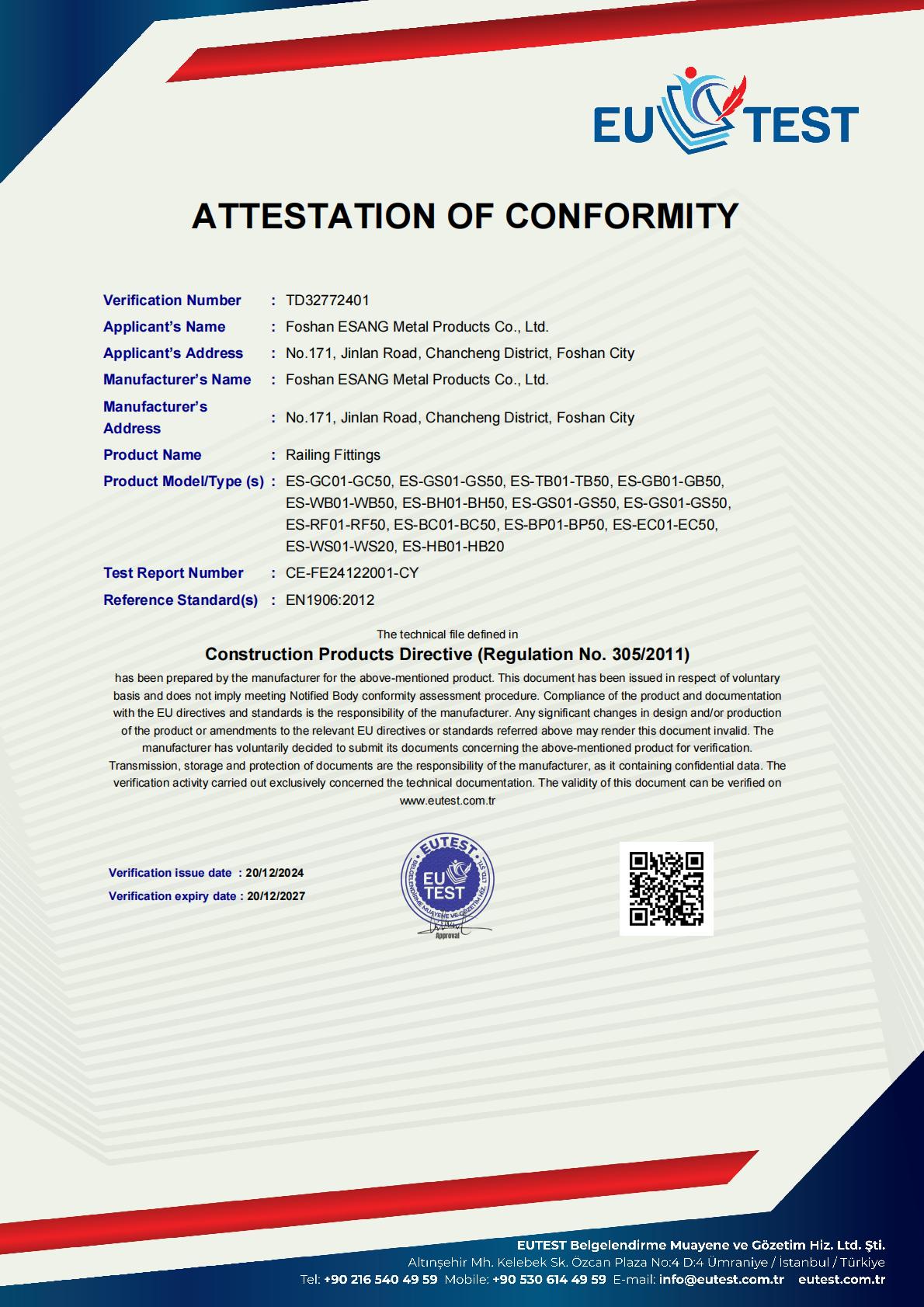
Foshan ESANG Metal Products est fier d'entretenir Certification CE (numéro de vérification TD32772401) en vertu de la directive sur les produits de construction (règlement n° 305/2011), ce qui confirme notre engagement à respecter les normes européennes les plus strictes en matière de sécurité et de qualité.
Certifié Gamme de produits :
Notre gamme complète d'accessoires pour garde-corps, qui comprend des pinces à verre, des tendeurs, des supports, des supports muraux, des sabots, des accessoires pour mains courantes, des câbles et des composants pour poteaux, répond aux besoins des utilisateurs de garde-corps. EN1906:2012 garantissant l'intégrité structurelle et la fiabilité des performances dans toutes les installations.
Ce que cela signifie pour votre projet :
✓ Conformité réglementaire totale pour les marchés européens et internationaux
✓ Performances en matière de sécurité et de durabilité vérifiées de manière indépendante
✓ Support documentaire pour les spécifications architecturales
✓ Tranquillité d'esprit grâce à l'assurance qualité d'une tierce partie
Certification valable jusqu'en 2027 : CE-FE24122001-CY
Projets d'Esang

Produits de référence