Applications marines et côtières
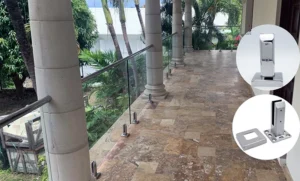
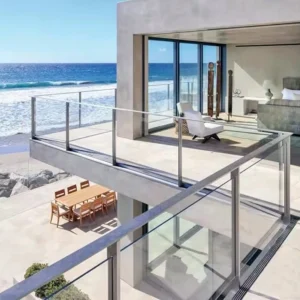
Applications marines et côtières
Use this category when chloride-bearing air, salt deposits, pool chemicals, waterfront moisture, direct splash or marine-adjacent service changes the railing decision. The correct route begins with exposure, drainage, dissimilar-metal contacts, cleaning access and the complete fixing interface—not with a “316,” “316L” or “marine-grade” label.
Discuss a marine or coastal requirement
Choose the route that matches the purchasing task
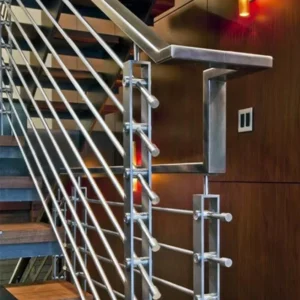
• Systèmes de garde-corps de qualité marine en acier inoxydable 316L — use when a project specification explicitly calls for 316L or when a welded assembly needs a documented material review. The name does not establish automatic suitability for the exposure.
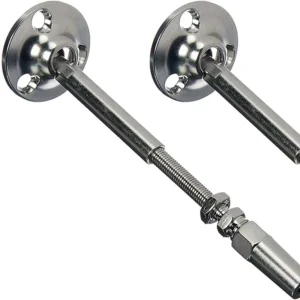
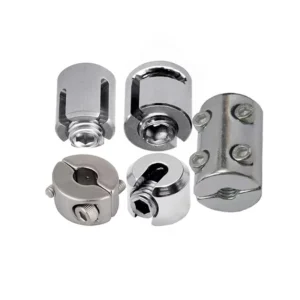
• Composants résistants à l'eau salée — use to compare exposed fittings, posts, rails and small hardware against a stated salt-deposition, splash or chemical condition. No component is corrosion-proof by title.
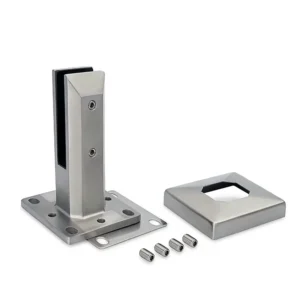
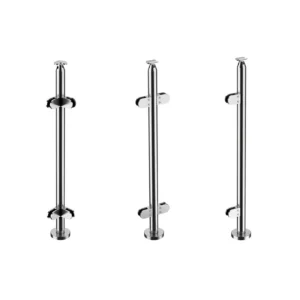
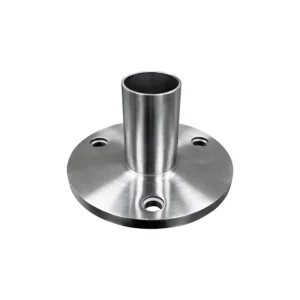
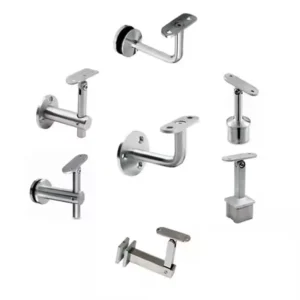
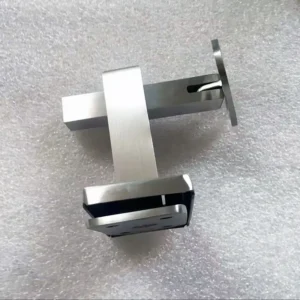
• Quincaillerie pour installations côtières — use when anchors, fasteners, base parts, brackets, isolation and drainage at the substrate are the primary procurement problem.
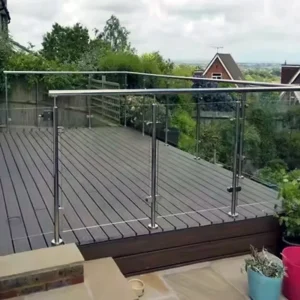
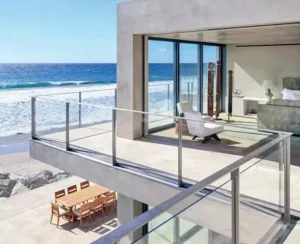
• Solutions de garde-corps pour les berges — use for buildings, promenades, balconies and public edges near water where design, exposure, cleaning access and building interfaces must be coordinated.
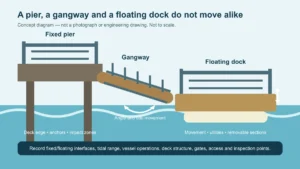
• Systèmes de garde-corps pour quais — use for piers, docks and marina-adjacent routes where wet zones, impact, moving structures, substrate fixing and inspection access need project-specific engineering.
Describe the exposure, not just the distance from water
• Airborne coastal deposition: state distance and orientation to the coast, prevailing wind, shelter, rainfall washing and whether deposits can accumulate on protected surfaces.
• Splash or intermittent wetting: identify direct seawater, pool water, washdown, tidal splash, standing water and the time surfaces remain wet.
• Direct or prolonged seawater contact: flag this separately. Do not select an architectural handrail grade from a category name; obtain a project corrosion/material review for the exact water, temperature, crevices and service duty.
• Chemical exposure: disclose pool treatment, cleaners, industrial contaminants or de-icing salts and the planned rinsing method.
• Maintenance reality: record access, cleaning water, frequency, inspection points and whether joints, undersides and base details can actually be reached.
316 and 316L are common material directions for some land-based coastal applications, but they are not universal answers. Grade, surface condition, fabrication, finish, geometry, deposits, wet time and maintenance work together. A material name cannot support a fixed service-life promise.
Review the complete metal and water path
List the proposed metal for rails, posts, brackets, screws, washers, nuts, anchors, cable and concealed parts. Dissimilar metals in contact under wet, salty conditions require deliberate compatibility or isolation review; do not assume a matching appearance means matching material. Also identify weld treatment, cut edges, contamination controls and any finish sample or material documentation required by the project.
Drainage must be resolved at base plates, channels, tube ends, caps, covers, glass shoes, anchor recesses and other low points. A cover that hides the fixing does not necessarily stop water or salt. The project team should decide how water leaves, how membranes are protected and how the detail remains inspectable.
Coordinate anchoring and adjacent work
• identify concrete, structural steel, timber, deck framing, masonry or another structural substrate beneath finishes;
• record slab or deck edge distances, joints, voids, reinforcement or services, membrane build-up and access for drilling or through-fixing;
• separate visible base covers and sealants from the load path through base plate, anchor and substrate;
• coordinate glass, cable or other infill with its posts, rails, terminals and corrosion-exposed small fittings;
• assign structural design, anchor design, waterproofing, electrical isolation, installation, cleaning and inspection responsibilities in the project documents.
Unless a written quotation expressly includes them, ESANG component supply does not assume complete-system engineering, substrate acceptance, anchor verification, waterproofing design, local approval, installation or a corrosion-life guarantee.
Information that makes a coastal quotation comparable
Start with the project location, exposure description, drawings or sketch, site photos, railing function, substrate, mounting route, infill, material specification, finish, estimated quantity and maintenance plan. Early photos and estimates are acceptable; unresolved dimensions can be marked for later confirmation.
Ask the proposed supply or quotation to list grade and finish by component, included fasteners and anchors, dissimilar-metal assumptions, drainage and sealing assumptions, mating dimensions, items by others, required material documents or samples, and the site or engineering information still needed before production. This is more reliable than comparing two offers only by the words “marine grade.”
Articles connexes :
Panneaux en treillis métallique à niveau, inclinés ou passant de l’incliné au niveau : quelle géométrie convient à chaque tronçon de garde-corps ?
Choisissez entre une géométrie de panneaux grillagés « à niveau », « inclinés » ou « inclinés puis ramenés à niveau » en fonction du tracé de la balustrade, de l'orientation du motif, des interfaces et des plans du projet.
Comment choisir les manchons internes et les raccords de jonction pour les tubes de main courante
Précisez les manchons de main courante et les raccords de jonction en fonction du diamètre intérieur réel du tube, de la force de retenue requise et de l'accès nécessaire à la pose, afin que le raccord puisse s'ajuster et être solidement fixé.
Où faut-il placer les raccords et les supports des mains courantes sur les longues portées ?
Localisez les raccords à l'aide de supports, de transitions et d'accès au montage afin que les ruptures dues au transport soient également prises en compte comme des raccords conformes à la documentation dans la main courante installée.
Mains courantes continues et raccords : guide des spécifications techniques pour les projets
Reliez le parcours de rail utilisable à l'aide de modules de jonction, de supports, de déplacement et de transport avant de définir les spécifications d'une main courante continue.
Appel d'offres pour des mains courantes à montage en surface : plans et données du projet à envoyer
Veuillez nous transmettre les plans d'implantation coordonnés, les détails relatifs au support, les références des finitions et les spécifications du cahier des charges afin de permettre une comparaison pertinente des devis pour les mains courantes à fixation en surface.
Installation a posteriori de mains courantes en applique : liste de contrôle pour l'étude sur site
Répertorier le support existant, l'état des bords, les finitions, les installations techniques encastrées, les accès, la géométrie et l'étendue des travaux de réparation avant le début de la fabrication des éléments destinés à la rénovation.
Projets d'Esang

Certificat d'Esang
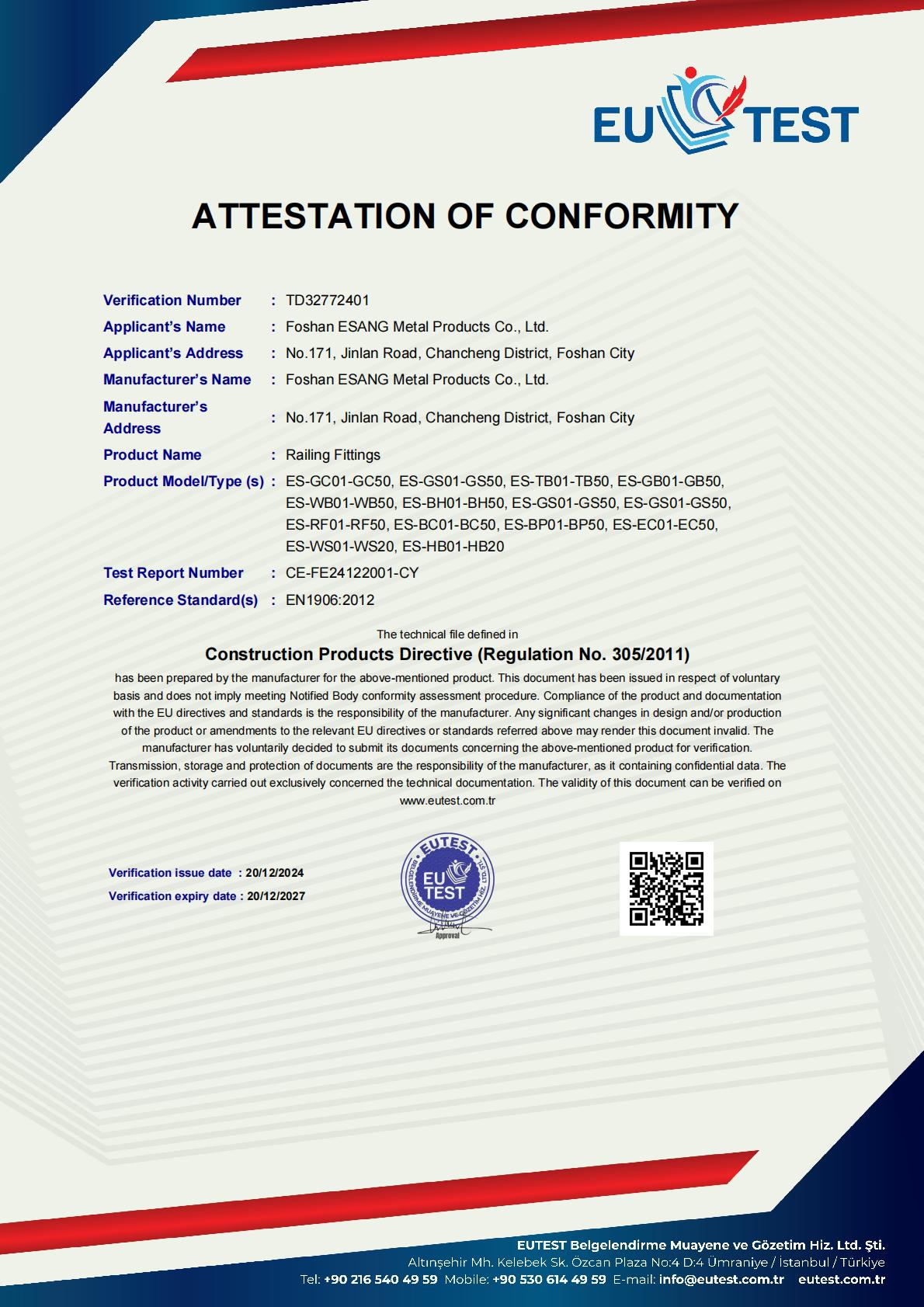
Foshan ESANG Metal Products est fier d'entretenir Certification CE (numéro de vérification TD32772401) en vertu de la directive sur les produits de construction (règlement n° 305/2011), ce qui confirme notre engagement à respecter les normes européennes les plus strictes en matière de sécurité et de qualité.
Certifié Gamme de produits :
Notre gamme complète d'accessoires pour garde-corps, qui comprend des pinces à verre, des tendeurs, des supports, des supports muraux, des sabots, des accessoires pour mains courantes, des câbles et des composants pour poteaux, répond aux besoins des utilisateurs de garde-corps. EN1906:2012 garantissant l'intégrité structurelle et la fiabilité des performances dans toutes les installations.
Ce que cela signifie pour votre projet :
✓ Conformité réglementaire totale pour les marchés européens et internationaux
✓ Performances en matière de sécurité et de durabilité vérifiées de manière indépendante
✓ Support documentaire pour les spécifications architecturales
✓ Tranquillité d'esprit grâce à l'assurance qualité d'une tierce partie
Certification valable jusqu'en 2027 : CE-FE24122001-CY
Projets d'Esang

Produits de référence