Specifying the wrong stainless grade for glass railing hardware rarely shows up as a problem at the time of installation. The hardware looks identical, the finish passes visual inspection, and the project closes without incident. The consequences arrive later — tea staining at two to three years, visible pitting at four to six, and fastener connections that require structural review by year eight to twelve on hardware that was selected to last decades. The grade decision that drives this outcome is almost always made in the wrong sequence: unit price is compared before exposure is classified, which means the environment ends up being rationalized around the budget rather than the other way around. Understanding where that sequence breaks down — and what questions to resolve before a grade appears on a proposal — is what separates a defensible specification from a warranty dispute.
Exposure classification drives stainless grade selection
Grade selection for stainless steel glass railing hardware is an exposure problem before it is a material problem. The metallurgical difference between 304 and 316 is straightforward: 316 contains molybdenum at approximately 2–3%, which significantly improves resistance to chloride-induced pitting and crevice corrosion. What makes that difference consequential is whether chlorides are actually present in the installation environment — and in what concentration, frequency, and form.
The practical challenge is that chloride exposure is not always obvious from a project address. A balcony described as “exterior” in inland construction carries a very different corrosion burden than one overlooking a marina or within airborne salt range of the ocean. A useful regional reference — not a universal regulatory rule, but a practical planning criterion — comes from coastal construction practice in the northeastern United States, where hardware specified east of the Garden State Parkway, or in sight of salt water, is typically called out in 316 regardless of whether the surface faces the water directly. The underlying logic applies to any coastal geography: once a site is within consistent airborne salt reach, 304 may not reliably hold its surface condition over the intended service life.
A polished 304 fitting can develop brown surface staining after months of salt spray exposure, while an equivalently finished 316 component in the same location remains visually clean. That is not a surface treatment difference — it is a metallurgical one, and no polish level or passivation treatment available to 304 closes that gap in a chloride-aggressive environment.
| Exposure Classification | Niveau recommandé | Rationale / Consequence of Wrong Grade |
|---|---|---|
| Inland – interior (dry, controlled) | 304 | Low chloride risk; 304 provides sufficient corrosion resistance. |
| Inland – exterior (sheltered outdoor) | 316 | Exterior exposure warrants 316 for enhanced corrosion resistance. |
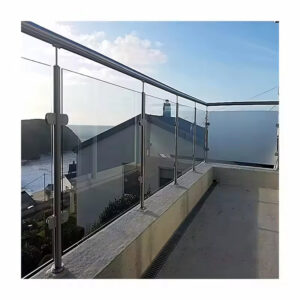
| Coastal / saltwater-view areas | 316 | Molybdenum in 316 resists chlorides; 304 would develop brown staining within months of salt spray. |
The table maps three exposure conditions to grade recommendations, but the more important implication is the consequence column. Selecting the wrong grade does not produce an immediate failure — it produces a deferred one, which is harder to catch during procurement review and easier to dispute during warranty resolution.
304 stainless in controlled interior railing zones
Grade 304 is appropriate for a wide range of railing applications, and over-specifying 316 where 304 is sufficient adds cost without adding performance. In dry interior environments — commercial lobbies, residential staircases, office mezzanines, and similar controlled spaces — 304 provides adequate corrosion resistance with expected service life in the range of 25–40 years under basic maintenance conditions. That figure applies to correct exposure conditions; it is a design-range reference, not a performance guarantee.
The useful boundary for 304 is not indoor versus outdoor — it is chloride presence versus chloride absence. Freshwater environments, sheltered inland exteriors, and dry cabin interiors generally fall within the acceptable range. What falls outside it is any environment where salt, pool chemicals, deicing compounds, or aggressive cleaning agents reach the hardware regularly.
When 304 is placed in a chloride-exposed location, the failure pattern is predictable in direction even if not precise in timing. Tea staining tends to appear within 18–36 months. Visible pitting follows at three to five years. Crevice corrosion at fastener interfaces and hidden contact points develops by eight to twelve years — often at exactly the connections where structural integrity matters most. This is not a worst-case scenario; it is the likely outcome of sustained chloride contact with 304 in an environment where 316 was the correct specification. The timeline is useful not as a scare figure but as a basis for comparing the cost of grade substitution against the cost of a replacement cycle.
| Application / Exposure | Suitability of 304 | Expected Outcome or Failure Timeline |
|---|---|---|
| Interior dry (homes, offices) / sheltered outdoor inland | Acceptable | 25–40 years with basic maintenance. |
| Freshwater boats, mild coastal above splash zone | Acceptable | Long service life; 25–40 years expected with proper care. |
| Salt or chloride exposure (coastal, deicing, poolside) | Non recommandé | Tea staining at 18–36 months, pitting at 3–5 years, crevice corrosion at 8–12 years. |
The most common misclassification in this zone is a balcony or terrace that is physically covered but not isolated from coastal air. A sheltered position reduces rain contact, but airborne salt still reaches exposed hardware surfaces. That distinction — sheltered from rain, but not from chloride-laden air — is where 304 specifications on exterior hardware tend to generate complaints.
For projects where interior balcony railings in 304 are appropriate, interior balcony railings 304 supply is available in components designed for those controlled conditions.
316 hardware for exterior and chloride exposure
For exterior installations subject to chloride exposure — coastal sites, pool decks, commercial terraces, and any location where deicing salts are used — 316 is the standard working grade, not a premium upgrade. The molybdenum content that distinguishes 316 from 304 specifically targets the pitting and crevice corrosion mechanisms that chlorides initiate, which is why pool areas and commercial exterior projects commonly call for 316 as a minimum. That is an industry planning criterion reflecting common practice, not a citation to a specific building code, but it reflects a consistent pattern of where 304 hardware underperforms in service.
The caveat worth holding alongside grade selection is that 316 is not self-correcting if other aspects of the hardware specification are inadequate. Poor surface finishing — inadequate polishing, weld scale left on fabricated assemblies, or surface discontinuities that trap moisture and chlorides — can compromise even 316 hardware in aggressive environments. Grade is necessary but not sufficient; surface finish quality and design details that prevent water and debris accumulation carry co-equal weight in the performance outcome.
One specific sub-grade distinction applies to welded assemblies in marine or heavily chloride-exposed conditions. For welded 316 components, specifying 316L — the low-carbon variant — prevents sensitization in the heat-affected zone adjacent to welds. Sensitization occurs when carbides precipitate at grain boundaries during welding, reducing localized corrosion resistance at exactly the locations under the most mechanical stress. This consideration applies specifically to welded marine assemblies, not to all 316 installations.
| Application / Situation | Specification Requirement | Key Detail / Reason |
|---|---|---|
| Pool areas & commercial projects | 316 as minimum required | High chlorine and humidity demand molybdenum-bearing stainless. |
| Exterior coastal / marine environments | 316 requis | Molybdenum resists chlorides; 304 would fail prematurely. |
| All 316 installations | Ensure proper surface finish | Poor polishing, trapped seawater, or unremoved weld scale can still cause corrosion. |
| Welded marine assemblies | Specify 316L | 316L avoids sensitization and premature weld corrosion. |
For balcony systems in exterior and coastal environments where 316 is the correct grade, Systèmes de garde-corps pour balcons 316 are available with hardware configured for those exposure conditions. For additional detail on how 316 and 304 compare specifically in marine and high-chloride environments, the analysis in Acier inoxydable 316 ou 304 pour les garde-corps en verre : Résistance à la corrosion et performance en milieu marin covers those distinctions in further depth.
Price comparison after maintenance expectations are known
The 15–30% cost premium that 316 typically carries over 304 is the figure that drives most grade substitution decisions — and it is also the figure that makes the least sense to evaluate in isolation. That range is approximate and subject to market conditions, but the directional point is consistent: the upfront savings from specifying 304 in an environment that warrants 316 are real, and they are eventually consumed by the replacement and maintenance costs the wrong grade generates.
What makes the comparison harder to make cleanly at the procurement stage is that the maintenance and replacement costs are deferred, project-specific, and distributed across parties — the contractor who specified, the installer who supplied, and the owner who maintains. The upfront savings are immediate and visible on the bid comparison. The downstream costs arrive years later, often after the original contract is closed.
Two cost-cutting patterns are worth identifying explicitly because they appear frequently in price-competitive bids. The first is selecting budget hardware at 40–60% below quality alternatives on the assumption that lower-grade product carries equivalent risk. In demanding exposures, that assumption does not hold — shorter service cycles and higher maintenance frequency eliminate the initial savings over any realistic building lifespan. The second is specifying zinc-plated fasteners within an otherwise stainless system to reduce fastener line costs. Zinc-plated fasteners rust in the environments where stainless systems are typically installed, and when they fail, the corrosion products migrate onto adjacent stainless surfaces and compromise the appearance and integrity of the surrounding hardware — a consequence disproportionate to the small cost saving at procurement.
| Cost-Saving Decision | Immediate Price Advantage | Hidden Cost / Long-Term Risk |
|---|---|---|
| Choosing 304 where 316 is needed | 15–30% lower material cost | Pitted hardware replacement after about 10 years; warranty and cleaning complaints. |
| Using low-cost budget hardware | 40–60% lower initial cost | Shorter lifespan and higher maintenance costs eliminate upfront savings. |
| Specifying zinc-plated fasteners instead of stainless | Small fastener cost reduction | Rust compromises the entire system and creates long-term problems. |
The decision sequence that produces defensible cost comparisons is: classify exposure first, determine the correct grade for that exposure, and then compare hardware options within that grade tier. Comparing across tiers — using the lower grade to reduce cost in an environment that warrants the higher grade — is the sequence that generates complaints.
Material-grade decision rule for balcony hardware
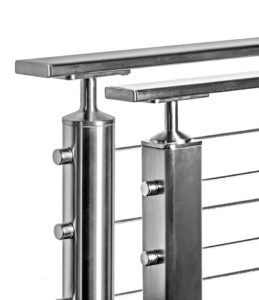
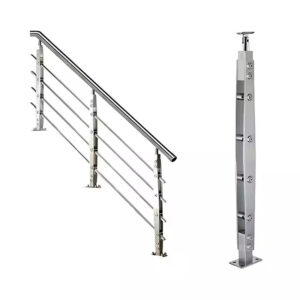
Balcony hardware is where grade decisions are most likely to be made inconsistently across a single assembly, and where that inconsistency creates the most concentrated risk. The decision rule that applies here is straightforward in principle but frequently violated in practice: if any component in the system requires 316 based on the exposure classification, the entire system should be specified in 316.
Mixing grades — 316 cables with 304 posts, or 316 clamps with 304 mounting brackets — introduces galvanic interaction between dissimilar alloys in contact, which accelerates corrosion at the interface and at the lower-alloy component. The weaker material corrodes faster than it would in isolation, and the failure often appears at a structural connection point rather than a surface that is easy to inspect. This is not a guaranteed outcome in every mixed installation under all conditions, but it is a defensible reason to reject mixed-grade proposals when the exposure environment is aggressive. When 316 is warranted anywhere in the assembly, accepting 304 elsewhere to reduce component cost trades a predictable upfront savings for an unpredictable failure location.
The specification completeness check that matters most at this stage is the finish definition. A proposal that lists “matte black” or “brushed” without specifying the substrate grade and the finish type — PVD over 316, for example, versus powder coat over 304 — leaves the procurement open to material substitution that may not surface until a defect investigation years later. Both can look identical at delivery; the difference becomes visible in service. Including substrate grade on every hardware line of the proposal is a basic defensibility standard, not a design preference.
| Decision / Rule | Action | Pourquoi c'est important |
|---|---|---|
| Coastal or poolside balcony | Use 316 or 316L for all components. | Prevents chloride corrosion and staining. |
| Sheltered inland balcony | 304 is sufficient. | Low chloride exposure; 25–40 year service life. |
| Any single component requires 316 | Use 316 for the entire system (posts, cables, fasteners). | Mixing 304 with 316 creates galvanic interaction and accelerates corrosion. |
| Specifying finish (e.g., matte black) | Include substrate grade (304/316) and finish type (PVD, powder coat). | A bid without grade is incomplete and risks material substitution. |
| Using 304 where 316 is warranted | Avoid this cost-cutting mistake. | Tea staining at 2–3 years, pitting at 4–6 years, structural concern at fasteners by 8–12 years. |
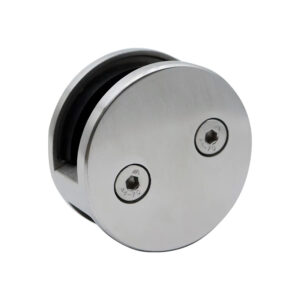
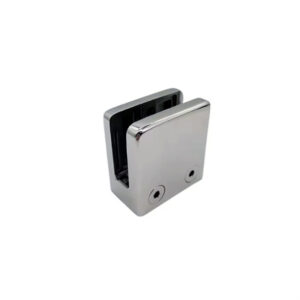
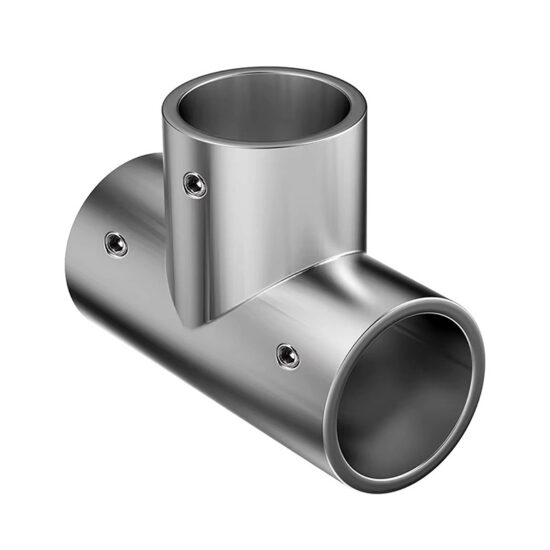
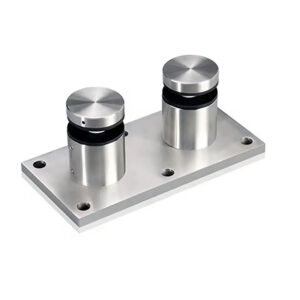
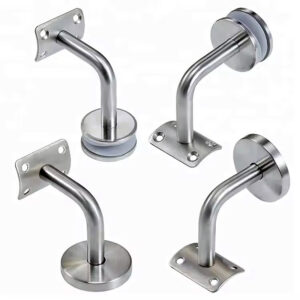
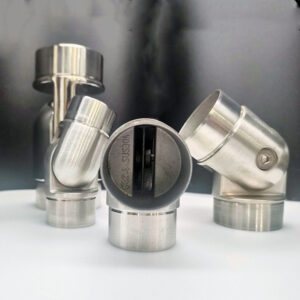
For clamp and connector hardware where both 304 and 316 options are stocked — such as round glass clamps used across interior and exterior assemblies — confirming grade consistency across all components before issuing the order is the last practical point at which a mixed-grade error is easy to catch and correct.
The practical conclusion of this comparison is that the grade decision is not primarily a materials question — it is a site classification question. Once exposure is classified accurately, the correct grade usually follows without ambiguity, and the cost difference between grades becomes a secondary variable rather than the primary driver. The difficulty is institutional: procurement sequences almost always present unit price before exposure analysis, which means the grade tends to be rationalized toward the budget rather than selected for the environment.
Before issuing specifications or accepting hardware submittals, confirm three things: that the exposure classification is documented and agreed upon, that the grade is consistent across all components in the assembly, and that finish specifications name both the substrate grade and the coating or polishing type. Those three checks are where most grade-related warranty disputes originate — not in the hardware itself, but in the specification gaps that allowed incorrect material to be supplied without detection.
Questions fréquemment posées
Q: Does the 304 vs 316 grade decision change if the exterior balcony has a roof or overhead cover that blocks direct rain?
A: No — a sheltered position reduces rain contact but does not eliminate chloride exposure from airborne salt. If the site is within consistent salt-air reach, hardware surfaces still accumulate chlorides between cleaning cycles regardless of overhead protection. Specifying 304 on a covered coastal balcony on the basis that it is “sheltered” is one of the most common misclassifications that generates surface complaints within the first few years of service.
Q: After the grade decision is made and the hardware is ordered, what should be confirmed before accepting the delivery?
A: Verify that the substrate grade matches the specification on every component line — not just the primary hardware pieces. Check that finish specifications on the delivery documentation name both the substrate grade and the coating or polishing type, since PVD over 316 and powder coat over 304 are visually indistinguishable at delivery. This is the last practical point where a mixed-grade substitution is easy to catch and correct before installation locks the error in place.
Q: Is there a scenario where 316 hardware still corrodes even when it was the correctly specified grade?
A: Yes. Grade selection is necessary but not sufficient — surface finish quality and design details carry equal weight in the performance outcome. Inadequately polished surfaces, weld scale left on fabricated assemblies, and design details that trap moisture or debris can initiate corrosion even on correctly specified 316 hardware. Specifying 316 does not compensate for poor fabrication or finishing practice in aggressive environments.
Q: When does the 15–30% price premium for 316 over 304 actually represent poor value rather than good insurance?
A: When the installation is genuinely in a controlled, chloride-free interior environment. In dry lobbies, office staircases, and similar spaces where no salt, pool chemicals, or aggressive cleaning agents reach the hardware, 304 performs reliably for decades and the premium adds no measurable performance benefit. The premium only pays back when deferred corrosion costs — replacement cycles, maintenance labor, warranty resolution — are realistic outcomes of under-specification for the exposure environment.
Q: If the project spec already calls for 316 clamps and fittings, is it acceptable to use 304 posts or structural brackets to reduce cost on those components?
A: No. Mixing grades within a single assembly introduces galvanic interaction between dissimilar alloys in contact, which accelerates corrosion at the interface and concentrates the failure risk at structural connection points rather than easily inspected surfaces. If 316 is warranted for any component based on exposure classification, the entire assembly should be specified in 316 — accepting 304 elsewhere to reduce component cost trades a predictable upfront saving for an unpredictable failure location.