Choisir un système de base pour garde-corps en verre sans avoir préalablement clarifié l’état du support et la responsabilité de l’étanchéité est l’un des moyens les plus sûrs de se retrouver avec des travaux de démolition une fois le revêtement de sol posé. La défaillance apparaît souvent lors de la mise en service ou après les premières fortes pluies : l’eau retenue dans une rainure encastrée sans drainage adéquat provoque la corrosion des fixations et, dans les climats froids, des dommages dus au gel-dégel qui compromettent l’ancrage. Aucun de ces problèmes ne peut être résolu sans entamer le revêtement de sol. La décision qui permet d’éviter cela n’est pas d’ordre esthétique : il s’agit de savoir si l’épaisseur du revêtement de sol, la responsabilité de l’étanchéité, l’orientation des solives et la procédure de remplacement du verre sont entièrement documentées avant que le système de canaux ne soit sélectionné ou commandé. Après avoir lu cet article, les prescripteurs et les entrepreneurs spécialisés dans les garde-corps seront mieux à même de juger quel système le support et le déroulement du projet peuvent réellement prendre en charge, et où la limite entre les corps de métier doit être définie avant le début de l’approvisionnement.
Les profilés en U et les semelles de base se distinguent par leur structure et leur accès
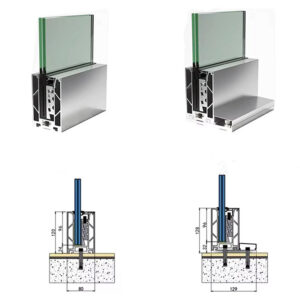
La différence structurelle entre ces deux systèmes ne réside pas seulement dans le fait que l’un est encastré et l’autre en saillie : elle tient au moment précis où chaque système impose au projet un ensemble de conditions relatives au support, au déroulement des travaux et à l’entretien, qu’il est difficile de modifier par la suite.
Un profilé en U encastré est intégré dans le support du sol ou de la terrasse, ce qui signifie que sa position doit être déterminée avant l’achèvement des travaux de finition du sol. Cet encastrement permet d’obtenir une ligne de sol plus épurée, sans qu’aucun élément de fixation ne soit visible, mais il nécessite également que le support soit de niveau sur toute la longueur du profilé. Les travaux de ponçage ou d’autonivellement nécessaires pour obtenir cette planéité entraînent des coûts de préparation souvent sous-estimés lors de la phase de conception. Si le support est irrégulier et que ces travaux sont omis, le profilé ne peut pas être aligné de manière homogène, et la profondeur d’encastrement du verre — c’est-à-dire la profondeur à laquelle chaque panneau est maintenu — devient inégale sur toute la longueur du profilé.
Une plinthe de surface se fixe directement sur le sol fini à l’aide de fixations mécaniques, et des cales mécaniques intégrées au profilé permettent un réglage précis une fois les panneaux de verre posés. Grâce à cette capacité d’ajustement, les systèmes de plinthes de surface peuvent s’adapter aux irrégularités du support qui empêcheraient la pose d’un profilé en U, et le coût de préparation est donc moindre. Le compromis réside dans la visibilité : le profilé de la plinthe dépasse du niveau du sol et est entièrement visible à la base de chaque panneau de verre.
La vitesse d’installation reflète ces différences. La plinthe permet généralement de poser 4 à 6 panneaux par heure dans des conditions de chantier normales, tandis que le profilé en U se situe plutôt autour de 3 à 4 panneaux par heure en raison des contraintes d’alignement et du temps de prise du mastic. Ces chiffres reflètent les conditions propres au projet plutôt que des cadences de production garanties, mais leurs implications en termes de planification et de coûts vont dans le même sens : les installations avec profilé en U prennent plus de temps à mettre en place et ne peuvent plus être ajustées une fois que le mastic a pris.
| Aspect | Profilé en U | Semelle de base |
|---|---|---|
| Exigence relative à la planéité du substrat | Nécessite un support relativement plat sur toute la longueur ; les surfaces irrégulières peuvent empêcher son utilisation | S'adapte aux surfaces irrégulières grâce à des cales mécaniques permettant un réglage précis |
| Coût/faisabilité de la préparation du substrat | Plus importante si le support est irrégulier ; peut nécessiter un ponçage ou un nivellement | Inférieur ; le réglage à l'aide de cales réduit le travail de préparation |
| Vitesse d'installation | 3 à 4 panneaux par heure (temps d'alignement et de prise du mastic) | 4 à 6 panneaux par heure |
Concrètement, cela signifie que la tolérance du support de la semelle de base constitue un véritable atout en termes de faisabilité pour les chantiers où le revêtement de sol est déjà posé ou lorsqu’il n’est pas possible d’obtenir une planéité homogène de manière rentable. L’exigence de planéité du profilé en U est un critère de conception, et non un seuil de conformité ; toutefois, le non-respect de cette exigence lors de la pose entraîne des problèmes d’alignement qui ne peuvent être résolus de manière satisfaisante une fois le sol terminé.
Responsabilités en matière d'étanchéité des canaux encastrés
La pose d’un profilé en U encastré pose un problème d’étanchéité que la plupart des équipes de projet traitent de manière incorrecte — voire ne traitent pas du tout. Le profilé forme un point bas continu à la base de la rangée de vitrages, et si aucun système de drainage n’est explicitement prévu dans ce renfoncement, l’eau s’accumule. Dans les climats froids, l’eau accumulée subit des cycles de gel-dégel qui peuvent endommager l’ancrage et accélérer la corrosion des ferrures. Dans les environnements humides ou côtiers, l’eau stagnante dans un profilé dépourvu d’orifices d’évacuation dégrade le mastic d’étanchéité et, à terme, compromet la résistance à la corrosion même des composants en acier inoxydable de nuance 316.
Les exigences relatives à la conception du système de drainage soulèvent plusieurs problèmes de coordination qui doivent être résolus avant le début des travaux de bétonnage ou de finition du sol. La profondeur des rainures doit être précisée suffisamment tôt pour que les maçons puissent réaliser correctement le coffrage ou le perçage des rainures. L’orientation des solives est également importante : les rainures parallèles aux solives de plancher s’intègrent généralement mieux au tracé du système de drainage, tandis que celles perpendiculaires aux solives peuvent créer des conflits structurels et de drainage nécessitant des précisions supplémentaires. Il ne s’agit pas d’une interdiction générale des installations perpendiculaires, mais d’un risque de coordination qui doit être mis en évidence lors de l’examen des aspects structurels et de drainage avant que l’ordre des travaux ne soit définitivement fixé.
L'erreur commise ici consiste à considérer le profilé en U comme un élément de quincaillerie de garde-corps, alors qu'il s'agit, d'un point de vue fonctionnel, d'un élément architectural du plancher devant assurer l'évacuation des eaux. Si la responsabilité de l'étanchéité est confiée au sous-traitant chargé des garde-corps, mais que les détails des renfoncements et les voies d'évacuation relèvent du domaine de compétence du corps de métier chargé du plancher, aucune des deux parties n'assume la responsabilité de l'espace qui les sépare — et c'est précisément dans cet espace que l'eau s'infiltre.
| Considérations relatives à l'étanchéité | Risques en cas de négligence ou d'erreur | Points à clarifier/confirmer |
|---|---|---|
| Orifices de drainage / conception du système de drainage | L'eau retenue provoque la corrosion des éléments métalliques et des dommages dus au gel-dégel dans les climats froids | Vérifier la présence d'un orifice d'évacuation et la conception du circuit de drainage |
| Profondeur de l'encastrement et orientation des solives | Problèmes de drainage ou conflits structurels si le canal est perpendiculaire aux solives | Préciser les exigences relatives à la profondeur des rainures et éviter d'orienter les solives perpendiculairement, sauf si cela est possible |
| Détermination précoce de la profondeur de la rainure | Un désalignement par rapport au sol fini peut compromettre l'étanchéité et entraîner des travaux de réfection coûteux au niveau des joints d'étanchéité. | Vérifier que la profondeur de l'encastrement est précisée et coordonnée avec les corps de métier chargés du sol dès le début des travaux |
L'absence de cette coordination n'est pas un simple détail mineur à régler. Elle implique, au minimum, une remise en état des joints d'étanchéité une fois le sol posé et, au pire, la démolition du revêtement de sol déjà posé pour corriger le drainage ou la profondeur d'encastrement. Une telle situation est pratiquement irrémédiable dans le cadre d'un calendrier de projet normal ; c'est pourquoi la responsabilité de l'étanchéité et les détails relatifs aux renfoncements doivent figurer dans le cahier des charges avant la commande du système — et non après l'achat du caniveau.
Avantages du réglage et du remplacement des sabots de base de surface
La différence en termes d’entretien à long terme entre ces deux systèmes est plus importante que ne le reconnaissent la plupart des cahiers des charges. La conception à montage en surface de Base Shoe permet aux installateurs et aux équipes de maintenance d’accéder directement à chaque panneau et à chaque fixation sans perturber les panneaux adjacents ni les surfaces finies. Un panneau de verre endommagé ou défectueux peut être retiré en desserrant les vis de fixation qui le maintiennent dans le profilé et en le faisant glisser vers l’extérieur — les panneaux voisins restent en place et le profilé lui-même n’est pas endommagé.
Le remplacement des panneaux à profilé en U suit une procédure différente. Les panneaux étant maintenus en place par du mastic à l’intérieur du profilé encastré, leur retrait nécessite généralement de découper le mastic le long des bords du panneau et, selon la géométrie du profilé et l’encastrement du vitrage, peut nécessiter de décaler les panneaux adjacents pour créer un espace libre. Le temps de main-d’œuvre nécessaire au remplacement de chaque panneau est plus important, les perturbations causées aux surfaces finies environnantes sont plus importantes, et les travaux de réparation eux-mêmes réexposent l’interface d’étanchéité à la base du profilé.
La possibilité de réglage après la pose est un autre critère important à prendre en compte lors de l’installation, et pas seulement lors de l’entretien ultérieur. Les cales mécaniques intégrées au profilé de base permettent de mettre à niveau et d’ajuster avec précision une fois le verre posé, ce qui s’avère utile sur des supports présentant de légères irrégularités ou lorsque le revêtement de sol entraîne de légères variations de hauteur de surface. Le profilé en U offre une capacité de réglage post-durcissement limitée : une fois le mastic durci, la position du verre est fixe. Cette différence ne fait pas du profilé en U un mauvais système, mais elle implique que les tolérances de pose doivent être plus strictes et que la préparation du support doit être plus minutieuse avant le début de la pose du verre.
| Scénario d'ajustement/de remplacement | Semelle de base | Profilé en U |
|---|---|---|
| Démontage d'un panneau individuel | Desserrez les vis de fixation et retirez le panneau ; les panneaux adjacents restent en place | Nécessite souvent de découper le mastic d'étanchéité et de démonter les panneaux adjacents ; cela implique davantage de main-d'œuvre et de perturbations. |
| Mise à niveau après l'installation | Les cales mécaniques permettent un réglage précis une fois le verre posé, afin de compenser les irrégularités du support. | Réglage limité ; généralement figé une fois que le mastic a durci |
| Accès global pour les réparations | Une réparation simplifiée permet de réduire les temps d'arrêt et les coûts de main-d'œuvre | Difficulté et coût de réparation plus élevés en raison d'un ancrage fixe |
Il convient de mettre en balance les implications en matière d’entretien et la préférence esthétique pour un profilé encastré, en particulier dans le cadre de projets commerciaux où le remplacement du vitrage est prévisible et où le coût des temps d’arrêt constitue un facteur réel à prendre en compte. La facilité d’accès pour la réparation de la plinthe constitue un avantage pratique dont la valeur s’accroît tout au long de la durée de vie du système — mais il ne s’agit pas d’un argument de supériorité universel. Pour les projets où l’encastrement au niveau du sol est une exigence et où l’accès pour l’entretien a été prévu, le profilé en U reste un système viable et largement utilisé.
Pour les projets où la ligne de sol dégagée et la facilité de remplacement constituent toutes deux des priorités, il convient d’examiner Systèmes de garde-corps en verre et en acier inoxydable : sans cadre ou à montants afin de disposer d'un champ de sélection plus large avant que le choix du système de base ne soit définitivement arrêté.
Limite entre les travaux au sol et la pose de garde-corps
Le problème de coordination lié aux profilés en U encastrés n’est pas d’ordre technique, mais contractuel et séquentiel. Lorsqu’un profilé doit être encastré dans le béton ou posé sur un lit de mortier avant la pose du revêtement de sol, cette opération relève de la responsabilité des corps de métier chargés du béton ou du revêtement de sol, et non de celle de l’entrepreneur chargé des garde-corps. Si le sous-traitant chargé des garde-corps n’est engagé qu’après le coulage de la dalle et une fois la pose du revêtement de sol programmée, il est déjà trop tard pour procéder à un encastrement correct.
Cette jonction est la cause la plus fréquente de retouches dans les projets impliquant des profilés en U. Le fournisseur de garde-corps fournit le profilé, l’installateur s’occupe de sa mise en place, mais aucune des deux parties n’assume la coordination avec les corps de métier chargés du sol, qui détermine si l’évidement est correctement formé, à la bonne profondeur et avec un chemin d’évacuation adéquat. Le profilé en U arrive sur le chantier, aucun évidement n’existe dans la dalle, et le déroulement des opérations est compromis. Ce résultat n’est pas un défaut du produit — il s’agit d’un défaut d’attribution des responsabilités qui aurait pu être évité en identifiant le profilé en U comme faisant partie de la séquence des travaux architecturaux de la dalle dès la phase d’élaboration du projet.
La plinthe de surface permet d’éviter presque entièrement ce problème. Comme elle se fixe sur la surface du sol fini, elle peut être posée une fois tous les travaux de revêtement de sol terminés. Le champ d’intervention de l’entrepreneur chargé des garde-corps commence là où celui de l’entrepreneur chargé du revêtement de sol s’achève, et la délimitation entre les corps de métier est sans ambiguïté. Cela ne signifie pas que la plinthe de surface est toujours plus facile à poser, mais cela signifie que le risque lié à la coordination est nettement moindre et que la dépendance du calendrier vis-à-vis des corps de métier chargés du revêtement de sol est éliminée.
| Aspect de coordination | Profilé en U (encastré) | Socle (montage en saillie) |
|---|---|---|
| Calendrier d'installation | À encastrer lors de la pose du sol ; doit être mis en place avant le coulage du béton ou la finition du sol | Installé une fois les travaux de sol terminés ; montage en saillie |
| Responsabilité commerciale | Fait partie des travaux de sol en architecture ; nécessite une coordination avec les corps de métier spécialisés dans le béton ou les revêtements de sol | Fourniture de matériel pour garde-corps ; généralement installé par un entrepreneur spécialisé de manière indépendante |
| Risque en cas de limites floues | Conflits de planning et travaux supplémentaires si la responsabilité n'est pas attribuée suffisamment tôt à l'entrepreneur chargé du revêtement de sol | Risque minime ; séparation claire entre les corps de métier chargés de la pose des sols et ceux chargés de la pose des garde-corps |
La vérification pratique est simple : si le calendrier du projet ne désigne pas clairement un responsable de la mise en place des profilés en U, chargé de se coordonner avec les corps de métier chargés de la pose du plancher avant la coulée du béton, cela signifie que le système est prescrit sans qu’un plan de mise en œuvre viable ait été défini. C’est à ce moment-là qu’il faut soit clarifier la répartition des tâches, soit opter pour un socle de fondation.
Déclencheur de sélection une fois que le substrat et le drainage ont été consignés
Aucun des deux systèmes ne doit être choisi uniquement pour des raisons esthétiques, et les conditions qui déterminent la faisabilité dépendent tellement du support qu'une préférence par défaut pour l'un ou l'autre système constitue un risque pour la planification. Les contrôles de vérification du support doivent être effectués avant de passer la commande.
Pour les semelles d’ancrage, les seuils structurels pertinents concernent l’épaisseur du béton et la profondeur d’ancrage. D’après les pratiques de terrain — et non pas en tant que minimum universel imposé par la réglementation —, la mise en place de semelles d’ancrage nécessite généralement au moins 4 pouces de béton structurel, les ancrages devant être enfoncés d’au moins 3 pouces dans ce substrat. Les revêtements minces, le béton léger ou les surfaces de terrasse composites peuvent ne pas offrir une profondeur d’ancrage suffisante ; ces conditions doivent donc être vérifiées par rapport aux plans structurels réels, et non pas supposées. Les exigences structurelles locales doivent être vérifiées de manière indépendante. Pour les projets sur des terrasses en bois ou en composite, la semelle de base constitue généralement le système le plus approprié, car elle peut être calée pour s’adapter aux mouvements du support et répartit la charge d’une manière adaptée à la construction de la terrasse ; le profilé en U n’est pas bien adapté aux supports en bois, où les mouvements saisonniers peuvent compromettre la continuité du mastic d’étanchéité et l’alignement du profilé.
Pour les profilés en U, les éléments essentiels à vérifier avant la sélection comprennent les cotes de la structure du plancher, la confirmation de la responsabilité en matière d'étanchéité et le parcours prévu pour le remplacement du vitrage. Sur les longues portées, il est indispensable d'intégrer des joints de dilatation afin de compenser les mouvements thermiques ; leur absence peut entraîner la rupture du vitrage lorsque le profilé se dilate et se contracte au fil des saisons. Les calculs de résistance aux charges latérales, en fonction des caractéristiques techniques des panneaux de vitrage, peuvent être effectués à l'aide de EN 16612:2019 à titre de référence en matière de cadre d'essai, bien que le choix du canal dépende en réalité des conditions du substrat et du drainage, et non directement de cette norme.
Les projets de rénovation aboutissent à un choix évident : la semelle de base s'impose comme solution par défaut. Le carottage pour l'ancrage de profilés sur une structure existante est rarement réalisable compte tenu des contraintes budgétaires et de calendrier, et la méthode de montage en surface de la semelle de base permet d'éviter totalement toute démolition. Utilisations des profilés en U sur les terrasses de toit exposées à des vents violents impliquent des détails spécifiques qui vont au-delà de la logique de sélection générale décrite ici et doivent être examinés séparément lorsque ces conditions de chantier s'appliquent.
| État du site / Contraintes | Système recommandé | Élément clé à prendre en compte ou contrainte |
|---|---|---|
| Épaisseur du béton < 4 pouces ou profondeur d'ancrage < 3 pouces | Semelle non adaptée | Vérifier l'épaisseur du béton de structure ; l'utilisation d'un profilé en U peut être envisagée s'il est possible de réaliser un évidement. |
| Support de terrasse en bois ou en matériau composite | Semelle de base recommandée | Le profilé en U n'est pas recommandé en raison des risques de déplacement ; la semelle de base peut être calée et permet de répartir la charge |
| Surface exposée à l'eau | Les deux sont possibles, mais les compromis diffèrent | Le profilé en U doit être muni d'orifices d'évacuation pour éviter que l'eau ne stagne ; la semelle de base assure un meilleur drainage mais retient les débris dans le profilé |
| Projet de modernisation | Le « base shoe » fait l'unanimité | Pas de carottage ni d'ancrage ; se fixe sur les supports existants ; évite les travaux de démolition |
| Les courses de longue durée nécessitant une adaptation aux variations de température | Le profilé en U nécessite des joints de dilatation | L'absence de joints de dilatation peut entraîner le bris du verre ; la semelle de base est généralement moins sensible à ce risque, mais il convient de vérifier |
| Exhaustivité de la documentation (structure du plancher, étanchéité, procédure de remplacement des vitrages) | Profilé en U uniquement si les trois éléments sont entièrement documentés | L'absence de documentation entraîne des travaux de mise en conformité coûteux ; dans le cas contraire, optez pour le socle de base ou reportez le choix. |
Avant de choisir un système, il convient de vérifier si trois documents sont bien disponibles : la confirmation de l’épaisseur du revêtement de sol ou de la sous-couche, la désignation d’un responsable de l’étanchéité au niveau de l’interface avec le profilé en U, et la définition d’un accès permettant le remplacement du vitrage. Si l’un de ces trois éléments fait défaut, le choix du profilé en U doit être reporté. Il ne s’agit pas d’une préférence conservatrice en faveur de la semelle de base, mais bien d’une prise en compte du coût que représenterait la résolution de ce problème une fois le sol achevé. Esang’s profilés en U en acier inoxydable et canaux pour chaussures de base en verre sont tous deux disponibles en tant que composants d'approvisionnement, mais le composant ne permet pas de déterminer quelles sont les conditions de coordination et de documentation qui permettent de savoir lequel le projet peut réellement intégrer.
La vérification la plus fiable avant l’achat consiste à s’assurer que la documentation relative au support et à la séquence d’exécution est suffisamment complète pour s’engager sur l’un ou l’autre système sans risque de reprise. Le profilé de base offre une solution par défaut présentant moins de risques dans la plupart des situations de rénovation, sur les supports en bois et en composite, ainsi que dans les projets où la délimitation des corps de métier entre les travaux de sol et ceux de garde-corps n’a pas été clairement définie. Le profilé en U est approprié lorsque l’épaisseur du revêtement de sol, la conception du drainage et le parcours de remplacement du vitrage sont entièrement documentés et attribués — et lorsque le support en béton peut supporter correctement l’ancrage dans le cadre de la séquence des travaux de sol.
Avant de finaliser l'un ou l'autre du cahier des charges, vérifiez l'épaisseur du béton ou le type de construction de la dalle, déterminez à qui incombe la responsabilité de l'étanchéité à la base de la baie vitrée et consignez par écrit la méthode prévue pour le remplacement futur des panneaux. Ces trois éléments permettront de faire un choix plus fiable pour la plupart des projets que n'importe quelle préférence esthétique.
Questions fréquemment posées
Q : Peut-on prévoir un système à profilés en U pour une terrasse de toit sur laquelle une membrane d'étanchéité est déjà posée ?
R : Uniquement si la membrane peut être percée puis refermée dans le cadre des prestations de l’entrepreneur en étanchéité avant la pose du revêtement de sol — ce qui est rarement faisable sur un toit achevé sans entraîner des problèmes de garantie et de responsabilité concernant la membrane existante. Le renfoncement et le chemin d’évacuation doivent être réalisés avant la pose de l’étanchéité, et non après. Sur un toit achevé où la membrane est déjà en place, la plinthe de base constitue la solution pratique par défaut, car elle se fixe à la surface sans nécessiter la démolition de la couche d’étanchéité.
Q : Une fois qu'il a été vérifié que la profondeur du support en béton est d'au moins 4 pouces, y a-t-il d'autres éléments qui pourraient encore empêcher le choix d'une semelle de fondation ?
R : Oui — la résistance à la compression du béton et l’état de la surface de la dalle sont tous deux déterminants, quelle que soit la profondeur. Une dalle qui respecte le seuil de profondeur de 4 pouces mais qui est détériorée, rapiécée à l’aide d’un mince revêtement collé ou constituée d’un mélange de béton léger peut ne pas offrir la résistance à l’arrachement des ancrages requise par le système. La profondeur du support est une condition nécessaire, mais non suffisante. La capacité réelle des ancrages doit être confirmée par rapport aux plans de structure et, si nécessaire, vérifiée par des essais d’arrachement avant que la disposition des fixations ne soit définitive.
Q : En quoi la différence de coût de main-d'œuvre entre le remplacement d'un profilé en U et celui d'un panneau de socle influe-t-elle sur le coût total sur toute la durée de vie d'un bâtiment ?
R : Pour les projets commerciaux où le remplacement du vitrage est une opération d’entretien prévisible — halls d’entrée à forte fréquentation, garde-corps dans le secteur de l’hôtellerie ou toute installation exposée à un risque de choc —, le coût de remplacement par panneau, bien que moins élevé pour les profilés de base, s’accumule de manière significative au fil du temps. Le démontage des panneaux à profilé en U implique la découpe du mastic, une perturbation potentielle des panneaux adjacents et la réexposition de l’interface d’étanchéité, ce qui ajoute à chaque fois des coûts de main-d’œuvre et de remise en état. Le remplacement d’un profilé de base se limite quant à lui essentiellement à la main-d’œuvre nécessaire pour desserrer les fixations et faire glisser le panneau vers l’extérieur. La question de savoir si cette différence justifie de privilégier le profilé de base plutôt que le profilé en U dépend de la fréquence prévue des remplacements, mais l’écart de coûts d’entretien s’accentue pour tout projet où le profilé encastré nécessite également une remise en état de la surface du sol après chaque réparation.
Q : L'utilisation d'un profilé en U encastré est-elle parfois appropriée dans le cadre d'un projet commercial intérieur où l'étanchéité et le drainage ne constituent pas un problème ?
R : Oui, et les environnements intérieurs secs comptent parmi les cas d’utilisation les plus simples pour les profilés en U, car les contraintes liées à la conception du drainage disparaissent en grande partie. Les autres contraintes de conception restent toutefois applicables : le support doit être de niveau sur toute la longueur, l’épaisseur du revêtement de sol doit tenir compte de la profondeur de l’encastrement, les limites de l’encastrement doivent être définies avant la coulée du béton, et des joints de dilatation sont toujours nécessaires sur les longues portées pour absorber les mouvements thermiques liés aux cycles de chauffage, ventilation et climatisation. Mais le risque de dommages liés au gel-dégel et les exigences de conception des trous d’évacuation, qui dominent les spécifications pour l’extérieur, ne s’appliquent pas, ce qui rend les installations de profilés en U en intérieur plus simples à détailler et à réaliser correctement.
Q : Où exactement la responsabilité de la mise en place des profilés en U doit-elle être attribuée dans les documents contractuels afin d'éviter le décalage dans le périmètre décrit ?
R : Il doit être attribué à un corps de métier spécifique dans la section du cahier des charges régissant la mise en œuvre du plancher — généralement le corps de métier du béton ou celui du carrelage et de la pierre, selon la finition — et non dans le cahier des charges relatif aux éléments de fixation des garde-corps. Le profilé en U doit être répertorié comme un élément fourni par l’entrepreneur, plus précisément par l’entrepreneur chargé des garde-corps, dans le cadre du cahier des charges de ce corps de métier. Il incombe à ce dernier de fournir les dimensions du profilé et de son encastrement en temps utile pour que le corps de métier chargé du sol puisse réaliser l’évidement avant la coulée du béton ou la pose des lits de mortier. Si cette exigence de coordination ne figure pas dans le cahier des charges du projet ni dans le calendrier de pré-construction, aucun des deux corps de métier ne s’en chargera, et le vide dans le périmètre des travaux, source de retouches, existera par défaut.