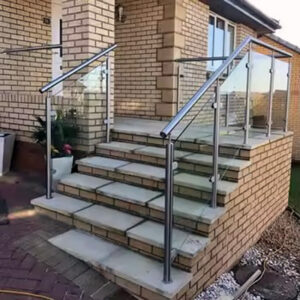
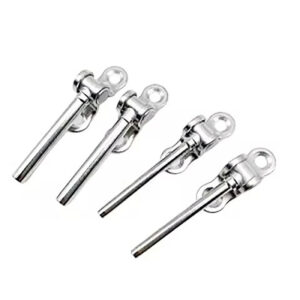
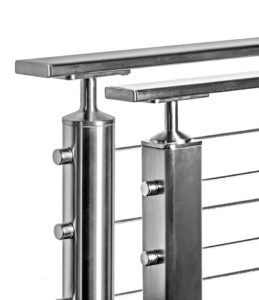
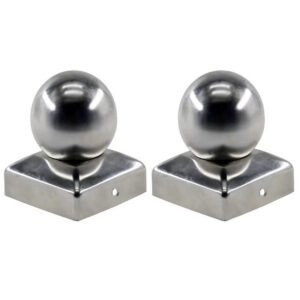
Le verre percé ne pardonne pas les erreurs de conception en amont. Lorsque les axes des embouts sont considérés comme un détail de fabrication plutôt que comme un choix de conception, le désalignement qu’ils engendrent se retrouve déjà figé dans le verre une fois sur le chantier — et aucun ajustement des ferrures ne permet de corriger un gabarit de perçage qui ne correspond pas aux positions des montants installés. Le coût concret se traduit par le remplacement des panneaux percés, un retard dans le calendrier et la frustration croissante liée à un ensemble qui semble hors plan, même lorsque chaque composant individuel respecte sa propre tolérance. Pour éviter ce résultat, il faut définir les axes, les distances par rapport aux bords, l’ordre des panneaux et le contenu des plans avant le lancement de la fabrication — et non après la commande du verre.
L'emplacement des robinets détermine le tracé de mise à niveau de l'installateur
Le placement des raccords est une question d'ordre de pose, et non de choix de matériel. Avant de fixer le moindre poteau, l’installateur a besoin d’un plan de nivellement clair : un point de départ défini, une largeur de panneau connue, des distances par rapport aux bords confirmées, ainsi que des espaces prévisibles aux angles et aux extrémités. Lorsque ces paramètres figurent sur le plan d’implantation, l’installateur peut travailler efficacement tout au long du parcours. Dans le cas contraire, chaque panneau devient un problème indépendant à résoudre sur place, et le temps perdu en ajustements répétés s’accumule à chaque position suivante.
La fixation bidirectionnelle et la possibilité de réglage des entretoises dans les systèmes de fixation à emboîtement viennent à l’appui de ce principe en offrant à l’installateur une marge de correction limitée lors de la mise à niveau. Cette possibilité de réglage ne remplace pas un tracé planifié : son intérêt réside dans la capacité à absorber les légers écarts de position qui subsistent après un réglage minutieux, et non à compenser un tracé qui n’a jamais été finalisé. Considérer la possibilité de réglage comme un filet de sécurité pour la planification plutôt que comme une marge de tolérance est une erreur récurrente sur les longues portées : les équipes partent du principe que les fixations corrigeront tout ce que le plan n’a pas permis de résoudre, et se rendent compte lors de l’installation que la plage de réglage est épuisée bien avant que les panneaux ne soient alignés.
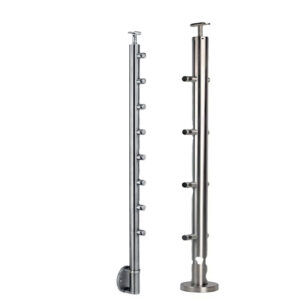
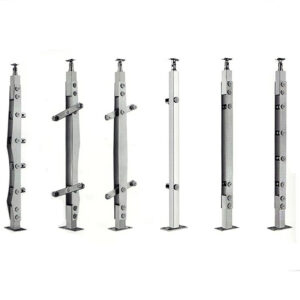
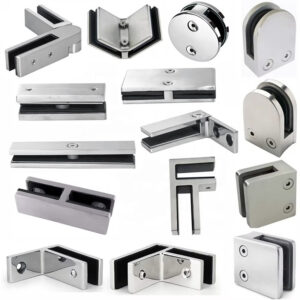
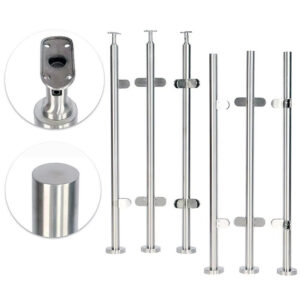
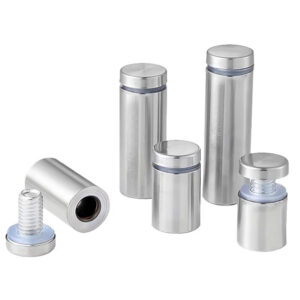
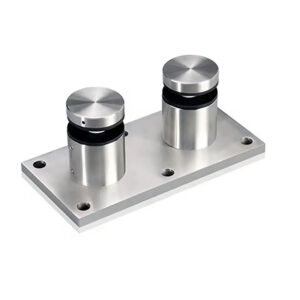
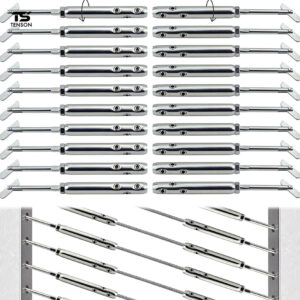
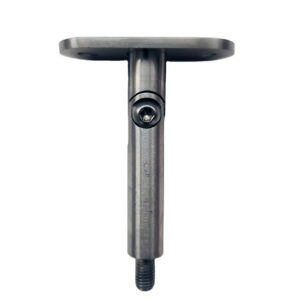
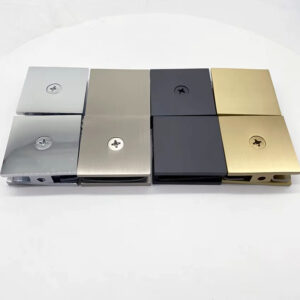
Embouts en verre pour montage en surface Conçues avec un système de fixation bidirectionnel, elles permettent une correction progressive de l'alignement pendant la mise à niveau ; toutefois, cette méthode est particulièrement efficace lorsque les axes des embouts ont déjà été définis avec précision sur le plan.
Lignes médianes, distances par rapport aux bords et ordre des panneaux
L'espacement entre les axes et la largeur des panneaux sont interdépendants. La largeur des panneaux détermine la distance d'axe à axe entre les montants, et ces deux paramètres sont soumis à des limites qui varient en fonction du type de verre, du support et des exigences réglementaires applicables. Dans le cadre des conditions de charge des garde-corps prévues par l'IBC, l'espacement entre les montants est généralement limité à 6 pieds au maximum ; la largeur des panneaux est généralement maintenue à 4 pieds ou moins, la limite précise étant déterminée par les spécifications du verre et la réglementation en vigueur sur le lieu du projet. Aucune de ces valeurs n’est universelle pour tous les contextes d’installation, mais ensemble, elles définissent les limites extérieures de la trame de disposition avant le début de la mise en place des panneaux.
Les décisions relatives à l’enchaînement des panneaux découlent de ces seuils. Une fois l’espacement maximal entre les axes défini, le nombre de panneaux sur une ligne est pratiquement déterminé, et toute configuration d’angle ou d’extrémité qui ne se divise pas de manière égale dans ce module crée un panneau d’extrémité nécessitant son propre calcul de distance par rapport au bord. Laisser ce calcul à la charge de l’installateur signifie qu’il est résolu sur le terrain, souvent en répartissant visuellement un espace plutôt que de manière dimensionnelle — ce qui introduit une incohérence à l’endroit le plus visible de la ligne.
| Paramètres | Limite maximale autorisée | Facteur déterminant |
|---|---|---|
| Largeur du panneau de verre | 4 pieds | Type de vitrage et code de la construction applicable |
| Espacement des poteaux (spigot) | 6 pieds | Charge admissible de la rambarde IBC (200 lb) |
L'ajout de raccords pour respecter la limite d'espacement améliore la répartition de la charge, mais alourdit le travail de mise en place, multiplie les points de fixation visibles et augmente le nombre de points qui doivent chacun se situer dans les limites de tolérance acceptables. Il convient de prendre en compte ce compromis dès la phase de révision des plans, plutôt que de le découvrir au moment de l'installation.
Tolérance sur le terrain sur une longue section de poteaux
Un décalage d'une fraction de pouce au niveau d'une seule plaque de base peut être corrigé au niveau de ce montant. Sur une longue portée, ce même écart, répété à chaque montant, s'accumule pour former un décalage cumulé qui dépasse ce que la capacité de réglage des embouts peut compenser. C'est là le principal risque d'alignement dans les portées étendues montées sur montants : les petits écarts ne s'annulent pas, ils s'additionnent.
Les mesures sur site pour les panneaux de verre sur mesure doivent être prises avec une précision de 1/4 de pouce afin de garantir que les panneaux s'adaptent au gabarit de perçage correspondant à leurs positions d'installation. Ce chiffre reflète la précision pratique requise pour éviter tout désalignement ; il ne s'agit pas d'une tolérance réglementaire formellement codifiée, mais il sert de seuil opérationnel pour déterminer si une série est prête pour la commande du verre. Si les conditions sur site ne permettent pas d'obtenir de manière fiable des mesures dans cette fourchette, la fabrication du verre ne doit pas avoir lieu.
Pour les séries de grande envergure, cela implique que le processus de mesure devient lui-même une tâche de séquençage. Mesurer à partir du point de départ et vérifier la position de chaque raccord avant de valider la commande complète des panneaux constitue une approche plus justifiable que de mesurer toutes les positions en une seule fois et de livrer le verre en un seul lot. Un décalage apparaissant en cours de série, après la pose des premiers panneaux, peut encore être corrigé sans remplacement complet si les panneaux restants n’ont pas encore été percés.
Charge d'ajustement en cas de déplacement des plaques de base
La stabilité des plaques de base relève d’un problème de support avant même de devenir un problème matériel. Le support présent à chaque emplacement de poteau — ossature en bois, béton, acier de construction — détermine la méthode d’ancrage appropriée, les renforts éventuellement nécessaires, ainsi que le degré de fiabilité sur lequel l’installateur peut compter pour le nivellement. Lorsque l’état du support n’est pas vérifié avant le début de l’installation, les plaques de base se déplacent, et un décalage au niveau d’un poteau se répercute sur tous les espaces entre les panneaux suivants.
Les éléments de fixation fournis par le client introduisent un risque supplémentaire. Lorsque les configurations des vis et des boulons sont déterminées par l’installateur ou le client en fonction de la surface du sol plutôt que d’être spécifiées sur le plan, les éléments de fixation à chaque emplacement de poteau peuvent présenter des comportements de maintien différents, même s’ils semblent équivalents sur le plan dimensionnel. Cette variation n’entraîne pas toujours un mouvement visible immédiatement — elle peut ne devenir apparente que lorsqu’une charge latérale est appliquée, ou lorsque les variations de température provoquent un léger décalage de position que la plage de réglage de l’embout ne peut plus compenser.
| Facteur | Qu'est-ce qui détermine la stabilité ? | Risque en l'absence de mesures correctives |
|---|---|---|
| État du substrat aux emplacements des poteaux | Support en bois, en béton ou en acier – vérification des renforts nécessaires | La plaque de base peut se décaler, ce qui multiplie les erreurs d'alignement tout au long de la série |
| Matériel de fixation de la base fourni par le client | Vis, boulons, tirants d'ancrage – en fonction de la surface du sol | Une incompatibilité matérielle entraîne un décalage, ce qui alourdit la charge de travail liée aux ajustements et augmente le risque de devoir refaire le travail. |
Les répercussions du décalage de la plaque de base ne se limitent pas à ce montant. Chaque déplacement modifie la dimension effective de l'interstice pour le panneau adjacent, ce qui modifie la distance par rapport au bord au niveau de la languette suivante, ce qui — si le panneau a déjà été percé — oblige à choisir entre accepter un interstice hors tolérance, caler le panneau de manière à ce que les fixations ne puissent pas le soutenir correctement, ou remplacer le panneau. Vérifier l'état du support et préciser les fixations sur le plan constitue le point d'intervention qui permet d'éviter cette cascade de problèmes, et non l'ajustement des fixations sur le chantier.
Véreg vf 'edn ctéetaiç ouueiliaregairdnl a tpdve le agrre
La publication des plans d'exécution avant que les conditions d'installation ne soient entièrement définies fait peser la responsabilité des choix de conception sur l'installateur, qui doit alors interpréter des plans ambigus sous la pression du chantier. Le résultat est prévisible : les poteaux sont mis en place sur la base d'hypothèses qui entrent en conflit avec l'état réel de la barrière de sécurité, l'épaisseur du verre ou la géométrie de la rampe supérieure, et ce conflit n'apparaît qu'après le perçage.
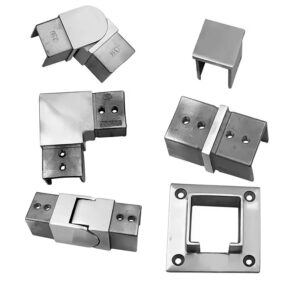
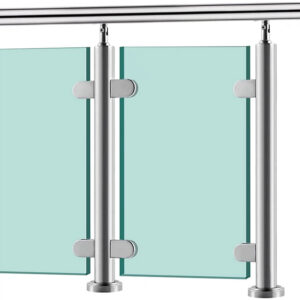
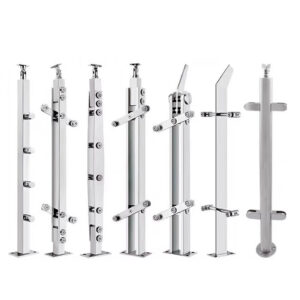
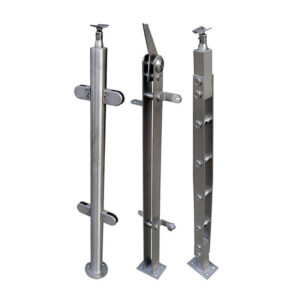
Pour adaptateurs pour fixation sur verre En ce qui concerne les ferrures à emboîtement, le plan doit préciser quatre éléments avant le début de la fabrication : l'emplacement de la protection et la hauteur requise pour chaque situation (escalier, balcon, belvédère) ; les caractéristiques du verre, notamment son épaisseur, son type et toute teinte ou finition ; la disposition des panneaux avec leurs largeurs approximatives et les détails des angles ou des extrémités ; ainsi que le plan de la main courante, y compris le profil de la rampe supérieure ou le tracé et les retours en cas de fixation murale. Chacun de ces éléments influe sur la position des embouts ou la hauteur des montants d’une manière qui ne peut être corrigée une fois le verre percé.
| Élément à confirmer | Pourquoi est-ce important pour l'alignement des robinets ? | Risque en cas d'absence de résolution |
|---|---|---|
| Emplacements des postes de surveillance (escaliers, balcon, belvédère) et hauteurs requises | Les différentes conditions de protection ont une incidence directe sur l'emplacement des raccords | Une retouche sur place ou un mauvais alignement peuvent s'avérer nécessaires |
| Épaisseur et type de verre (trempé ou feuilleté) et teinte ou finition dépolie | Le poids et la résistance du verre ont une incidence sur la conception des tenons et l'ajustement des panneaux | Des écarts dimensionnels peuvent survenir après le perçage |
| Dimensions indicatives des panneaux (largeurs approximatives) et détails relatifs aux angles et aux extrémités | Les emplacements des robinets doivent être alignés sur les largeurs des panneaux et les jeux au niveau des angles | La facilité d'alignement est réduite, ce qui nécessite davantage de réglages sur place |
| Plan de la main courante (profilé de la main courante ou tracé mural et retours) | Les exigences relatives à la traverse supérieure modifient la hauteur des poteaux et l'alignement des tenons | Des conflits peuvent survenir après la fabrication si le plan de la main courante n'est pas définitivement arrêté. |
La logique du gel des plans ne relève pas d’une simple formalité procédurale : il s’agit de déterminer quelle partie supporte le coût des décisions non tranchées. Une fabrication réalisée à partir de plans incomplets fait peser le coût des retouches sur l’installateur et le fournisseur de verre. Les contrôles de gel effectués avant la validation permettent de maintenir ce coût au stade des plans, où il peut être résolu sans conséquence matérielle. Dans le cas spécifique du verre percé sur mesure, le coût d’une validation prématurée se mesure en panneaux de remplacement, et non en révisions.
Pour obtenir des explications détaillées sur la manière dont ces étapes de planification correspondent à la séquence d'installation physique, consultez le Guide d'installation d'un système de garde-corps en verre à poteaux explique, étape par étape, comment positionner et régler les robinets.
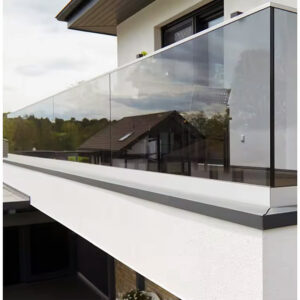
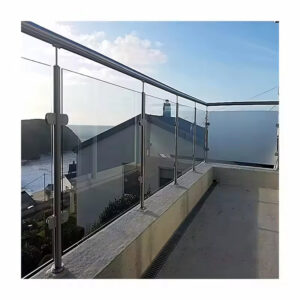
Dans le cadre d’un projet de garde-corps en verre à fixation sur poteaux, la décision la plus cruciale ne réside pas dans le choix des fixations, mais dans la vérification que le tracé a été suffisamment précis pour permettre la fabrication sans créer de désalignement qui serait mis en évidence par les conditions du chantier. Cela implique de vérifier les axes et les distances par rapport aux bords par rapport aux largeurs des panneaux et aux seuils d’espacement, de comprendre comment l’état du support affecte la stabilité des plaques de base sur toute la longueur du garde-corps, et de ne pas valider le plan tant que les quatre points de vérification n’ont pas été documentés et ne sont pas cohérents entre eux.
Avant de procéder au perçage du verre, assurez-vous que les mesures sur site ont bien été effectuées dans les tolérances requises pour l’ajustement de votre panneau, que l’état du support à chaque emplacement de poteau a été vérifié et spécifié, et que les éléments de fixation sont indiqués sur le plan plutôt que d’être laissés à l’appréciation du chantier. C’est au moment de ces vérifications que le risque d’alignement est maîtrisé — et non lors de la mise à niveau, ni par le réglage des éléments de fixation après l’arrivée des panneaux.
Questions fréquemment posées
Q : Que se passe-t-il si les conditions sur site empêchent les mesures sur le terrain d'atteindre le seuil de tolérance de 1/4 de pouce avant la commande du verre ?
R : Ne validez pas le verre pour le perçage tant que les conditions ne permettent pas d’obtenir des mesures respectant ce seuil. La valeur de 1/4 de pouce est un seuil opérationnel, et non une valeur arrondie à respecter : si le support est instable, si les montants ne sont pas complètement fixés ou si l’accès pour la prise de mesures est limité, valider le verre sur la base de mesures imprécises fait peser le coût de cette incertitude sur le remplacement du panneau plutôt que sur un retard dans le calendrier. Stabilisez le support, fixez et vérifiez la position de chaque montant, puis effectuez de nouvelles mesures avant de valider la commande.
Q : Le fait d'ajouter davantage de robinets le long d'une conduite améliore-t-il la fiabilité de l'alignement, ou cela augmente-t-il les risques ?
R : Les deux sont possibles, et l’équilibre dépend de la longueur de la série et de la précision du tracé. Un plus grand nombre de tenons permet de répartir la charge de manière plus homogène et peut aider à respecter les limites d’espacement, mais chaque tenon supplémentaire représente un point de plus qui doit se situer dans les tolérances de fabrication — et chaque position supplémentaire de pièce de fixation visible augmente la charge de travail liée au tracé. Sur les longueurs importantes où l’écart cumulatif des plaques de base constitue déjà un problème, ajouter des tiges de fixation sans renforcer le processus de tracé multiplie le nombre de points susceptibles d’accumuler des erreurs, au lieu de les réduire. La décision doit découler de la largeur des panneaux et des seuils d’espacement déjà définis dans le plan, et non d’une hypothèse générale selon laquelle un soutien accru est synonyme de plus de sécurité.
Q : Cette approche de planification est-elle tout aussi nécessaire pour les installations de petite envergure, composées de seulement deux ou trois panneaux, ou s'applique-t-elle principalement aux installations de grande envergure ?
R : Les contrôles de gel des plans et la vérification des axes de centrage sont essentiels pour toute série de vitrages comportant des perçages sur mesure, quel que soit le nombre de panneaux. Une série de deux panneaux avec une terminaison en angle nécessite tout de même le calcul de la distance par rapport au bord au niveau de cette terminaison — s’en remettre à un jugement visuel sur chantier entraîne la même incohérence à l’endroit le plus visible de la série. Ce qui varie en fonction de la longueur de la série, c’est le risque cumulé de dépassement des tolérances : le décalage de la plaque de base s’amplifie sur un grand nombre de montants, ce qui n’est pas le cas sur seulement deux ou trois. Mais les étapes de planification en amont — axes de centrage confirmés, spécifications du verre figées, substrat vérifié — s’appliquent quel que soit le nombre de panneaux composant la série.
Q : Comment faut-il indiquer les éléments de fixation sur le plan lorsque le support de sol varie sur une même longueur — par exemple, du béton à une extrémité et une ossature en bois à l'autre ?
R : L'emplacement de chaque poteau doit être défini individuellement en fonction de l'état confirmé du support sur lequel il est posé ; il ne faut pas attribuer un seul type de fixation pour l'ensemble du tronçon. Le béton et les ossatures en bois nécessitent des méthodes d’ancrage différentes et peuvent exiger des détails de contre-appui différents ; or, une spécification unique appliquée à des conditions mixtes engendre précisément le risque d’inadéquation identifié par l’article : des fixations qui semblent équivalentes sur le plan dimensionnel mais qui se comportent différemment sous l’effet d’une charge ou de cycles thermiques. Le type de support, les exigences en matière de contre-appui et les spécifications des fixations doivent tous être documentés pour chaque emplacement de poteau avant la validation des plans.
Q : À quel stade d'un projet un ingénieur en structure ou un consultant en réglementation doit-il vérifier la disposition des raccords par rapport aux exigences de charge de l'IBC, plutôt que de se fier uniquement à l'examen interne des plans ?
R : Avant le gel des plans et, a fortiori, avant le perçage du verre. L’espacement maximal de 6 pieds entre les poteaux, prévu par la norme IBC pour la charge des garde-corps, est un seuil qui s’applique à l’ensemble du tracé, et non pas uniquement aux positions individuelles des poteaux. Les projets présentant des conditions particulières — escaliers, belvédères surélevés, charges d’occupation commerciales ou juridictions appliquant des amendements locaux — peuvent nécessiter une expertise technique formelle afin de confirmer que le tracé tel qu’il est dessiné satisfait à la norme applicable. Les vérifications internes de validation des plans constituent une étape de contrôle qualité visant à s’assurer que la fabrication peut débuter ; elles ne remplacent pas l’avis d’un ingénieur quant à la conformité du système monté sur poteaux aux exigences structurelles de la norme ASTM E985 ou du code en vigueur pour les conditions spécifiques du projet.