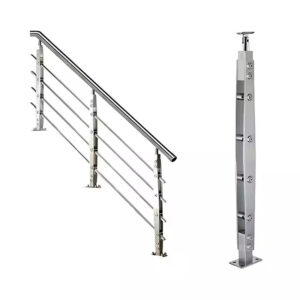
Rust spots appearing on stainless steel railings within the first coastal season rarely trace back to a material defect. They trace back to a sequencing failure: passivation was performed before fabrication residue was fully removed, or it was applied over a surface where embedded carbon-steel particles from nearby grinding were already active. The result is corrosion that looks like a product failure at handover but is actually a process failure from weeks earlier. The decision that separates a durable coastal installation from an early warranty dispute is not which grade of stainless to specify—it is whether cleaning, passivation, and ongoing maintenance are treated as three separate responsibilities with defined handover points between them.
Different Jobs Performed by Cleaning and Passivation
Cleaning and passivation address different problems, and confusing them creates a specific failure: passivating over an incompletely cleaned surface does not produce a defective passivation record—it produces one that looks valid but leaves active sites under the oxide layer where organic residue or loose particles blocked the treatment from reaching the base metal.
Cleaning removes what is on the surface—installation grease, smut, oils, and debris. Passivation, as defined under ASTM A967, is a chemical treatment using a mild oxidant such as nitric acid to remove free iron and other foreign matter from the surface and restore a protective oxide layer. The standard is precise: passivation is not a substitute for cleaning, and cleaning is not a substitute for passivation. They operate in sequence, not interchangeably.
The downstream consequence of omitting the cleaning step is that the passivation chemistry cannot work uniformly. Organic soils and residues act as a barrier, leaving sections of the substrate untreated. Those sites do not show any visible sign of failure at the time of treatment—they only become visible once the installation is in service and salt exposure begins.
| Aspect | Cleaning | Passivation |
|---|---|---|
| Objectif principal | Remove surface contaminants like grease, oil, and installation debris | Remove free iron and other foreign matter; restore a protective oxide layer |
| What It Addresses | Organic residues, smut, and loose particles | Embedded iron particles and surface iron that can initiate corrosion |
| Typical Process | Mechanical or detergent washing | Chemical treatment with a mild oxidant (e.g., nitric acid) per ASTM A967 |
| Order in Treatment | Must be performed before passivation to ensure a clean substrate | Follows cleaning; cannot substitute for removal of organic soils |
The practical implication for contractors and specifiers is that any surface treatment record should confirm both steps were completed, in order, on a fully prepared substrate—not simply that a passivation chemical was applied.
Contamination That Survives an Incorrect Treatment
Not all contamination is removed by the passivation process. The treatment is designed to address free iron and surface oxides on a properly prepared substrate—it is not designed to remediate embedded mechanical contamination from fabrication.
Carbon-steel particles are the most common example of contamination that passivation cannot fix after the fact. When stainless steel components are cut or ground near carbon-steel materials, microscopic iron particles can embed into the stainless surface. Those particles are not chemically bonded iron in the same sense as the surface oxides that passivation targets—they are physically embedded foreign material. A passivation treatment applied after that contamination is present may restore the surrounding stainless surface while leaving those embedded particles active. Once moisture and salt contact the surface in a coastal installation, those particles corrode and produce the rust-colored spots that are frequently misidentified as base-material failure.
This contamination pattern is particularly difficult to catch because the surface may look clean at inspection. There is no reliable visual test that distinguishes a properly passivated surface from one that has been passivated over embedded iron particles. The failure only becomes apparent after the first few months of coastal exposure, at which point responsibility for the surface condition has often already shifted to the owner.
The practical site precaution—and it should be treated as practical guidance rather than a regulatory prohibition—is to avoid performing any carbon-steel cutting or grinding operations in the immediate vicinity of stainless steel components before passivation. If that separation cannot be maintained, the stainless surfaces should be fully inspected and any suspect areas mechanically cleaned before treatment proceeds. Passivation applied over an already-contaminated surface does not resolve the contamination; it only preserves the surrounding substrate while leaving the defect in place.
Fabrication Treatment Versus Service Maintenance
Passivation restores a condition. Routine cleaning sustains it. The distinction matters because the two are often treated as interchangeable by owners who receive a passivation record at handover and interpret it as proof that the surface is permanently protected.
Shipping, handling, and installation disturb the passive oxide layer that forms naturally on stainless steel. Post-installation passivation per ASTM A967 is intended to restore that layer before the installation enters service. That is a discrete event with a defined outcome. What it does not do is prevent new contamination from accumulating during service life—and in a coastal environment, salt deposition is continuous.
Salt deposits left on the surface trap moisture, and that combination creates the conditions for pitting and tea staining over time. Routine cleaning—freshwater rinsing, mild soap washing, and the deliberate exclusion of steel wool and aggressive chemicals—removes those deposits before they reach a concentration that drives localized corrosion. One manufacturer’s coastal maintenance benchmark, offered as a practical starting point rather than a code requirement, suggests freshwater rinsing every few weeks and a more thorough wash every few months, with the frequency adjusted based on proximity to the waterfront and local exposure conditions.
| Aspect | Fabrication Treatment (Passivation) | Service Maintenance (Routine Cleaning) |
|---|---|---|
| When Performed | After installation, before handover | Continuously during service life: freshwater rinse every few weeks, wash every few months |
| Objective | Restore the protective passive layer disturbed during shipping/installation | Remove accumulated salt deposits and moisture that otherwise cause pitting or tea staining |
| Recommended Actions | Clean the surface, then apply chemical passivation per ASTM A967 | Rinse with fresh water, wash with mild soap and water; avoid steel wool, bleach, and harsh chemicals |
| Consequences of Neglect | Passive layer remains compromised, increasing early corrosion risk | Salt and debris accumulate, promoting localized corrosion and surface staining |
The failure pattern that connects these two stages is the assumption that passivation absorbs the maintenance responsibility. It does not. The transition from installer-managed surface care to owner-managed surface care is the point where that misunderstanding does its damage—and it is largely invisible until corrosion has already started. A marine-grade 316L railing system selected for coastal exposure can still develop early surface corrosion if that transition is not documented and handed over with clear instructions.
Responsibility Across Factory Site and Owner
Surface care for a coastal railing installation passes through at least three parties—fabricator, installer, and owner—and in typical practice none of them has formal contractual authority over the others’ steps. That gap is where most preventable failures originate.
The fabricator controls the surface condition of components before they leave the shop. That includes removing fabrication residues, ensuring that carbon-steel contamination from adjacent operations has not been introduced, and confirming the substrate is in a condition suitable for passivation. Those steps cannot be corrected on site once installation begins. If the fabricator ships components with embedded contamination or surface scale, the installer inherits that condition whether or not they recognize it.
The installer typically performs the post-installation passivation—or is responsible for confirming it was specified and completed. This is also the point where an initial thorough cleaning to remove installation residues is most critical, since those residues must be removed before passivation is applied. In practice, however, passivation is sometimes treated as the fabricator’s scope and sometimes the installer’s, and the ambiguity means it occasionally falls between both. When it does, neither party has a record to produce.
The owner takes responsibility for the surface from the point of handover forward. Routine cleaning is an owner responsibility in most project structures, but that only functions if the owner receives a cleaning schedule and understands what products and methods are prohibited. Without that transfer, the typical outcome is that the owner either does nothing—because they were never told maintenance was needed—or uses inappropriate materials, such as wire brushes or bleach-based cleaners, that damage the passive layer they were trying to clean.
The risk that runs across all three stages is that responsibility shifts without documentation. There is no inherent mechanism in a standard construction handover that captures passivation records or delivers maintenance instructions to the person who will actually perform the cleaning. That mechanism has to be built deliberately into the project close-out.
Coastal Handover Evidence for Surface Care
A railing installation that is properly treated but poorly documented creates the same downstream exposure risk as one that was undertreated. In a coastal environment, where corrosion risk is continuous rather than episodic, the maintenance relationship between the owner and the surface begins at handover—and if the documentation package is incomplete, that relationship starts with a gap.
The three items that carry the most weight in a coastal handover are the passivation record, the cleaning and maintenance schedule, and any recommendation for a supplementary protective coating or sealant. Each one addresses a different stage of the surface’s service life, and the absence of any one of them leaves the owner without the information needed to maintain the surface correctly. For the most aggressive coastal microclimates, ISO 9223 provides a corrosivity categorization framework that can help characterize the expected exposure environment—useful context for determining whether a supplementary coating is warranted, though it should be treated as a testing and classification reference rather than a direct compliance requirement.
| Handover Item | What It Confirms | Why It Matters in Coastal Environments |
|---|---|---|
| Passivation Certification / Record | Post-installation passivation was performed per ASTM A967 or equivalent, creating the protective oxide barrier | Without documented passivation, the surface is more vulnerable to moisture and salt attack |
| Cleaning and Maintenance Schedule | Specified frequency (e.g., freshwater rinse every few weeks, mild soap wash every few months) and prohibited materials (steel wool, harsh chemicals) | In coastal areas salt accumulates continuously; a clear schedule empowers the owner to prevent pitting and tea staining |
| Protective Coating Recommendation | Indicates if an additional protective coating or sealant should be applied for extra salt and moisture resistance | In harsh coastal microclimates, a supplementary barrier may be necessary; handover clarifies if and when to apply it |
The documentation package does not need to be elaborate. What it needs to do is connect the surface treatment that was performed to the maintenance actions the owner is expected to take. A passivation record without a maintenance schedule leaves the owner with proof that the surface was treated but no guidance on how to keep it that way. A maintenance schedule without a passivation record leaves the owner with instructions but no baseline confirmation that the surface was in the correct condition to begin with. Together, they establish both the starting point and the ongoing commitment. That combination is what closes the responsibility gap and gives the installation a reasonable chance of performing as specified through its service life. For context on how material selection intersects with surface care decisions in marine environments, the broader discussion of grade selection and corrosion prevention is worth reviewing alongside any surface treatment plan.
The most preventable coastal railing failures are not material failures—they are sequencing and handover failures. Before accepting a completed installation, the questions worth confirming are: was the substrate cleaned before passivation was applied, was there any carbon-steel work performed nearby before treatment, and is there a passivation record tied to a maintenance schedule that the owner can actually use? If any of those elements are missing, the surface condition at handover is harder to defend and the maintenance trajectory from that point forward is undefined.
The handover evidence framework outlined here is not a compliance requirement—it is a practical alignment with what ASTM A967 documentation expectations support and what the service environment demands. Specifying the right grade of stainless resolves the material selection question. Confirming that cleaning, passivation, and maintenance handover are each treated as distinct and documented steps is what determines whether that material selection holds up through the first coastal season and beyond.
Questions fréquemment posées
Q: What if my stainless railing is not directly on the coast but still develops rust spots?
A: The same contamination and sequencing risks apply away from the shoreline. De-icing salts, industrial fallout, and airborne particulates from nearby construction can introduce the same free-iron deposits that trigger corrosion. Passivation and a documented cleaning routine are still necessary wherever the environment delivers salt, moisture, or airborne metal particles to the surface.
Q: After the handover documents are received, what should the owner do in the first week?
A: Perform a freshwater rinse and visual inspection to establish a baseline surface condition. This confirms that the installation matches the handover record and removes any light contamination deposited during the final stages of construction, before the regular maintenance cycle begins.
Q: At what point does passivation alone become insufficient and a protective coating required?
A: In highly corrosive atmospheres — roughly ISO 9223 categories C4 and above, which include heavy surf zones, direct salt spray, or frequent airborne chloride accumulation — passivation restores the oxide layer but does not prevent rapid chloride attack. In those conditions, a supplementary coating or sealant tailored to stainless steel is often necessary to achieve the intended service life.
Q: How does passivation differ from pickling, and when would I specify one over the other?
A: Pickling uses stronger acids to remove scale, weld tint, and heavier oxide layers, etching the surface. Passivation is a milder treatment that removes free iron and restores the passive layer without significant material removal or dimensional change. Choose pickling when heat tint or heavy fabrication scale is present; choose passivation when the surface is clean and only light iron contamination needs to be addressed.
Q: Is post-installation passivation still worth the cost if the railing looks flawless at handover?
A: Yes, because the most damaging contamination — embedded carbon-steel particles and disturbed surface oxides — is invisible at inspection. Skipping passivation to reduce upfront cost frequently shifts the expense to early remediation, warranty disputes, or premature owner dissatisfaction, which cost far more to resolve.