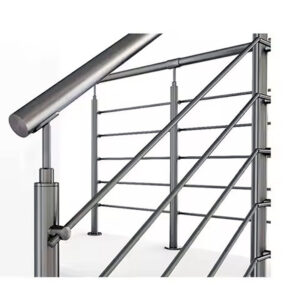
A stainless steel handrail that fails to provide a secure grip is not just a compliance issue—it’s a critical safety failure. For architects, contractors, and facility managers, the challenge lies in translating dense regulatory text into a buildable, durable system. The specifications for gripping surfaces are precise, non-negotiable, and often misinterpreted, leading to costly rework and liability exposure.
Understanding these standards is not optional. The ADA is a civil rights law, and non-compliance carries legal risk for any public accommodation. Beyond the law, correctly specified handrails directly prevent falls by enabling a biomechanically sound “power grip.” This focus on functional safety is paramount for any professional specifying or installing these systems in commercial, healthcare, or educational environments.
Key ADA Handrail Gripping Surface Specifications
The Ergonomic Foundation: The Power Grip
The dimensional standards for handrails are not arbitrary. They are engineered around the human hand’s ability to form a secure “power grip,” which provides significantly more strength and control than a fingertip grasp. This principle directly dictates the allowable range for cross-section and perimeter. A rail outside these parameters forces an insecure hold, increasing fall risk and negating the handrail’s primary safety function.
Translating Principle into Specification
For a circular profile, the outside diameter must be between 1 ¼ inches (32 mm) minimum and 2 inches (51 mm) maximum. Non-circular shapes require a perimeter of 4 inches (100 mm) minimum to 6 ¼ inches (160 mm) maximum, with a cross-section not exceeding 2 ¼ inches (57 mm). These are the absolute boundaries for the gripping surface itself. In our experience, value engineering that pushes these limits to save on material costs directly compromises user safety and guarantees a failed inspection.
The Compliance Baseline
These specifications form the non-negotiable baseline for universal accessibility. They ensure that individuals with varying hand strength or dexterity can use the rail effectively. The table below summarizes the core dimensional requirements that every specification must meet.
ADA Gripping Surface Dimension Ranges
The following table outlines the foundational technical requirements for handrail profiles, as established by federal accessibility law.
| Profile Type | Dimension Range | Key Parameter |
|---|---|---|
| Circular | 1.25″ – 2″ (32-51 mm) | Outside diameter |
| Non-circular | 4″ – 6.25″ (100-160 mm) | Perimeter |
| Any shape | Max 2.25″ (57 mm) | Cross-section |
Source: 2010 ADA Standards for Accessible Design. This federal standard establishes the minimum and maximum dimensional requirements for handrail gripping surfaces to facilitate a secure power grip, directly informing the specifications for cross-section and perimeter.
Stainless Steel Handrail Height Requirements
Consistency is Critical for Predictability
The top of the gripping surface must be positioned between 34 inches (865 mm) and 38 inches (965 mm) above the walking surface, stair nosing, or ramp surface. This height must remain uniform along the entire run. Inconsistent height forces users to readjust their grip, creating a moment of instability. This specification ensures predictable support, allowing users to transition onto and off of stairs or ramps with confidence.
Addressing Diverse User Populations
A single height cannot serve all users. In facilities like elementary schools, a second handrail at a maximum height of 28 inches is recommended alongside the standard rail. A minimum 9-inch vertical clearance must be maintained between the two rails to prevent entrapment. This tiered approach addresses the distinct biomechanical needs of children versus adults, moving beyond minimum compliance to achieve true universal design.
Height Specifications by Application
The required height varies based on application and user group. The following data clarifies the specific requirements for standard installations and specialized environments.
Handrail Height for Different Applications
This table details the mandated gripping surface heights for standard installations and the allowances for accommodating children, as per the ADA.
| Application | Gripping Surface Height | Key Requirement |
|---|---|---|
| Standard Stairs/Ramps | 34″ – 38″ (865-965 mm) | Uniform along run |
| Elementary Schools (Primary) | Max 28″ | For child users |
| Vertical Clearance (Between Rails) | Min 9″ | Prevents entrapment |
Source: 2010 ADA Standards for Accessible Design. The ADA mandates the consistent height range for the top of the gripping surface and provides allowances for additional rails to accommodate children, ensuring predictable support for all user groups.
Gripping Surface Diameter & Cross-Section Standards
The Functional Zone Definition
It is crucial to distinguish between the gripping surface and the overall handrail assembly. The diameter and perimeter specifications apply strictly to the part of the rail designed to be grasped. The assembly, including brackets, supports, or decorative elements, must be designed to maintain the required clearances around this defined functional zone. A common mistake is measuring the diameter of a tube that includes a welded seam or bracket connection point within the grip area.
Implications for Material and Fabrication
For stainless steel, achieving these tolerances requires precision fabrication. Tube stock must be selected and cut to ensure the finished outside diameter falls within the narrow 1.25″ to 2″ window. For custom profiles, fabricators must calculate the perimeter accurately, accounting for weld beads or finishes that could alter the effective graspable dimension. The surface must also be smooth, with rounded edges, to prevent abrasion.
Ensuring Continuous Graspability
The standards also limit obstructions on the underside of the gripping surface to no more than 20% of its total length. This ensures the hand can slide along the rail without encountering frequent interruptions from bracket stems or mounting hardware. This requirement directly influences bracket design and spacing, pushing for solutions where supports attach from the side or well below the gripping zone.
Required Clearances for Walls & Adjacent Surfaces
The 1.5-Inch Non-Negotiable
The mandatory 1 ½ inches (38 mm) of clearance between the gripping surface and any wall is a precise spatial requirement. This gap allows users to wrap their fingers and thumb fully around the rail to achieve the necessary power grip. Insufficient clearance reduces the grip to a pinch, severely limiting control and stability. This dimension often becomes an installation bottleneck when wall conditions or existing structures are not accounted for in the design phase.
Designing for the Underside
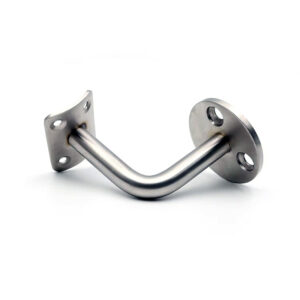
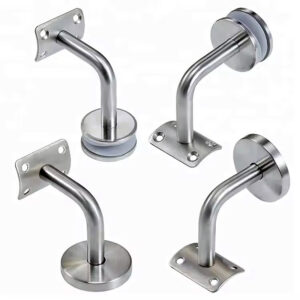
The clearance requirement extends beneath the rail. Any horizontal projections, like the stems of brackets, must be set at least 1 ½ inches below the bottom of the gripping surface. Furthermore, these projections cannot obstruct more than 20% of the rail’s length. This dictates the use of offset brackets or custom-fabricated mounting solutions. We consistently see projects delayed because standard, off-the-shelf brackets fail to provide this critical underside clearance.
Clearance Specifications Dictate Mounting
These clearance rules are not afterthoughts; they fundamentally dictate mounting system design. The following table breaks down the specific spatial requirements that ensure functional graspability.
Mandatory Clearances for Functional Grasp
The technical specifications for clearances, as defined in accessibility standards, are critical for mounting system design.
| Clearance Type | Minimum Dimension | Purpose |
|---|---|---|
| Gripping surface to wall | 1.5″ (38 mm) | Full hand wrap |
| Bracket projection below rail | Min 1.5″ | Unobstructed underside |
| Underside obstruction length | Max 20% of total | Continuous graspability |
Source: ICC A117.1 Accessible and Usable Buildings and Facilities. This referenced standard provides the technical specifications for clearances necessary to achieve a functional power grip, dictating mounting system design and bracket selection.
Handrail Continuity, Extensions & Surface Quality
Uninterrupted Support Along the Run
The gripping surface must be continuous along the entire length of the stair or ramp, including through turns and switchbacks. Segmented rails or interruptions at landings violate this core safety principle. Continuity provides constant orientation and support, which is especially critical for users with visual impairments. Any break in the rail creates a hazardous point where a user may lose their balance.
Critical Safety: The Mandated Extensions
Handrail extensions are non-delegable safety features. At the top of a stair flight, the handrail must extend horizontally at least 12 inches (305 mm) beyond the nosing. At the bottom, it must extend at the stair slope for a distance equal to one tread depth before terminating or turning. These extensions provide critical support during the transition onto or off of the stair, where balance is most challenged. Omitting them is a frequent and serious installation error.
Surface Integrity and Fixation
The surface must be free of sharp or abrasive elements. For stainless steel, this means all edges must be smoothly rounded, and welds must be ground and polished flush. The rail must also be securely fixed to prevent rotation, wobble, or displacement within its fittings. A loose rail that twists under load is as dangerous as no rail at all. Regular inspection logs for such issues are a key part of ongoing compliance.
Compliance with ADA, IBC & Local Building Codes
Navigating the Regulatory Landscape
Professionals must understand the differing scopes of key regulations. The ADA is a federal civil rights law establishing accessibility requirements. The International Building Code (IBC) is a model code focused on safety, including fall prevention. While they often align on handrail height (34″-38″), a critical conflict arises for guards on elevated walks: the IBC typically mandates a 42-inch minimum guard height.
The Guard vs. Handrail Dilemma
This conflict creates a common and costly error: installing a single rail at 42 inches to meet the guard requirement, which then fails the ADA’s graspability rules. The correct solution is often a dual-component system—a 42-inch guard and a separate, compliant handrail within the 34″-38″ height range. This integrated approach requires careful engineering from the outset.
The Hierarchy of Authority
Local amended building codes always take precedence over model codes like the IBC. A project compliant with the ADA and IBC may still violate a local jurisdiction’s more stringent amendments. The table below clarifies the differing focuses and potential conflicts between these governing documents.
Code Comparison: ADA vs. IBC
Understanding the differing scopes of accessibility standards and building codes is essential to avoid non-compliant designs.
| Code / Standard | Key Handrail Height | Key Guard Height | Primary Focus |
|---|---|---|---|
| ADA Standards | 34″ – 38″ | Not specified | Accessibility & usability |
| International Building Code (IBC) | 34″ – 38″ | 42″ minimum | Fall prevention |
| Local Amended Codes | Varies | Varies | Always takes precedence |
Note: A 42″ guard cannot serve as an ADA-compliant handrail, often requiring a dual-component system.
Source: 2010 ADA Standards for Accessible Design and ICC A117.1. The ADA is a civil rights law, while the IBC is a model building code; understanding their differing scopes (accessibility vs. safety) is critical to avoid non-compliant designs.
Common Installation Mistakes & How to Avoid Them
Error 1: Compromised Clearances
The most frequent mistake is failing to maintain the 1.5-inch wall clearance, usually due to improper bracket selection or unplanned obstructions. The solution is upfront coordination: review wall construction details, specify code-compliant offset brackets, and use detailed shop drawings that map clearances before fabrication begins.
Error 2: Neglecting Continuity and Extensions
Omitting required handrail extensions or segmenting the rail at turns violates the continuity mandate. Prevention requires treating the handrail layout as a critical path element on construction documents. Clearly dimension extensions on plans and detail transitions at turns to ensure a continuous run.
Error 3: Confusing Guard and Handrail Height
As noted, installing a single 42-inch guard rail is a fundamental error. Avoid this by clearly defining the separate functions of “guard” and “handrail” in project specifications. Specify dual-component railing systems that are pre-engineered to meet both requirements simultaneously, ensuring a cohesive and compliant installation for your stainless steel handrail systems.
Selecting the Right Stainless Steel Handrail System
Partner with a Compliance-First Manufacturer
Selection begins with choosing a manufacturer that provides more than components. They must act as a compliance partner, offering technically engineered systems with comprehensive documentation—including load test certifications (e.g., ASTM) and code-referenced installation details. This documentation is increasingly required by building officials as proof of due diligence.
Specify for the Environment
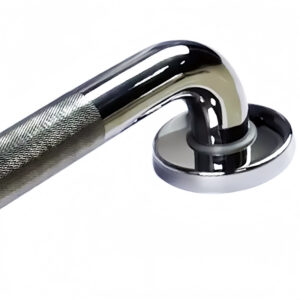
Material and finish selection must consider the environment. For wet areas like showers, locker rooms, or pool decks, a standard polished stainless finish may become slippery. Specifying a textured finish, such as a peened or brushed surface, can enhance grip. While not explicitly mandated by ADA, this meets the law’s intent for safe usability and can be supported by standards like ANSI/BHMA A156.18 for finish durability.
Plan for Ongoing Liability Management
ADA compliance is an ongoing obligation. The selected system should facilitate easy maintenance. More importantly, property managers must implement scheduled inspection logs to check for loose fittings, damage, or corrosion. This maintenance record is not just operational; it’s a critical liability shield, demonstrating proactive effort to keep accessible routes safe.
Specifying ADA-compliant stainless steel handrails requires a decision framework that prioritizes the power grip principle above aesthetics or cost-saving shortcuts. The core priorities are clear: enforce the 1.5-inch clearance, mandate continuity with proper extensions, and resolve the guard/handrail height conflict through integrated design. These are not just code items; they are the functional requirements that prevent falls.
Need professional guidance to navigate these specifications for your next project? The experts at Esang provide engineered railing solutions backed by the technical documentation required for compliance. For a detailed review of your project requirements, Contact Us.
Frequently Asked Questions
Q: How do you resolve the conflict between ADA handrail height and IBC guardrail requirements on elevated walks?
A: You must install two separate components: a graspable handrail between 34 and 38 inches high for accessibility and a separate guard at a minimum of 42 inches high for fall protection, as mandated by the International Building Code. These are distinct safety systems with different functions. For projects with elevated walkways, plan and budget for an integrated or dual-component railing system from the outset to satisfy both codes simultaneously.
Q: What are the critical dimensions for the gripping surface clearance, and why is it a common installation failure point?
A: You must maintain a 1.5-inch (38 mm) gap between the handrail’s gripping surface and any adjacent wall, guard, or bracket. This clearance is essential for a full power grip, as defined in the 2010 ADA Standards. The required space often conflicts with standard bracket designs. This means you should select mounting systems engineered specifically for ADA compliance, as retrofitting clearance after installation is typically costly and impractical.
Q: When selecting a stainless steel handrail system, what documentation should you require from the manufacturer?
A: Require detailed installation drawings that reference applicable codes, along with certified load test results (e.g., ASTM). Manufacturers acting as compliance partners provide this, while component suppliers may not. This documentation is often requested by building officials. For your project’s liability protection, prioritize vendors offering this engineered system approach over those selling only aesthetic components.
Q: How should handrail specifications differ for environments like school buildings or pool decks?
A: In elementary schools, install a second, lower handrail at a maximum 28-inch height with a 9-inch vertical separation from the standard rail to serve children. For wet areas like pools, specify a textured finish (e.g., peened) on the gripping surface to counteract slipperiness, aligning with the safety intent of accessibility standards. This means facilities serving diverse user groups or wet environments must move beyond a single-rail solution to meet both code and practical safety needs.
Q: What is the purpose of the mandatory handrail extensions at stair and ramp ends?
A: The 12-inch horizontal extensions at the top of stairs and both ramp ends, plus the sloped extension at the stair bottom, provide critical support during transition zones where balance is most challenged. These are non-negotiable safety features that prevent falls at mounting and dismounting points. If your installation omits these extensions to save cost or space, you create a significant liability exposure and fail the basic continuity requirement.
Q: Why is the handrail’s cross-sectional shape and size so strictly regulated?
A: The permitted range—1.25″ to 2″ diameter for circular shapes or a 4″ to 6.25″ perimeter for non-circular profiles—is engineered to facilitate a secure “power grip.” This full-hand grasp provides maximum stability and is a core ergonomic principle behind the standards in ICC A117.1. This means any value engineering that alters these dimensions to reduce cost directly compromises user safety and guarantees the installation will be non-compliant.