Through-Post Hardware
Through-Post Hardware
Through-post hardware is selected by what the cable does at the post. At an intermediate post the cable may pass straight through; at a terminal post it ends or tensions; at a corner post it changes direction or terminates and restarts. These roles need different drawings even when the visible holes appear similar.
Discuss Through-Post Hardware on WhatsApp
Three Current Product Routes
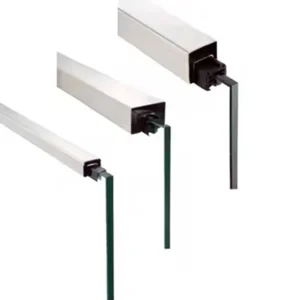
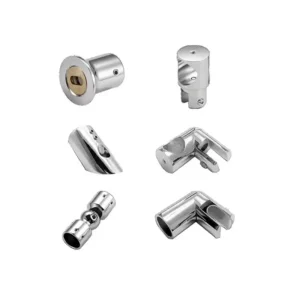
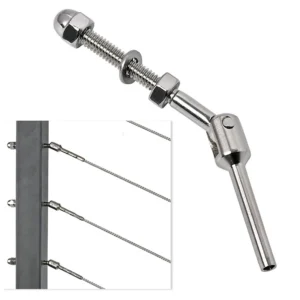
• Through Post Cable Hardware — start here when a fitting body, thread, washer, nut or terminal feature passes through or bears at the post. State whether it guides, terminates or tensions the cable.
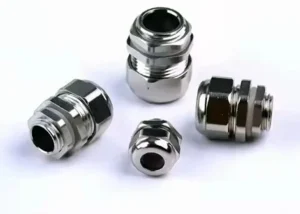
• Cable Pass-Through Fittings — start here when the main task is a finished or protected cable passage through an intermediate post. Define the desired interface; the category name alone does not prove a sleeve, liner or sealing function.
• Corner Post Cable Hardware — use this route when cable direction changes at a post. Provide the corner angle and say whether the two directions terminate separately or use a reviewed directional fitting.
Intermediate, Terminal and Corner Posts
Intermediate post: passage and alignment
Show the cable axis through the post, the hole or fitting at both faces, the post wall or section and the direction in which the cable is laced. If a sleeve or insert is proposed, ask how it is retained and whether it suits the cable’s approach angle. A clean-looking insert is not automatically a structural terminal.
Terminal post: end connection and access
A terminal post receives the cable end and may also contain the adjustment hardware. Coordinate the end fitting, tensioner, hole, bearing face, washer or nut, projection and tool access. The cable should not be cut to finished length until the installed end details are agreed.
Corner post: direction change
Do not assume a cable can be pulled around a corner through one ordinary straight hole. A corner detail can terminate and restart the two directions, use separated passages, or use an angle-specific component reviewed for that layout. Show the cable path, corner angle, clearances and tensioning plan for each direction.
Post Geometry Changes the Fitting
For square or rectangular posts, provide face orientation, outside size, wall or section detail and hole coordinates from a common datum. For round posts, provide outside diameter, wall or section, hole angle and the way a flange, washer or fitting seats on the curved surface. For timber, composite, wrapped or other posts, identify the substrate and connection detail rather than carrying over a metal-post assumption.
Also state whether drilling is done by ESANG, by a post supplier or on site. The responsible party needs a frozen hole schedule: row coordinates, hole diameter, entry/exit orientation, any counterbore or thread, and the terminal or corner exceptions.
Coordinate Holes with the Whole Run
• Use the same cable-axis datum across posts; do not set each hole independently.
• Separate standard intermediate holes from terminal, stair and corner exceptions.
• Check that the cable or fitting can be inserted in the intended installation sequence.
• Allow access for nuts, washers, grip parts and tensioning tools.
• Do not ask a cable-hole insert to correct an unresolved post alignment or corner route.
• Coordinate any spacer bar with the same row positions.
Information to Start the Inquiry
• railing elevation and plan with terminal, intermediate, stair and corner posts marked;
• post profile, outside size, wall or section and material;
• cable diameter and construction;
• row count, hole coordinates, hole diameter and cable approach angle;
• pass-through, termination or tensioning role at each post type;
• corner angle and whether directions terminate/restart or continue;
• inside and outside access, visible projection and finish expectation;
• requested material grade, exposure, quantity and destination.
Quotation Fields to Freeze
• fitting role and exact post positions where it is used;
• compatible cable and cable-side attachment;
• body, thread, hole, washer, nut, sleeve or insert detail;
• post profile, wall or section range and seating face;
• straight, stair or corner orientation;
• drilling responsibility and approved hole schedule;
• proposed material grade and finish, with requested evidence;
• included small parts, installation tools and exclusions.
Final post strength, terminal loading, anchorage, cable spacing and code compliance must be evaluated for the complete installed railing. A through-post component image does not verify those system outcomes.
Related Posts:
What Should Be Included at Handrail Ends: Returns, End Caps or Open Coordination Points?
Distinguish handrail returns, end caps and unresolved end interfaces, then schedule each termination by function, adjoining construction and supply responsibility.
Factory-Cut or Site-Trimmed Handrails: Which Release Method Fits the Available Dimensions?
Choose factory-cut or site-trimmed handrails by checking dimension status, datums, mating allowances and the finish work attached to each cut.
Handrail Tube Only or a Complete Component Package: What Should the Supplier Quote Include?
Compare tube-only and component-package handrail quotes by separating fittings, fabrication, mounting interfaces, finish work and delivered quantities.
Continuous or Sectional Handrail Supply: Which Split Strategy Fits Transport and Site Assembly?
Compare continuous and sectional handrail supply using delivery access, joint locations, mating details and section identification before fabrication release.
Where Should a Handrail Change from Wall-Supported to Post-Supported Along a Mixed Route?
Choose a handrail support change by comparing wall and post interfaces, preserving the gripping path and locating the transition on coordinated drawings.
Level, Raked or Raked-to-Level Mesh Panels: Which Geometry Belongs on Each Railing Run?
Choose between level, raked, and raked-to-level mesh panel geometry by railing run, pattern orientation, interfaces, and project drawings.
Esang's Projects

Esang's Certificate
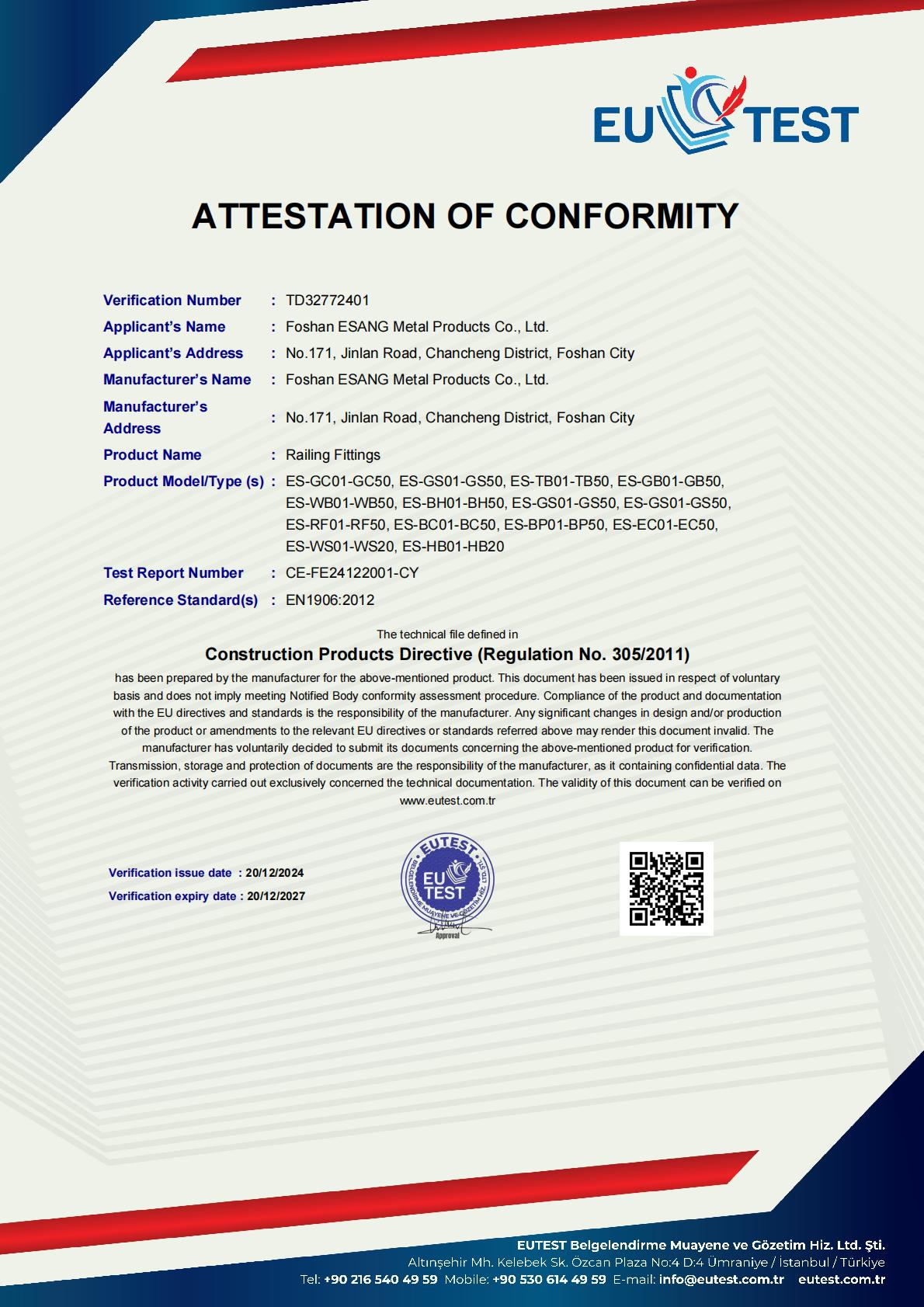
Foshan ESANG Metal Products proudly maintains CE certification (Verification No. TD32772401) under the Construction Products Directive (Regulation No. 305/2011), affirming our commitment to the highest European safety and quality standards.
Certified Product Range:
Our comprehensive railing fittings portfolio—including glass clamps, tensioners, brackets, wall mounts, base shoes, handrail fittings, cable hardware, and post components—meets EN1906:2012 standards, ensuring structural integrity and performance reliability across all installations.
What This Means for Your Project:
✓ Full regulatory compliance for European and international markets
✓ Independently verified safety and durability performance
✓ Documentation support for architectural specifications
✓ Peace of mind from third-party quality assurance
Certification valid through 2027 | Test Report: CE-FE24122001-CY
Esang's Projects

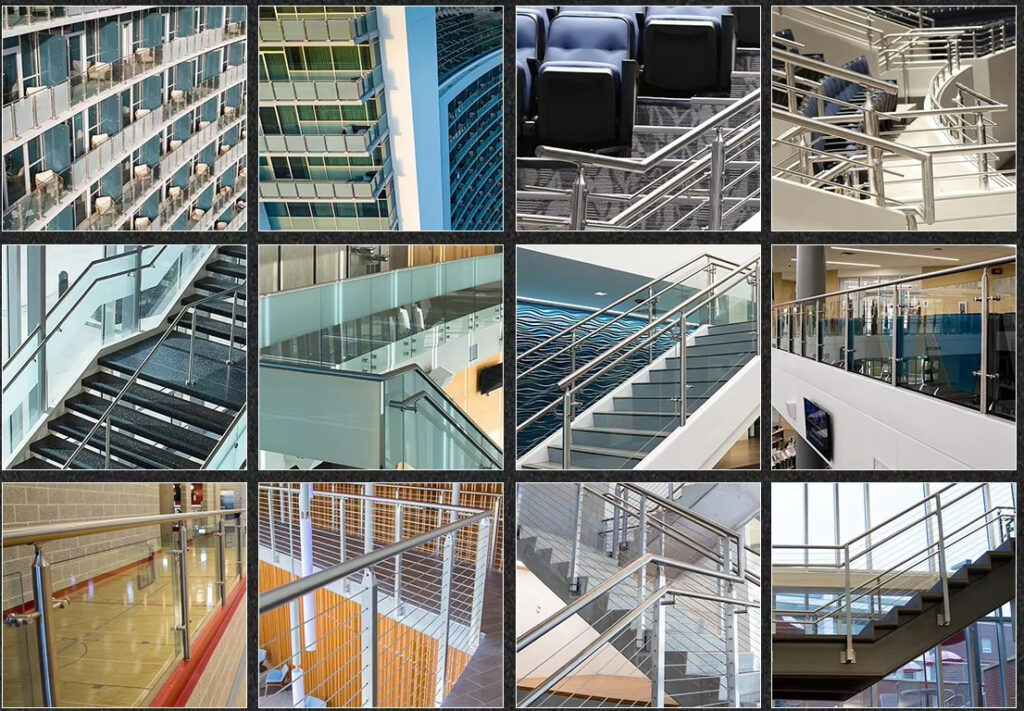
Reference Products