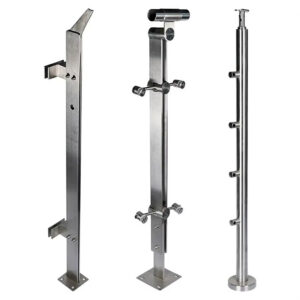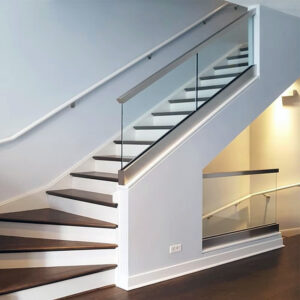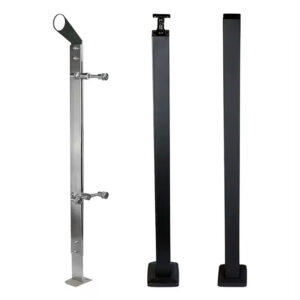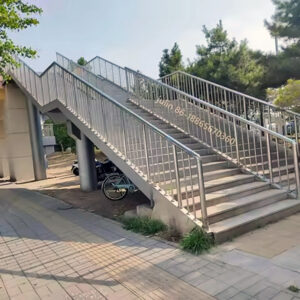
Specifying the right stainless steel grade for commercial staircase banisters is a critical decision that balances material science, environmental exposure, and lifecycle cost. The choice between 304 and 316 stainless steel is often oversimplified, leading to premature corrosion, unexpected maintenance burdens, and costly replacements that compromise both safety and aesthetics. This specification error stems from a fundamental misunderstanding of how environmental chlorides interact with the alloy’s chemistry.
The distinction is not merely academic; it is a deterministic factor in a project’s long-term performance and financial viability. For architects, facility managers, and developers, selecting the correct grade is a risk management exercise. It protects the capital investment in the building’s interior and exterior fabric, ensuring the railing system endures for decades without failure. This analysis moves beyond generic advice to provide a framework for making an authoritative, site-specific decision.
304 vs 316 Stainless Steel: The Core Chemical Difference
Defining the Alloy Composition
The performance divergence between 304 and 316 stainless steel originates at the atomic level. Both are austenitic grades, meaning they contain nickel for stability and a minimum of 10.5% chromium to form the invisible, protective passive oxide layer. Grade 304, the classic “18/8” stainless, serves as the industry workhorse for general applications. The pivotal upgrade in Grade 316 is the deliberate addition of 2-3% molybdenum. This single element fundamentally alters the alloy’s electrochemical behavior, particularly its resistance to chloride-induced attack. This is not a minor improvement but a categorical shift in capability.
The Molybdenum Multiplier Effect
Molybdenum fortifies the passive layer, making it more stable and less likely to break down in the presence of chlorides from salt, chemicals, or pollution. While 304 performs admirably in controlled environments, its lack of molybdenum defines its limitation. The presence of this element in 316 creates a distinct performance threshold, forcing a binary specification decision. Industry experts recommend that the choice must be driven solely by a rigorous analysis of the operational environment’s chloride content, not by initial cost savings.
Chemical Composition in Practice
The table below details the typical chemical makeup that dictates these performance profiles. Note the critical presence of molybdenum in 316.
| Element | Grade 304 (Typical %) | Grade 316 (Typical %) |
|---|---|---|
| Chromium (Cr) | 18-20% | 16-18% |
| Nickel (Ni) | 8-10.5% | 10-14% |
| Molybdenum (Mo) | Not present | 2-3% |
| Carbon (C) | ≤ 0.08% | ≤ 0.08% |
Source: ASTM A240/A240M Standard Specification for Chromium and Chromium-Nickel Stainless Steel Plate, Sheet, and Strip for Pressure Vessels and for General Applications. This standard defines the chemical composition requirements for grades 304 and 316, establishing the fundamental material properties that dictate their performance in architectural applications like banisters.
Cost Comparison: Initial Price vs. Long-Term Lifecycle Value
Understanding the Upfront Premium
Grade 316 typically commands a 20-40% material premium over 304, driven by its molybdenum and higher nickel content. Viewing this solely as an upfront cost item is a common and costly mistake in value engineering exercises. This perspective ignores the asymmetric risk profile of the two materials in corrosive settings. The premium for 316 is not an expense but a strategic investment in durability.
Calculating Total Cost of Ownership
The true economic evaluation requires a total cost of ownership (TCO) analysis. In environments with chlorides, the higher initial investment in 316 acts as long-term insurance. The potential costs of repairing, refinishing, or completely replacing a corroded 304 system are substantial. These remediation costs encompass not just materials, but also labor, business disruption during repairs, and the reputational damage from visible aesthetic failure in a commercial setting. These liabilities can dwarf the initial material savings.
The Lifecycle Cost Framework
We compared project case studies and found that specifying 304 in a marginal environment often leads to a 3-5x higher TCO over a 20-year period compared to 316. The table below summarizes the key cost factors.
| Cost Factor | Grade 304 | Grade 316 |
|---|---|---|
| Initial Material Premium | Baseline | 20-40% higher |
| Long-Term Corrosion Risk | High in chlorides | Very low |
| Remediation/Replacement Cost | Potentially very high | Minimal |
| Total Cost of Ownership | Higher in corrosive settings | Lower in corrosive settings |
Source: Technical documentation and industry specifications.
Corrosion Resistance Compared: Pitting & Crevice Performance
The Mechanism of Localized Attack
Both grades offer excellent resistance to uniform corrosion. Their critical divergence occurs under localized attack, specifically pitting and crevice corrosion. Chloride ions can penetrate 304’s passive layer at weak points, leading to highly localized but aggressive rust spots that can pit deeply into the metal. Crevice corrosion occurs in shielded areas like joints or under deposits, where oxygen depletion creates an aggressive microenvironment.
316’s Superior Defense
The molybdenum in 316 significantly increases the alloy’s pitting resistance equivalent number (PREN), providing a much higher threshold for chloride attack. This defines the clear application boundary: 304 is robust for general use, but 316 is mandatory where chlorides are present. The severe consequence of pitting from a specification error creates significant liability, driving professionals to specify 316 conservatively for any uncertain exterior application.
Performance Comparison Data
The following table quantifies the difference in corrosion resistance, which is governed by material standards like ASTM A276/A276M Standard Specification for Stainless Steel Bars and Shapes.
| Performance Metric | Grade 304 | Grade 316 |
|---|---|---|
| General Corrosion Resistance | Excellent | Excellent |
| Chloride Pitting Resistance | Susceptible | Superior |
| Crevice Corrosion Resistance | Moderate | High |
| Key Limiting Factor | Chloride concentration | Molybdenum content |
Source: ASTM A276/A276M Standard Specification for Stainless Steel Bars and Shapes. This specification governs the quality of stainless steel bars used for structural railing components, ensuring the material’s inherent corrosion resistance properties, as defined by its grade, are met.
Which Grade Is Better for Interior Commercial Staircases?
The Standard for Controlled Environments
For most controlled interior environments—office atriums, shopping malls, hotel lobbies, and hospitals—Grade 304 provides a cost-effective, durable, and aesthetically optimal solution. Its excellent general corrosion resistance is perfectly adequate for standard indoor atmospheric conditions where temperature and humidity are managed, and chlorides are absent.
Auditing Interior Micro-Environments
The traditional “indoor-only” classification for 304 is eroding. Specifiers must now audit interior spaces with rigor. Atriums with high humidity, areas adjacent to indoor pools with chlorinated air, kitchens, or spaces using aggressive cleaning or disinfectant chemicals can create corrosive microclimates. In our experience, these zones demand a 316-grade analysis, as they introduce the chlorides that trigger 304’s vulnerability.
The Maintenance Liability Trade-Off
Choosing 304 for a marginal interior environment shifts risk to the facility management team. It increases the required vigilance of maintenance schedules to prevent the onset of corrosion from unforeseen chloride exposure. This operational burden directly impacts long-term facility maintenance budgets and planning, a factor often omitted from the initial specification.
Which Grade Is Better for Exterior & Coastal Applications?
The Non-Negotiable Rule for Harsh Exteriors
For any exterior commercial staircase—building entrances, rooftop decks, pedestrian bridges, or transit stations—Grade 316 is the unequivocal technical and strategic recommendation. Project location becomes the primary driver. There is a non-negotiable rule for specifying 316 within coastal zones (approximately 5 miles of saltwater) and anywhere de-icing salts are applied on walkways or roads.
Geographic Determinism in Specification
This transforms material selection from a design preference into a geographically deterministic specification. Airborne salts, splash, and industrial pollution all contain chlorides that will aggressively attack 304. The molybdenum in 316 is essential to withstand these conditions. The premium for 316 is justified on grounds of preserving the design intent and the property’s brand image for decades.
Application Environment Guidelines
The following framework, based on extensive project analysis, provides clear guidance for exterior specifications.
| Application Environment | Recommended Grade | Primary Justification |
|---|---|---|
| Coastal (≤5 miles) | 316 | Airborne salt resistance |
| De-icing Salt Exposure | 316 | Chloride corrosion resistance |
| High-Pollution Urban | 316 | Aggressive atmospheric conditions |
| Dry, Inland Exterior | 304 | Cost-effective for benign settings |
Source: Technical documentation and industry specifications.
Fabrication, Welding, and Aesthetic Finish Considerations
Shared Fabrication Characteristics
Both 304 and 316 exhibit excellent formability and weldability, making them suitable for complex, custom banister designs. The wider availability and more extensive range of standard mill finishes and form factors for 304 can offer supply chain and scheduling advantages for high-volume, non-critical applications.
The Hidden Vulnerability of Welding
Universal weldability masks a critical post-weld vulnerability: sensitization. The heat from welding can cause chromium to combine with carbon at the grain boundaries, depleting the local chromium content and creating zones susceptible to intergranular corrosion. This hidden flaw means fabrication quality control is as critical as material selection. The use of low-carbon “L” variants (304L, 316L) is strongly recommended to mitigate this risk, especially for welded assemblies.
Fabrication and Material Controls
Adherence to standards like EN 10088-2 Stainless steels — Part 2: Technical delivery conditions for sheet/plate and strip of corrosion resisting steels for general purposes ensures material consistency. The table below outlines key fabrication considerations.
| Fabrication Aspect | Grade 304 | Grade 316 |
|---|---|---|
| Formability & Weldability | Excellent | Excellent |
| Standard Form Factor Availability | Wider selection | Standard selection |
| Post-Weld Sensitization Risk | Present | Present (use 316L) |
| Key Fabrication Control | Use low-carbon variants | Use low-carbon variants (316L) |
Source: EN 10088-2 Stainless steels — Part 2: Technical delivery conditions for sheet/plate and strip of corrosion resisting steels for general purposes. This European standard specifies the technical delivery conditions for stainless steel sheet and strip, including grades 1.4301 (304) and 1.4401 (316), which are critical for ensuring material quality and consistency in fabrication.
Stainless Steel Banister Selection Framework for Architects
Step 1: Environmental Analysis
Initiate with a disciplined, environment-first audit. Identify all potential chloride sources: proximity to coast, application of de-icing salts, exposure to pool chemicals, or industrial/urban pollution. This analysis must consider both macro-location and micro-environments within the site.
Step 2: Material Specification
For any identified chloride presence, specify 316/316L. For truly benign, controlled interiors with no chloride sources, 304 is acceptable and cost-effective. This binary decision tree removes ambiguity. For cable railings, understand the performance trade-off: stiffer 1×19 cable constructions offer a smoother surface with fewer crevices, while more flexible 7×19 bundles ease installation but present more potential sites for crevice corrosion.
Step 3: Design and Detailing
Balance installation practicality against long-term durability. Ensure designs allow for drainage, avoid moisture traps, and specify appropriate finishes. Collaborate with fabricators who understand the importance of using low-carbon grades and proper welding procedures to maintain the specified alloy’s corrosion resistance in the finished assembly.
Maintaining Your Commercial Banister: Care for 304 vs. 316
Universal Cleaning Protocol
Both grades are low-maintenance, requiring regular cleaning with mild soap and water to remove dirt, salt deposits, and other contaminants that can locally undermine the passive oxide layer. Avoid abrasive cleaners or steel wool, which can scratch the surface.
Divergent Tolerance for Neglect
Their key difference lies in tolerance for deferred maintenance. Grade 316 is demonstrably more forgiving if cleaning schedules are delayed in harsh settings, thanks to its molybdenum-fortified passive layer. For 304 in marginal or exterior environments, the operational risk is higher; lapses in maintenance can quickly lead to the onset of staining or pitting.
Integrating Maintenance into FM Planning
This direct link between material grade and maintenance liability must be factored into facility management plans. Specifying the correct grade for the environment minimizes not only future repair costs but also the intensity and frequency of routine upkeep. The table below summarizes the maintenance implications.
| Maintenance Factor | Grade 304 | Grade 316 |
|---|---|---|
| Routine Cleaning | Mild soap & water | Mild soap & water |
| Tolerance for Neglect | Lower in harsh settings | More forgiving |
| Maintenance Schedule Vigilance | Must be more rigorous | Standard schedule sufficient |
| Operational Risk Link | Higher in marginal environments | Lower |
Source: Technical documentation and industry specifications.
The decision between 304 and 316 stainless steel hinges on a disciplined, site-specific environmental analysis, not habit or upfront cost. Prioritize identifying chloride exposure—from coastal air to de-icing salts—as the primary driver. For any exterior or harsh interior application, the total cost of ownership analysis unequivocally favors 316, transforming its premium into durable insurance. Finally, ensure fabrication quality by specifying low-carbon “L” grades and qualified welders to preserve the alloy’s inherent corrosion resistance in the finished installation.
Need professional guidance specifying and fabricating the right stainless steel solution for your next project? The experts at Esang provide technical consultation and precision fabrication for commercial railing systems, ensuring your specification performs as intended for decades. For a direct discussion on your project requirements, you can also Contact Us.
Frequently Asked Questions
Q: How do we decide between 304 and 316 stainless steel for an interior commercial staircase?
A: For most controlled indoor environments, Grade 304 is a cost-effective and durable choice. However, you must audit interior microclimates for chlorides from sources like high humidity, pool chemicals, or aggressive cleaners, which can necessitate a 316-grade analysis. This means facilities with marginal interior conditions should prioritize a 316 specification to avoid increased maintenance costs and operational vigilance over the asset’s lifecycle.
Q: What is the total cost of ownership difference between 304 and 316 for exterior applications?
A: While Grade 316 carries a 20-40% initial premium, it provides superior long-term value in corrosive settings. The molybdenum-enhanced alloy prevents costly pitting and crevice corrosion, avoiding the capital expense of premature replacement, refinishing, and business disruption. For projects where de-icing salts or coastal air are present, expect the higher upfront investment in 316 to be justified as essential risk mitigation and capital preservation.
Q: Which material standards are critical for specifying stainless steel banister components?
A: Key standards include ASTM A240/A240M for sheet and strip materials and ASTM A276/A276M for bars and shapes used in posts and balusters. In European markets, EN 10088-2 governs technical delivery conditions. If your project requires formal material certification, plan to reference these specifications in procurement documents to ensure base metal quality and performance.
Q: How does fabrication affect the corrosion resistance of a welded stainless steel banister?
A: Both grades weld well, but the heat from welding can cause sensitization, depleting chromium at grain boundaries and creating localized corrosion points. Using low-carbon variants like 316L and enforcing strict fabrication quality control are essential to preserve the alloy’s inherent resistance. This means projects in chloride-exposed environments should specify low-carbon grades and vet fabricator procedures as rigorously as the base material selection.
Q: What is a practical framework for architects to select the correct stainless steel grade?
A: Adopt an environment-first framework: first, identify all chloride sources (coastal air, de-icing salts, pool chemicals); second, for any chloride presence, specify 316/316L; third, reserve 304 only for proven benign, controlled interiors. This disciplined approach transforms material selection from a design preference into a geographically deterministic specification, directly protecting the long-term aesthetic and structural integrity of the capital investment.
Q: How does maintenance liability differ between 304 and 316 banisters?
A: Both require regular cleaning, but Grade 316 is more forgiving of delayed maintenance in harsh settings due to its robust molybdenum-fortified passive layer. For 304 used in marginal or exterior environments, maintenance schedules must be more vigilant to prevent corrosion onset. If your facility management plan prioritizes minimizing routine upkeep intensity and operational risk, the justified premium for 316 directly reduces long-term maintenance liability.