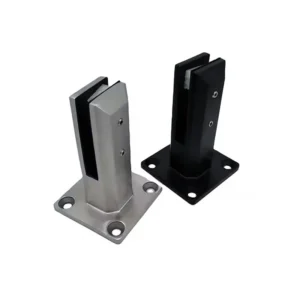
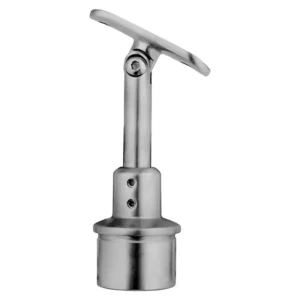
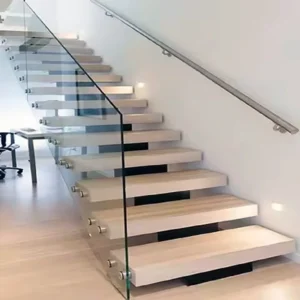
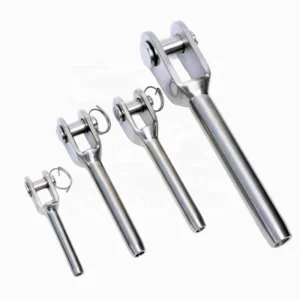
Specify the round clamp as part of the glass-support detail, not by face shape alone. Send a panel sketch, glass build-up, support profile and exposure conditions. ESANG can use those inputs to prepare a proposed clamp configuration for comparison.
Discuss round glass clamps on WhatsApp

Start with the connection, not the diameter
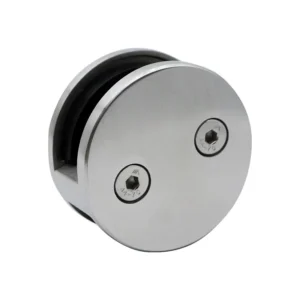
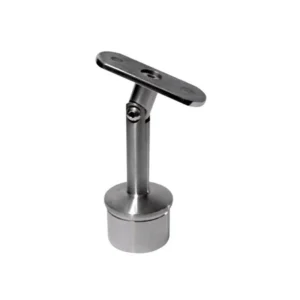
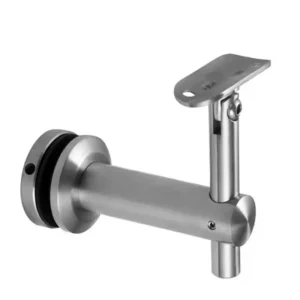
“Round glass clamp” can describe a circular face, a rounded D-shaped body or another curved visual treatment. Those forms do not establish the same rear connection or the same role in a railing. Mark the clamp location on an elevation and identify whether it meets a flat post, a round tube, a wall plate or another glass panel. A flat-backed clamp placed on a curved post can rock; a curved saddle selected for the wrong tube can leave uneven bearing or force a site modification.
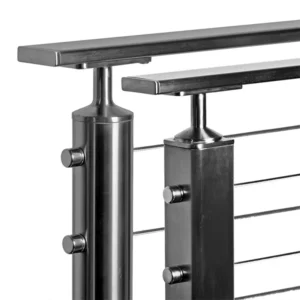
The quotation should identify the proposed body form and its mounting-side geometry. If a round tube is involved, provide its outside diameter and wall thickness rather than a photograph alone. For a flat post or plate, provide the available face width, material thickness and access behind the mounting face.
Define the glass and retention route together
The glass description should state monolithic or laminated construction, heat treatment where specified by the project designer, nominal build-up and tolerance, edge condition and any interlayer details. A nominal thickness on its own does not select the inlay or prove that the complete assembly is suitable.
Then choose the retention concept required by the approved system:
- Non-drilled clamping: the glass bears against matched inlays and depends on the specified clamp arrangement, pressure and system detailing.
- Drilled glass with a locating or safety pin: the hole diameter, centre position and edge distance must be coordinated before glass fabrication. A field-drilled substitute is not equivalent.
- Laminated glass: the designer must define the anti-slip or mechanical retention method appropriate to the assembly; clamp pressure should not be assumed to provide the complete post-breakage strategy.
Ask the quote to list the inlay material and thickness, whether a locating pin is included, and whether the glass requires a hole. These details prevent a clamp body and an otherwise similar-looking gasket from being treated as interchangeable.
304 or 316 is one field in the specification
The title identifies 304 and 316 as sourcing directions, but it does not mean that every visible round form is offered in both grades. State the installation environment, distance from salt or de-icing exposure where relevant, pool or cleaning chemicals, indoor or outdoor use, and the desired finish. The proposed quote should name the grade for the clamp body and the exposed fasteners and should identify any parts made from a different material.
Material grade does not replace drainage, cleaning access, surface finishing, crevice control or maintenance planning. If grade verification is required, request the documentation with the inquiry so the proposed supply and the required evidence can be compared together.
Compare a complete clamp package
| Quote field | What should be stated | Why it changes the result |
|---|---|---|
| Clamp body | Visible form, dimensions and mounting-side geometry | Controls appearance, clearance and fit to the support |
| Glass interface | Glass build-up, matched inlay and required hole or no-hole route | Controls bearing, edge preparation and retention |
| Positioning | Locating pin, anti-slip device or other stated method | Separates panel positioning from simple clamping pressure |
| Fasteners | Clamp screws, mounting screw or stud, caps and any installation tool requirement | Prevents an incomplete bag of parts reaching site |
| Supply boundary | Included inlays and fasteners; excluded posts, glass, anchors, rails and engineering | Makes two offers commercially comparable |
System responsibility remains project-specific
A clamp is only one load-transfer point. Panel size, glass make-up, clamp quantity and spacing, hole location, posts, rails, base connections, anchors, substrate and applicable project requirements act together. The name “round clamp,” the steel grade and the product photograph do not establish a load rating or compliance for the completed guard or barrier.
The project designer or responsible system supplier should approve the layout and complete load path. Installation records should capture the approved clamp locations, fastener details and tightening procedure rather than relying on a generic value transferred from another configuration.
Send enough to start, then close the critical fields
An inquiry can begin with an elevation, marked-up photograph or estimated quantity. Include what is available:
- panel count and approximate glass width and height;
- glass construction, nominal thickness and whether holes already exist;
- flat or round mounting surface, tube outside diameter where applicable, and available face dimensions;
- required clamp locations and whether a pin or other positive retention is specified;
- indoor, outdoor, coastal, poolside or chemical-cleaning exposure;
- preferred visible finish, quantity, destination and any required material documents.
The resulting proposal should freeze the proposed clamp body, inlay, back seat, positioning method, fasteners and exclusions before glass drilling or site installation begins.
Round glass clamp questions
Does a round face fit a round post?
Not automatically. The rear seat must match the support profile. Provide the post outside diameter and wall information so the mounting-side geometry can be selected.
Can the clamp be ordered without drilling the glass?
That depends on the proposed retention route and the approved system. The quote should state “hole required” or “no hole” and identify any locating or anti-slip component.
Is 316 a complete coastal specification?
No. Grade selection is only one part of the assembly. Exposed fasteners, finish, drainage, cleaning chemicals, interfaces and maintenance all remain relevant.
Can clamps be requested as components rather than a full railing package?
Yes. State that the inquiry is for component supply and identify which inlays, pins and fasteners must be included. The quotation should make the component boundary explicit.