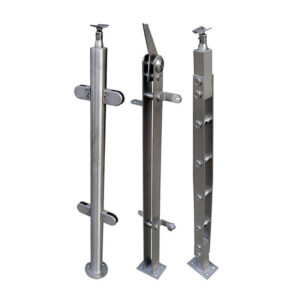
Anchor bolts hidden beneath a coating can be extensively corroded while the rail surface looks structurally sound. When a later audit or a failure event demands proof of compliant installation, the only way to resolve the dispute without reopening finished work is a record taken before those interfaces were covered. Projects that treat post installation as a visual check after finishes are complete routinely discover that the photos on file cannot demonstrate the correct anchor type, embedment depth, or weld quality was achieved—because nothing in the image proves where the post sits, what it is anchored to, or whether the substrate met tolerance at the time of installation. The judgment that controls downstream risk is taken before covers go on, not after: what gets recorded at the interface, how it is tagged, and whether the record can be matched back to an approved drawing location determines whether close-out is defensible or disputed.
Location-Based Evidence for Installed Posts
The slab-to-post connection carries the full transferred load from any impact or loading event on the rail, yet it is the part of the assembly most likely to be recorded with the least precision. A photo showing a post in position tells a reviewer that the post was installed; it does not tell them which anchor was used, whether embedment met the specified depth, or whether the substrate condition at that location was acceptable on that day.
Location-based records change the audit function of a photo by tying it to something a reviewer can check. When a post image is tagged with a location identifier that corresponds to the approved drawing—post P-14 at gridline C3, for example—the reviewer can trace that record back to the specified anchor detail, the approved material batch, and any condition notes recorded at that interface. Without that link, the photo exists in isolation. A collection of unlocated installation images is difficult to use as evidence that any specific post location was installed correctly.
In coastal environments, this matters most at the connection point rather than at the rail itself. Where chloride exposure is a realistic condition, the anchorage is the part of the assembly that begins degrading earliest and least visibly. ASTM E894 provides a testing framework for anchorage strength under applied loads, and while it is not a field inspection method, the load conditions it models are a useful reference for understanding why the connection—not the rail—is where inspection evidence needs to be most precise. A railing system that passes strength requirements at installation can perform differently years later if the embedded anchorage has been degraded by corrosion in a way that was never recorded and never visible from the surface. The Complete Stainless Steel Posts Guide for Construction and Architecture Projects provides further context on how material selection and installation standards interact across the service life of a stainless steel post assembly.
Why Untagged Photos Fail Review
An installation photo without a location tag, measurement reference, or verifiable timestamp creates a specific audit gap: it shows a state but cannot prove a condition. Reviewers tasked with confirming that field installation matches the tested configuration need more than visual confirmation that work was done. They need to verify that what was done at a specific location matches what was approved for that location—which requires the photo to carry that locating information in the frame or its metadata, not just in someone’s memory of the site.
Product documentation alone does not close this gap. Evaluation reports and cut sheets confirm what a system is rated to do; they do not confirm what was installed in the field. Anchor strength, post placement, and substrate condition at each location are field variables that a product data sheet cannot speak to. When an inspector finds a discrepancy between the approved detail and the as-built configuration, the burden falls on the installation record to show that the correct condition was achieved. If the record cannot demonstrate that, the practical outcome is often a request to reopen work or to re-inspect—at the installer’s cost and schedule.
Timestamped, tamper-evident photo capture reduces one dispute vector: the question of whether a record was taken before or after a condition changed. Some inspection software tools create a tamper-evident audit layer by logging the exact capture time and preventing alteration of the file after the fact. That capability is not a universal requirement, but it addresses a real challenge when the sequence of events is contested. The more consequential control is the tagging and measurement information visible in the image itself.
| Photo Evidence Gap | Why It Fails Inspection Review | What Records Should Include Instead |
|---|---|---|
| Missing location tag or measurement reference | Cannot tie the photo to the correct post location, anchor type or weld; no proof of correct tolerance or placement | Tagged photo with location ID, measurement scale and reference dimension visible in frame |
| No timestamp or tamper-evident metadata | Reduces audit certainty; timeline of installation and integrity of the record cannot be verified | Timestamped, tamper-evident file that logs the exact capture time and prevents alteration |
| Relying solely on product documentation | Does not confirm as‑built field conditions, anchor strength or post placement against the tested configuration | Installation photos showing field conditions, anchor embedment and post layout matching approved drawings |
The common mistake pattern here is capturing photos at high volume but low specificity—dozens of images from a balcony run that together cannot confirm a single post location with precision. Review teams benefit more from fewer, well-tagged records than from a large library of images that cannot be matched to approved drawing locations.
Full Inspection Versus an Approved Sampling Plan
The choice between inspecting every post interface and inspecting a defined sample is a planning decision, not a default. Both approaches can be defensible; neither is automatically required or automatically sufficient. What makes either approach fail is leaving the choice unresolved until after covers have been installed.
Full inspection of every interface produces the strongest traceability: every connection point has a record, every deviation is captured at the time of installation, and there is no ambiguity about whether an uninspected post location was representative of the others. For smaller projects, or for installations in high-exposure environments where interface conditions may vary significantly from post to post, full inspection is easier to defend in a later dispute than any sampling argument would be.
A sampling plan reduces inspection effort on larger projects, but it introduces a condition that must be agreed before work starts: what constitutes a valid sample, what triggers an exception that expands the sample, and who has authority to make that call. ISO 9001:2015 supports the use of sampling plans under defined conditions as part of a quality management process, but it does not prescribe a specific ratio for railing post inspection. The ratio and exception criteria are project-specific decisions. Where the plan is not agreed in advance and documented, disputes about whether a sampled location was truly representative of the run are difficult to resolve—particularly if the unsampled locations are now covered.
The downstream consequence of an undocumented sampling decision is that it looks, in a later review, like a gap rather than a plan. If an audit or failure event raises questions about a post location that was not included in the sample, the absence of a documented sampling rationale makes it harder to argue that the decision was deliberate and technically justified rather than an oversight.
Recording Interfaces Before Covers Hide Them
Once a decorative cover, a floor finish, or a sealant coat goes over a slab penetration or a base plate, the interface is effectively inaccessible for visual inspection. The record taken before that point is the only evidence of what existed at the connection. This is not a sequence that can be partially corrected later—the opportunity to inspect is discrete and time-limited.
Slab penetrations around posts are a corrosion entry point in chloride environments. Every hole drilled through a balcony edge or slab surface creates a potential path for water and chloride to migrate toward the embedded steel and the anchorage. This does not mean that every penetration will degrade, but it does mean that the condition of those penetrations at the time of installation—how they were sealed, whether the surrounding substrate showed existing damage, and how the post was anchored into the prepared opening—is exactly the information that cannot be recovered once a finish coat covers the area. Placas base de montaje en superficie installed over penetrations that were not photographed and recorded before sealing present the same challenge: the interface condition becomes unverifiable from the surface.
A rail can appear structurally sound while the anchor bolts beneath a coating sit in compromised concrete. Surface appearance is not a reliable proxy for anchorage integrity once finishes are in place.
| Hidden Interface | Riesgo de corrosión | Consequence if Not Inspected Before Covering |
|---|---|---|
| Slab penetrations around posts | Chloride entry accelerates corrosion of embedded steel and anchorage | Gradual loss of anchorage capacity; rail may fail later despite initial strength test passing |
| Anchor bolts and base plates beneath coatings or finishes | Corrosion can compromise the connection without visible signs on the rail surface | Rail can appear sound while the anchorage is degraded; risk of sudden failure under load |
The practical implication is that the inspection sequence must be built into the installation workflow, not added as a close-out step. Scheduling photo capture and condition recording as a hold point before each cover application is a straightforward process control; treating it as optional or deferring it until punch-list creates the exact documentation gap that later disputes depend on.
Documentation Required to Close Installation
Closing a post installation means more than completing the physical work. It means assembling a record set that allows a reviewer—immediately or years later—to confirm that what was installed matches what was approved, at each specific location, under the conditions that existed at the time. A project that finishes the work but not the records has not actually closed the installation from a verification standpoint.
The risk of an incomplete record set is not simply that permit review takes longer. A railing that met strength requirements at installation can lose anchorage capacity over time if embedded corrosion was not captured in the initial condition record. If the first evidence of degradation is a failure event or a third-party inspection, the absence of installation documentation removes the baseline needed to determine whether the failure represents a material defect, an installation error, or post-installation deterioration. Each of those findings has different remediation and liability implications, and the record set is what separates them.
Keeping all documentation on site and matched to approved drawing locations is recommended practice because the alternative—assembling the record set after the fact from memory and file searches—reliably produces gaps. Evaluation reports should travel with installation records because they establish the code basis and the rated configuration; a cut sheet without an evaluation report leaves a reviewer without the independent confirmation that the system was acceptable under the governing standard.
| Document/Record | Lo que confirma | Risk if Missing |
|---|---|---|
| Product cut sheets | Approved material specifications and design details for the installed railing system | Field inspector cannot verify that installed product matches what was approved |
| Evaluation reports | Code‑acceptance basis, guardrail height and applied code standard for the system | No independent proof the system is acceptable under the governing building code |
| Installation photos (tagged and measured) | As‑built post placement, anchor embedment, weld quality and substrate condition match the tested configuration | Disputes over field conditions, anchor strength or alignment cannot be resolved without opening covers |
| Compliance summary | Simple collation confirming all records are present and matched to the approved drawing locations | Permit review proceeds without clear demonstration that the as‑built matches the approved design |
ISO 9001:2015 supports document control as a process discipline, but the specific documents that close a post installation are determined by the project’s approval requirements, not by a universal checklist. The table above maps document types to what each record confirms and what is at risk if it is missing—use it as a gap-check against the approved drawing package before sign-off, not as a substitute for confirming the specific submission requirements on the project.
The most consistent failure pattern across post installation close-out is the same at each project stage: a decision that should have been locked in before covers were applied gets deferred, and what remains afterward is a set of records that cannot answer the questions a reviewer will ask. Untagged photos cannot locate a post. A photo without a measurement reference cannot confirm a tolerance. A record taken after finishes are complete cannot prove the interface condition that existed before sealing.
Before signing off on a post installation, confirm that every record is tagged to a drawing location, that interface photos were taken before covers were applied, that the sampling approach—if one was used—was agreed and documented rather than assumed, and that the permit package is complete with cut sheets, evaluation reports, and a compliance summary matched to the approved configuration. That is the point at which the installation is actually closed, not when the physical work is finished.
Preguntas frecuentes
Q: Does the same inspection evidence standard apply to inland projects where corrosion risk is minimal?
A: Yes, though the urgency is lower. The core need — proving each post location was installed to the approved detail — remains because any later failure investigation, warranty claim, or ownership transfer may require traceable location records. Corrosion is one risk; anchor type errors, missed embedment depths, and slab condition anomalies occur regardless of chloride exposure, and once finishes cover the interface the evidence is equally lost.
Q: We’ve already installed decorative covers and finishes without taking pre‑cover photos. What’s the most defensible path forward?
A: Accept that retrospective proof of interface condition is impossible and disclose the gap. The next step is to work with the engineer to identify whether selective destructive inspection, non‑destructive testing, or drawing‑based reconciliation of the accessible hardware can provide enough confidence to close the installation. Document the gap, the remediation rationale, and any partial evidence explicitly so a future reviewer understands what was done and why.
Q: Are there project conditions where a sampling plan is not defensible even if agreed in advance?
A: Yes. Sampling becomes difficult to defend when failure of a single post has a disproportionate consequence, when post‑to‑post substrate variability is high and documented, or when the installation will be covered in a way that prevents later full inspection. In those situations, a sampling rationale can still be written but may not survive a serious audit or failure review — full location‑by‑location records are safer.
Q: How do I weigh the cost difference between full inspection and a sampling plan against the risk of a later dispute?
A: The calculation isn’t just inspection hours. Full inspection avoids the cost of defending a sampling rationale later, prevents the need to reopen work on a disputed post, and eliminates the risk that an unsampled location becomes the point of failure. For small to medium projects and any high‑exposure environment, the cost of full recording is typically lower than the cost of a single disputed close‑out or remedial opening.
Q: Is this level of documentation really necessary for a small residential railing project, or is it over‑engineering?
A: It can be scaled, not skipped. Even for residential work, a few tagged photos showing each post location with the anchor detail visible before covers are applied provides durable evidence if a failure or sale later raises questions. Local inspection may not demand it, but the absence of any location‑linked record leaves the installer carrying full risk for conditions that cannot be re‑verified once finishes are complete.