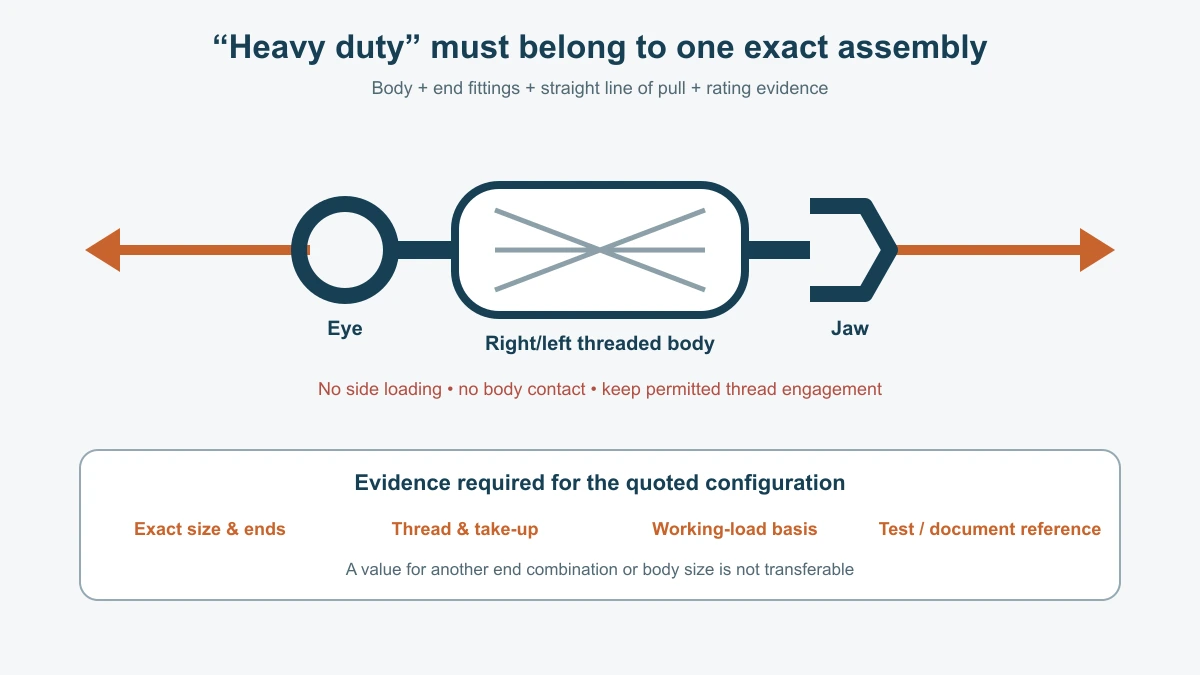
“Heavy duty” is a purchasing category, not a fixed load grade. A turnbuckle should be selected from an exact body size, end configuration, thread and take-up, material, stated working-load basis and supporting documentation for that configuration. For cable railing, the buyer must also confirm that the end fittings, cable termination, post connection and complete load path are appropriate; a large body or product title does not establish system capacity. Send the load or project requirement, cable and end details, installation geometry and quantity to begin a bounded review.
Discuss a documented turnbuckle configuration on WhatsApp
Make the “heavy duty” evidence specific
The proposed item should identify its manufacturer or drawing revision, nominal size, body type, right- and left-hand threaded ends, working load limit or other stated design basis, test or certificate reference where required, and any restrictions on use. Proof load, ultimate or breaking load, and working load are different terms; one must not be substituted for another. A value for an eye-and-eye assembly may not apply to the same body fitted with hooks or different end components.
The complete cable run is limited by its weakest verified element: cable, termination, pin, eye or jaw, turnbuckle body, mounting hardware, post and substrate. Project designers remain responsible for the railing and applicable load criteria. ESANG’s proposed supply should state what documentation belongs to the exact quoted item rather than treating the page name as a rating.
End fittings change the connection and the rating
| End form | Connection task | Main risk to resolve |
|---|---|---|
| Eye | Receives a compatible pin, shackle or connector | Pin fit, bearing, edge clearance and side loading |
| Jaw or fork | Straddles a tab or eye and closes with a pin | Jaw gap, pin diameter, tab thickness, retention and articulation |
| Hook | Provides a fast connection where the exact application permits it | Opening, retention, tip or side loading, and whether an open hook is acceptable |
| Threaded stud or cable terminal | Connects the turnbuckle directly to a matched threaded or cable component | Thread form and hand, engagement, cable termination and assembly tools |
Turnbuckles are intended to work in a straight line of pull unless the exact manufacturer documents another condition. Do not use the body or threaded shanks as bearing surfaces, and do not force a fixed eye or hook to accommodate an angled cable. A stair or sloped termination normally needs an articulated end or a separate multi-angle tensioner selected for that geometry.
Open and closed bodies have different inspection and access needs
An open-body turnbuckle exposes thread engagement and makes the relationship between the body and both end fittings easy to see. A closed body presents a cleaner envelope and may protect or conceal part of the mechanism, but the drawing must make the remaining engagement and adjustment limits clear. In both cases, the installer needs clearance to rotate the body and access the locknuts or retention feature.
Record the closed length, open length, usable take-up and minimum engagement. More body length is not automatically more safe adjustment. The initial cable length should place the turnbuckle within its stated working range, with reserve for final tensioning, without backing an end fitting past its permitted engagement. Confirm how the final setting is locked and whether the locking components are included.
Cable and termination compatibility still control the assembly
A turnbuckle may connect to a cable through a swaged terminal, a swageless mechanical terminal or another prepared end. State the cable diameter and construction, such as 1×19 or 7×7, because flexibility and gripping requirements differ. A fitting that accepts one diameter is not automatically suitable for every construction at that diameter.
For swaged assemblies, define whether the terminal is factory attached or field compressed, the approved tool and die, and the finished cable length. For swageless assemblies, define the gripping parts, cable preparation, hand tools and inspection sequence. Swageless does not mean no tools, reusable hardware or universal fit. The turnbuckle quotation should not hide these cable-side responsibilities behind a general “complete” description.
Railing interface: surface connection, through-post detail or separate anchor
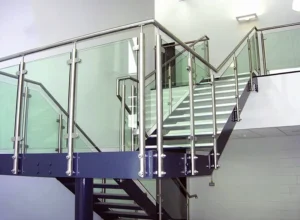
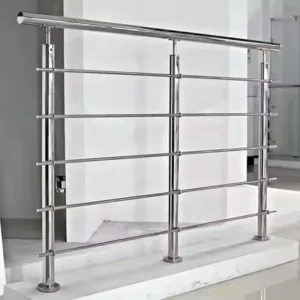
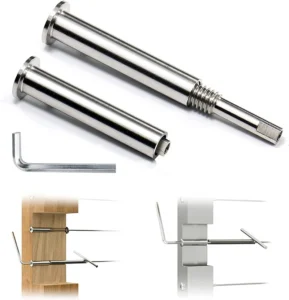
Many visible turnbuckles connect between an eye, jaw or mounting tab on the inside face of a terminal post. That is a surface interface, and its plate, weld, pin and fasteners must be defined by the project. A through-post cable tensioner instead passes a threaded element through the post and is usually a different product architecture. Do not assume a heavy turnbuckle can simply replace a compact through-post terminal.
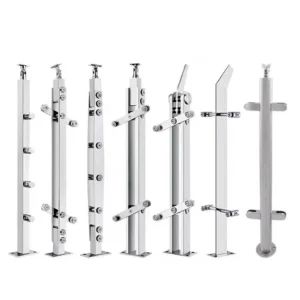
If a threaded or pinned connection does pass through or behind a post, confirm the actual post depth, wall thickness, hole or slot, bearing surface and rear access. A thicker post may need a longer terminal; a closed rear face may prevent installation. Post reinforcement and anchor design are part of the railing structure, not properties supplied by the turnbuckle name.
Keep railing tensioning separate from general rigging
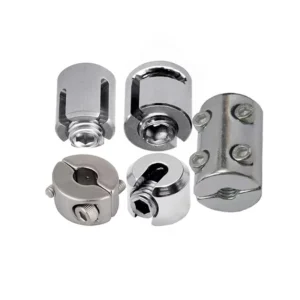
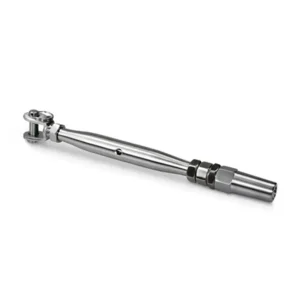
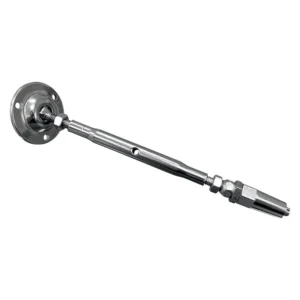
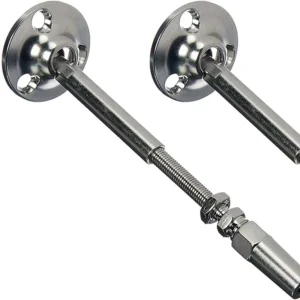
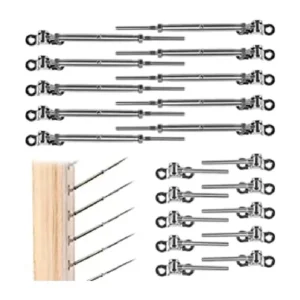
The photographed form on this page shows visible turnbuckle hardware, but a visual match does not prove material, load rating or approval for a particular use. General rigging turnbuckles, architectural cable turnbuckles and cable-railing tensioners may use similar bodies while differing in end retention, documentation, finish, geometry and intended service. The inquiry must name the actual application.
For a guard or handrail, the complete installed assembly must be evaluated to the project requirements. This page does not authorize lifting, life-safety, marine standing-rigging or other specialist use. If the requirement is primarily fine cable adjustment in a compact railing post, compare adjustable cable tensioners instead of choosing a heavy turnbuckle by appearance.
Supply boundary and common mismatch consequences
The proposed supply may be one body, a body with two end fittings, a cable-connected assembly or a scheduled set for multiple runs. Ask the quotation to itemize bodies, eyes, jaws, hooks, studs, pins, cotters, locknuts, cable terminals and cable. Mounting tabs, post plates, anchors, structural calculations, site installation, initial setting and inspection are excluded unless expressly included.
- Rated body with unrated or different ends: the assembly no longer has the cited basis.
- Hook or eye loaded off-axis: the end sees a condition not represented by a straight-pull rating.
- Wrong thread hand or pitch: the parts will not tension together and may be damaged.
- Insufficient engagement after take-up: visible adjustment remains, but the thread is outside the permitted working range.
- No body-rotation clearance: the selected turnbuckle cannot be adjusted after mounting.
- Railing and rigging uses confused: documentation for one application is applied to another without approval.
What to send and what the proposal should return
Send the application and required design basis; straight-line load information supplied by the project designer; cable diameter, construction and terminal method; required end combination; closed and open envelope; required take-up; mounting tabs, pins, eyes or post details; through-post or surface-mounted condition; articulation requirement; installation and future adjustment access; material and finish requirement; exposure; quantity; and documentation required for acceptance.
The proposed item should return the exact body and end configuration, thread size and hand, closed/open length, usable take-up, minimum engagement, locking detail, pin or eye interface, proposed material and finish, cable termination route, included parts, use restrictions and configuration-specific rating evidence where offered. If those fields are not fixed, “heavy duty” remains only a name.