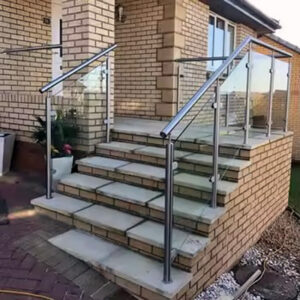
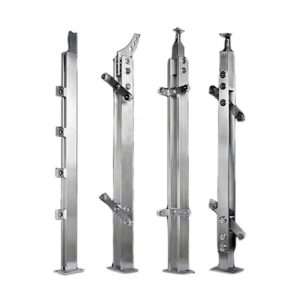
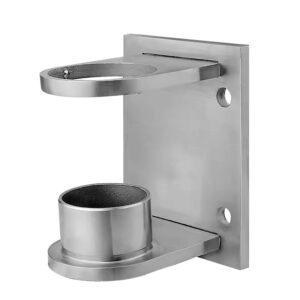
Specifying a railing post as “core-drilled” resolves the mounting method but leaves the consequential questions unanswered. Grout selection, drainage path, membrane termination, and trade responsibility are routinely deferred to installation, and by the time staining appears or a post shifts, the assembly is buried and the coordination window has closed. The rework is destructive: breaking out hardened grout, repairing concrete, and re-establishing a waterproofing seal in a finished condition costs significantly more than resolving these details on paper. The decisions that prevent failure—embedment approach, annular geometry, grout chemistry, and who owns the penetration seal—need to be made and documented before coring begins, not improvised by the installing trade.
Core Hole and Sleeve Assembly Boundaries
A core-drilled post installation is suited to hard structural substrates—concrete decks, stone pavers—where the drill can produce a clean, dimensionally consistent hole capable of carrying the post base loads. That constraint is a starting point, not a specification. The hole diameter, depth, edge distance, and annular gap between post and surround are design figures that need to be derived from the specific substrate, structural requirement, and grout manufacturer’s placement instructions, not carried over from an unrelated project or a generic detail sheet.
The sleeve assembly boundary is where that geometry decision becomes irreversible. Once the hole is drilled and the grout or sleeve is set, the annular space is fixed. If the gap is undersized for the specified grout’s aggregate, full encapsulation is compromised before the post is ever loaded. If the gap is oversized relative to the sleeve fit, the sleeve will need independent stabilization, and the sealing requirements at both the inner and outer interface multiply. Neither condition is recoverable without demolition.
ASTM E894 provides a testing framework for the anchorage performance of permanent metal railing systems, which is relevant when specifying or validating what the embedded post assembly must resist. It does not prescribe substrate type, hole geometry, or grout selection, so it cannot substitute for a coordinated embedment detail. Treat the anchorage performance requirement as the performance target, and treat the core hole geometry as the design figure that must demonstrably serve it.
Water Entrapment and Grout Failure Risks
The most damaging failures in core-drilled post assemblies are not structural—they are waterproofing failures that appear after handover. Staining, spalled concrete, and lifted posts are typically the visible result of a grout or drainage detail that was specified incompletely, not a post that was improperly anchored. The risks compound: trapped water feeds freeze-thaw expansion, which cracks grout, which allows more water in, which accelerates corrosion of the embedded post section, which then stains the finish and attacks the membrane below.
Grout chemistry is a frequent source of this failure pattern. Specifying non-shrink grout by referencing ASTM C1107 alone does not close the risk. ASTM C1107 does not exclude gypsum-containing formulations, and gypsum is water-soluble under sustained moisture exposure. Repeated wet-dry or freeze-thaw cycling can turn a gypsum-bearing grout to rubble, returning the post to an essentially unanchored condition while the surface shows only fine cracking. The specification needs to go further: non-shrink, outdoor-rated, freeze-thaw stable, with a positive confirmation that the selected product is appropriate for prolonged wet exposure at the specific climate and exposure category.
Drainage geometry matters equally. A chamfer formed on the top surface of the grout directs surface water away from the post rather than pooling it at the annular interface. For hollow posts, weep holes at the base prevent condensation accumulation inside the post section; a pourable sealer fill up to weep level is one approach to managing the interior cavity without blocking drainage. A sealant bead at the post-to-grout interface is sometimes added as a secondary barrier, but it is fallible and degrades over time—if it appears in the detail, a maintenance interval and a responsible party for renewal need to appear alongside it.
Each risk mechanism in this assembly interacts with at least one other, which is why partial details tend to fail in clusters rather than in isolation.
| Risk Mechanism | Por qué es importante | Qué hay que comprobar en el detalle |
|---|---|---|
| Condensation and trapped water (no weep holes) | Internal corrosion, freeze‑thaw cracking, staining | Define weep holes at post base; optional pourable sealer up to weep level in hollow posts |
| Expansive grout (gypsum‑containing) | Volume instability under moisture, grout turns to rubble | Specify non‑shrink grout suitable for outdoor wet freeze‑thaw; verify whether gypsum is present and its long‑term stability |
| Freeze‑thaw of water in annular space | Spalling concrete, post thrust upward | Chamfer on top of grout for runoff; confirm drainage path so water does not collect around post |
| Embedded metal corrosion | Staining, loss of section, structural degradation | Identify post material corrosion resistance; clarify whether grout or sealant provides primary weatherproofing |
| Cracked grout at post base | Water ingress to concealed surfaces, waterproofing damage | Form chamfer to shed water; if sealant bead is used, state maintenance interval and responsible party |
Direct Embedment Versus Replaceable Sleeves
The choice between grouting directly around the post and installing a separate sleeve is often treated as a product preference, but it carries a long-term consequence that belongs in the specification: how the post will be replaced if it needs to come out.
Direct embedment—post shimmed, grouted, and anchored in one operation—is compact and introduces a single interface. When the grout functions as both the anchor and the primary weatherproofing agent, there is no secondary gap to seal. The design is straightforward in principle. The liability appears when the post must be replaced: extracting a post from hardened grout is a destructive operation that also opens the waterproofing below. In high-traffic or exposed installations where post damage or finish change is a realistic lifecycle event, the cost of that extraction is a legitimate design consideration, not a remote contingency.
A replaceable sleeve shifts that maintenance calculus. The sleeve stays embedded; the post lifts out. That is an advantage. The trade-off is that the sleeve introduces two sealing interfaces—post-to-sleeve and sleeve-to-surround—both of which must be sealed and held rigidly. The hole diameter increases to accommodate the sleeve wall, which affects edge distance requirements and may constrain placement geometry on narrow decks or at slab edges. If the sleeve-to-post fit is loose, movement at the post base is possible even when the sleeve itself is solid.
Neither approach is inherently superior. The question to resolve in the detail is whether post replaceability is a defined maintenance requirement for this project, and whether the substrate and geometry can absorb the larger hole that a sleeve assembly requires.
| Factor | Direct Embedment | Replaceable Sleeve |
|---|---|---|
| Post replacement | Requires breaking out grout and re‑setting post | Post lifts out; sleeve remains in place and is reused |
| Interface count | One (post‑to‑grout) | Two (post‑to‑sleeve, sleeve‑to‑surround) |
| Weatherproofing reliance | Grout acts as anchor and weatherproofing agent | Sealing required at both inner and outer sleeve interfaces |
| Compactness | Minimal additional diameter beyond post | Sleeve increases overall hole size and may require more edge distance |
| Stabilization | Shim and grout provide direct bearing | Sleeve must be fixed rigidly; post‑to‑sleeve fit must control movement |
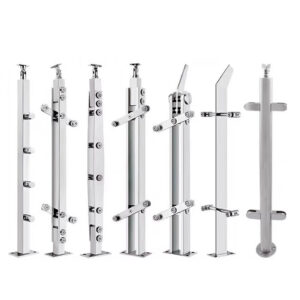
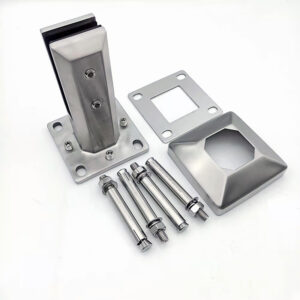
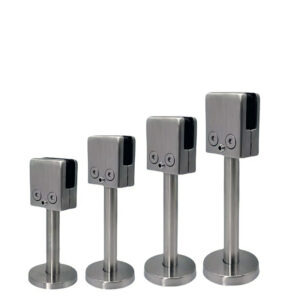
For projects where both approaches are under consideration, sistemas de base para montaje central illustrate how the hardware configuration varies between embedment methods and what dimensional planning each requires.
Trade Handoffs at the Waterproofing Interface
The core-drilled post penetrates the deck surface. That fact is not incidental—it is the origin of the most persistent accountability gap in this type of installation. Side-mounted posts avoid the penetration entirely, which is part of why they are specified for waterproofing-sensitive decks. When penetration is the chosen approach, somebody must own the seal at that penetration through the full construction sequence, and that ownership rarely gets defined in the way a structural or mechanical system would be.
What typically happens instead: the waterproofing contractor installs and terminates the membrane, the drilling subcontractor cores the hole, and the railing installer sets the post and groutes. Each trade performs its scope. No single party is responsible for the integrity of the seal at the interface between them. If the membrane is not lapped and terminated around the post base before grouting, the grout itself becomes the only barrier against downward water migration—which is precisely the condition that leads to invisible damage accumulating in the substrate beneath a finished deck.
The practical resolution is not complicated, but it does require explicit contract language. Membrane repair or termination around the penetration needs a designated responsible trade and a sign-off requirement before grouting proceeds. Grout compatibility with the waterproofing system needs to be confirmed by the waterproofing manufacturer before it is placed, not after. If a sealant bead is part of the detail, the substrate preparation requirement and the post-handover maintenance responsibility need to be stated, not assumed.
| Task / Interface | Riesgo si no está claro | Lo que debe especificar el contrato |
|---|---|---|
| Core drilling | Overcut, dust, damage to existing membrane; no acceptance of substrate readiness | Hole diameter tolerance, surface cleanout, and who inspects before post placement |
| Membrane repair / termination | No single trade owns the waterproofing seal around the post | Designate a waterproofing trade responsible for membrane upturn, boot, or flashing detail; require sign‑off before grouting |
| Post setting and grouting | Grout not compatible with waterproofing; not installed to waterproofing manufacturer’s requirements | Grout type approved by waterproofing manufacturer; confirm grout is placed without damaging membrane |
| Sealant bead / final water seal | Sealant applied without substrate prep; no defined maintenance | State surface preparation, sealant compatibility, and who maintains (and how often) the seal after handover |
The table defines the sequential tasks and what each contract handoff needs to specify. The prose point that the table cannot carry is simpler: when there is no single acceptance owner for the waterproofing breach, the liability surface is the entire concealed assembly, and it will not become visible until it has already failed.
Detail Approval Inputs for a Core-Mounted Post
A detail that reaches the field incomplete transfers the specification burden to the installing trade, which is not equipped to make those judgments. The five elements that most often remain undefined—embedment depth, annular space, grout type, drainage, and membrane termination—are not independent. A change to any one of them affects the others, and leaving any one open means the detail cannot be reviewed or approved with confidence.
Embedment depth needs to be derived from the structural requirement and the substrate, not estimated from a generic table. Edge distance affects where posts can be positioned relative to slab edges, penetrations, or existing rebar, and it needs to be resolved before coring is scheduled. Annular space needs to match the grout manufacturer’s recommended gap for full encapsulation at the specified diameter. A gap too small for the grout aggregate produces an incomplete bond; a gap sized for a sleeve that was later substituted with direct embedment leaves the post under-constrained.
Grout specification is where the greatest downstream consequence is concentrated. Referencing ASTM C1107 without supplementing it creates a genuine exposure: the standard provides a testing framework for packaged dry-mix cementitious grout but does not guarantee outdoor durability or exclude gypsum. For an exterior deck in a climate with freeze-thaw cycles, the specification needs to require outdoor-rated, freeze-thaw stable performance and should positively confirm the absence of gypsum or provide documented evidence of long-term stability under wet exposure. These are not conservative interpretations—they are the conditions the assembly will experience.
| Detail Element | What to Confirm or Specify | Riesgo si se deja abierto |
|---|---|---|
| Profundidad de empotramiento | Minimum depth per structural requirement, substrate type, and edge distance | Post instability, uplift or lateral movement |
| Annular space | Gap size that matches grout manufacturer’s requirements and allows full encapsulation | Incomplete bond, excessive shrinkage, difficulty centring post |
| Grout type | Non‑shrink, outdoor freeze‑thaw grade; verify gypsum‑free or proven stability; reference ASTM C1107 with additional moisture‑exposure criteria | Expansion, cracking, water entrapment, long‑term deterioration |
| Drenaje | Weep holes at base, chamfered grout top, pourable sealer if hollow post | Trapped water, freeze‑thaw damage, concealed corrosion |
| Membrane termination | Detailed tie‑in between post waterproofing boot/flashing and deck membrane; identify responsible trade | Water ingress into structure, no accountable party for penetration seal |
The review checklist in the table works most usefully as a cross-referencing tool: each element should appear in at least one submitted document—structural drawing, grout data sheet, waterproofing shop drawing—and each should be traceable to an accountable party. If an element appears on none of those documents, it is an open specification gap, not a field judgment. For a broader view of how post material selection and installation method interact across mounting configurations, the Complete Stainless Steel Posts Guide covers material and performance considerations that inform the detail before it reaches the approval stage.
The detail for a core-drilled post is ready for release when five things are confirmed in writing: embedment depth supported by structural analysis, annular space matched to grout placement requirements, grout type specified beyond a generic ASTM reference to include outdoor durability and freeze-thaw stability, drainage geometry defined for both surface runoff and internal condensation, and membrane termination assigned to a responsible trade with a sign-off requirement before grouting. If any of those five elements is deferred to installation, the detail is incomplete regardless of how well the hardware itself is specified.
Before procurement or installation scheduling begins, the most useful question is not whether the hardware is correct—it is whether every party who will touch the penetration knows exactly where their responsibility ends and the next trade’s begins. That boundary, and the documentation that establishes it, is where most of the long-term performance risk actually sits.
Preguntas frecuentes
Q: Can I core-drill into a thin concrete overlay on a wood-framed deck?
A: No. Core-drilled posts need a full-depth structural concrete or stone paver substrate to develop reliable embedment depth and edge distance. A thin overlay cannot safely carry post loads and may debond from the supporting structure. Switch to a surface-mounted or fascia-mounted system when the structural substrate is insufficient.
Q: What should I include in the bid package to close the waterproofing handoff gap described in the article?
A: Add a pre-installation coordination schedule that names the trade responsible for membrane termination and mandates a hold-point inspection before grouting. Attach it to the scopes for waterproofing, drilling, and railing so that no post is grouted until the membrane seal is signed off by the designated owner.
Q: Do the article’s grout precautions about gypsum and freeze-thaw stability apply to an interior railing installation?
A: Not to the same degree. For dry, climate-controlled interiors with no moisture exposure or freeze-thaw cycling, a standard non-shrink grout meeting ASTM C1107 is generally adequate. Confirm that condensation or occasional wetting is not expected; if any moisture risk exists, avoid gypsum-bearing formulations to prevent long-term deterioration.
Q: When is it better to use side-mount posts instead of core-drilled to bypass the waterproofing complications?
A: Choose side-mount when the deck has a continuous waterproofing membrane that cannot be reliably terminated and sealed around a penetration, or when the substrate cannot accommodate the required hole diameter and edge distance. Side-mount eliminates the penetration entirely at the cost of a fascia attachment that must handle lever-arm loads.
Q: For a small residential balcony in a mild climate, is it worth paying extra for a gypsum-free, outdoor-rated grout?
A: The cost difference is usually small compared to the expense of destructive repair if water eventually degrades a gypsum-bearing grout. In mild climates the risk is lower, but if the assembly can trap rainwater, specifying a gypsum-free grout is a low-cost hedge. If the budget is tight, at minimum ensure a generous chamfer, clear weep paths, and a scheduled sealant maintenance plan.