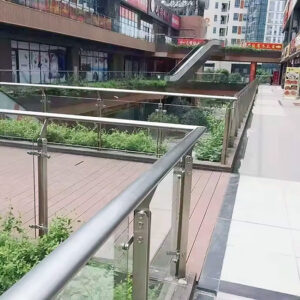
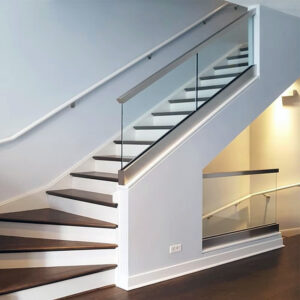
Selecting the wrong glass finish for a balcony railing is rarely obvious at the time of purchase—it becomes obvious six months later when a replacement panel arrives from a different production batch and the tone mismatch is visible from thirty feet away. At that point, correcting the problem means either accepting the inconsistency or replacing panels across the entire run, neither of which is a low-cost outcome. The real decision is not simply clear versus frosted; it is whether the privacy benefit justifies the finish management obligations that frosted glass introduces at every stage after installation. Understanding where those obligations become liabilities helps contractors and specifiers make a more defensible choice before the order is placed.
Privacy goals that change finish selection
Finish selection should follow a site-specific privacy assessment, not a default preference for one glass type over another. The relevant question is what the overlooking risk actually is: who can see the space, from what angle, at what distance, and under what light conditions. Frosted glass does not perform uniformly across all of those variables. At close range and in direct sunlight, standard frosting reduces visual detail effectively. At longer distances or in diffuse light, the privacy gain may be marginal compared to clear glass with appropriate railing height or landscaping.
Panel orientation compounds this. A frosted panel installed in a channel system with a vertical orientation reads differently than one installed in a horizontal slot, and the visible effect of frosting shifts depending on whether the viewer’s line of sight is perpendicular to the panel or at an oblique angle. Specifiers who treat frosting as a universal privacy fix, regardless of orientation or viewing conditions, often find that the finish delivers less than expected in practice—while still introducing all of the maintenance and matching constraints discussed below.
The more useful framing is to treat frosting as appropriate when overlooking risk is confirmed as the dominant concern at the site, not as a standard upgrade. When the goal is diffusing a direct sightline from an adjacent building or elevated walkway, frosting is a rational response. When the goal is simply a less reflective or more contemporary aesthetic, the finish choice has a different cost-benefit structure and the privacy framing may be doing more work in the specification rationale than the actual conditions support.
Surface treatments that affect appearance and upkeep
A common assumption among buyers is that frosted glass conceals surface marks better than clear glass. The opposite is often true. Acid-etched and ceramic-treated surfaces have textured profiles at the microscopic level that trap oils, mineral deposits, and airborne particulates in ways that smooth clear glass does not. Edge contamination—residue that migrates from sealant, adjacent metal hardware, or installation adhesives—tends to become more visible on frosted surfaces over time, not less. Uneven weathering across a panel face is also more legible on frosted glass because the diffuse background makes tonal variation easier to see than it would be on a reflective surface.
Cleaning protocol is not optional maintenance flexibility on frosted panels—it is a finish preservation decision. Abrasive pads and harsh chemical cleaners can alter the surface texture of frosted glass in ways that are not reversible without refinishing or panel replacement. Once that damage appears, it tends to be visible as irregular light-diffusion patches across the panel face.
| أسبكت | ما الذي يجب تحديده | ما أهمية ذلك |
|---|---|---|
| التنظيف الروتيني | Use pH-neutral cleaner and a soft microfiber cloth only; avoid all abrasive pads and harsh chemicals | Harsh cleaners and abrasives damage the frosted finish, leading to increased visible marking that is difficult to reverse |
| Hydrophobic Coating | Specify a hydrophobic coating to reduce water spots and fingerprints | Reduces visible maintenance marks but adds upfront coating cost; coating may require periodic reapplication over time |
The hydrophobic coating option is worth evaluating honestly. It does reduce fingerprint transfer and water spotting, both of which are more visible on frosted surfaces than on clear glass. But the coating adds upfront cost and introduces a reapplication schedule that is rarely factored into the initial project budget. On a commercial balcony with high occupant traffic, that reapplication interval becomes a recurring facilities cost, not a one-time specification decision. Whether the coating’s maintenance reduction justifies its lifecycle cost depends on the project’s actual traffic load and cleaning frequency—there is no single threshold that applies across all installations.
Clear glass versus frosted glass cost tradeoffs
Glass railing systems are generally estimated in the $200–$500 per linear foot range as a baseline—a planning figure useful for understanding the incremental cost of a frosted finish in context, not a fixed market price. The relevant question is where the frosted finish premium lands relative to that range and whether the functional benefit justifies the difference at the project’s specific scale.
On a short residential balcony run, the cost differential between clear and frosted panels may be manageable as a one-time decision. The math changes on longer commercial runs where every incremental dollar per linear foot compounds into a meaningful budget line. More importantly, the cost comparison cannot stop at the initial panel price. Frosted glass—particularly acid-etched or ceramic-treated finishes—tends to narrow the supplier pool, which has downstream procurement implications. A narrower supplier pool means less pricing competition on replacement panels, longer lead times when stock is limited, and less flexibility if the original supplier discontinues a specific finish specification.
The upfront cost of a hydrophobic protective coating should also be modeled into the comparison if that coating is being specified to offset the maintenance visibility problem. Buyers who compare clear glass at the base price against frosted glass at the base price, without accounting for coating cost and reapplication intervals, are not making an equivalent comparison. The full cost tradeoff includes finish cost, coating cost, cleaning protocol requirements, and replacement panel procurement risk—not just the per-panel price difference at order time.
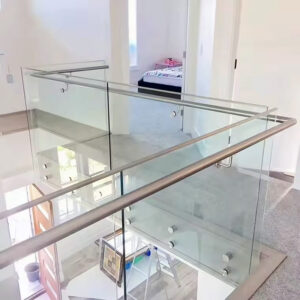
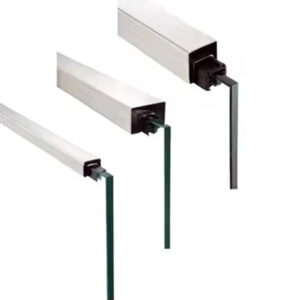
For installations where clear glass with a glass cap rail assembly and appropriate panel height can address the visual concern adequately, the added cost and management burden of frosted glass may not be justified. The functional benefit needs to be confirmed before the premium is accepted.
Replacement panel matching problems on long runs
Panel replacement is where frosted glass finish choices create their most consequential downstream problems. Frosting consistency—whether achieved through acid etching or ceramic coating—varies between production batches, and that variation is usually too small to detect when comparing a single replacement panel against a sample chip or specification sheet. It is not too small to detect when that panel is installed next to panels that have been weathering in place for two or three years.
On a long balcony run, even a slight tonal mismatch in frosting depth or surface texture becomes immediately obvious. The eye follows the horizontal line of the panels, and any variation in light diffusion reads as a defect rather than normal manufacturing tolerance. This is a procurement and aesthetic risk, not a structural one—but it is often more difficult and expensive to resolve than a structural correction would be, because it requires either sourcing a perfect batch match or accepting a visual inconsistency that owners and tenants will notice on a daily basis.
The practical implication for specifiers is that finish documentation matters more on long runs than on short ones. Before finalizing a frosted glass specification, it is worth confirming whether the supplier can provide batch-matched panels for future replacement orders, what the lead time and minimum order quantity would be for a future single-panel replacement, and whether the finish is a current product or a specialty item that may be discontinued within the installation’s expected service life. These are procurement questions, not design questions, but they need to be answered at the design stage. Waiting until a panel is damaged to ask them typically means accepting whatever the market offers at that moment—which is rarely the outcome the original specification intended.
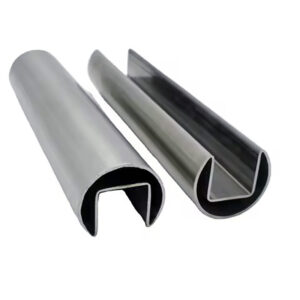
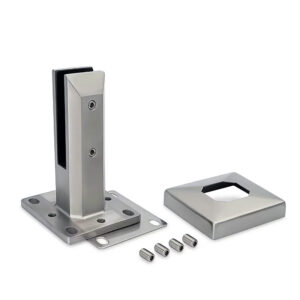
قنوات الأحذية ذات القاعدة الزجاجية and other hardware components are generally easier to source-match than the glass panels themselves, which means the panel finish is usually the more fragile element of the long-term appearance consistency plan.
Overlooking risk that makes frosting worthwhile
There is a specific site condition where the frosted glass case becomes clearly defensible: a balcony that is directly overlooked from above or from an adjacent structure at a close horizontal distance, where the occupant has a reasonable expectation of visual privacy that clear glass cannot provide at any practical railing height. In that situation, frosting addresses a functional problem that no amount of hardware refinement or alternative finish selection resolves.
Combining a 42-inch panel height with a frosted finish is a reasonable planning criterion for maximizing both privacy and wind barrier performance in those conditions—not a code mandate, but a practical specification that addresses overlooking risk more completely than frosting alone on a shorter panel. The height ensures the frosted zone covers the relevant sightline, and the frosted finish reduces visual clarity through the panel. Together they address the problem more reliably than either element alone.
The judgment threshold is whether overlooking risk is actually the dominant project concern or whether it is one of several factors being addressed through a single finish decision. Frosted glass earns its cost premium and its maintenance obligations when it is solving a confirmed, site-specific overlooking problem. When it is being specified as a general privacy preference, an aesthetic choice, or a hedge against undefined future concerns, the finish management burden it introduces—uneven weathering visibility, cleaning protocol sensitivity, replacement panel matching risk, coating reapplication cost—may outweigh the benefit over the installation’s service life. Clear glass, specified with appropriate panel height and hardware, is often the more defensible long-term choice when overlooking risk is not the controlling condition.
ASTM E985-24 provides a testing framework for permanent metal railing systems and rails for buildings that addresses structural and load performance; it does not govern privacy specifications or frosting decisions, but it remains a useful reference for confirming that the railing system itself meets structural performance expectations independent of the glass finish selected.
The most defensible path through this decision is to confirm the overlooking risk before committing to the finish. If a direct sightline problem exists at the site, frosted glass addresses it and the premium is justified by the function. If the concern is more diffuse—general privacy, aesthetics, or occupant preference—the finish management obligations that come with frosted glass are harder to justify against the long-term cost of coating maintenance, cleaning protocol enforcement, and replacement panel matching on a run that will eventually need a replacement panel.
Before finalizing any frosted glass specification, confirm batch-matching availability for future replacement orders, model the hydrophobic coating cost and reapplication interval into the total cost comparison, and verify that the cleaning protocol is compatible with the building’s maintenance program. Those three checks will surface the majority of the procurement and lifecycle risks before they become post-installation problems.
الأسئلة الشائعة
Q: Does frosted glass still provide meaningful privacy on a balcony that faces a public street rather than an adjacent building?
A: Probably not enough to justify the added cost and maintenance. Frosting performs best when a direct sightline exists from a close horizontal or elevated vantage point—a neighboring building, an overhead walkway, or a stacked unit above. A street-facing balcony typically involves longer viewing distances and oblique angles where the visual clarity difference between frosted and clear glass narrows considerably. In that condition, appropriate railing height with clear glass is usually the more cost-effective response, and the finish management obligations of frosted glass are harder to defend.
Q: Once a frosted glass railing is installed, what should be confirmed immediately to protect against future replacement risk?
A: Get batch identification and future sourcing commitments from the supplier before the project closes out. The most damaging replacement panel problems occur when a damaged panel needs to be swapped years later and no one recorded the original production batch, finish specification, or supplier product code. At installation completion, document the exact frosting method, batch reference, supplier lead time for single-panel replacement orders, and whether the finish is a current stock item or a specialty product that could be discontinued. That documentation is worth more later than it costs to gather now.
Q: Is a hydrophobic coating standard practice on frosted glass railings, or is it genuinely optional depending on the project?
A: It is genuinely optional, but the decision should be driven by actual traffic load rather than treated as a default upgrade. On a low-traffic residential balcony with a disciplined cleaning routine, a hydrophobic coating may add cost without proportionate benefit. On a commercial installation with frequent occupant contact—hospitality, multi-family, or mixed-use—the coating’s reduction in fingerprint and water spot visibility can meaningfully reduce the frequency of detail cleaning. The honest evaluation requires modeling the reapplication interval and cost into the project budget before deciding, not after the first maintenance cycle reveals the problem.
Q: How does frosted glass compare to using a taller clear glass panel to achieve the same privacy outcome?
A: A taller clear glass panel is often the lower-management alternative when the concern is sightline coverage rather than visual diffusion. Increasing panel height addresses overlooking risk by raising the barrier above the relevant viewing angle without introducing frosting’s batch-matching and surface-treatment complications. The trade-off is that height alone does not reduce visual clarity through the panel—someone at the right angle and distance can still see through clear glass at any height. Frosting addresses that residual clarity problem in a way that height cannot. When both close-range visual access and sightline elevation are concerns at the same site, combining height with frosting is defensible. When only one condition applies, matching the solution to the actual problem usually produces a lower total cost.
Q: At what project scale does the frosted glass premium become difficult to justify on budget alone?
A: The budget pressure becomes most acute on long commercial runs where the per-linear-foot premium compounds significantly and replacement panel procurement risk is highest. On a short residential balcony, the incremental cost between clear and frosted may be a manageable one-time decision. On a run long enough that a single future panel replacement will be visually compared against a weathered line of existing panels, the cost calculation must include not just the upfront finish premium but also coating costs, reapplication intervals, and the sourcing premium that comes from a narrower supplier pool. There is no fixed linear footage where the math flips, but any commercial run where replacement panel matching would be visible from common areas warrants a full lifecycle cost model before the frosted specification is finalized.