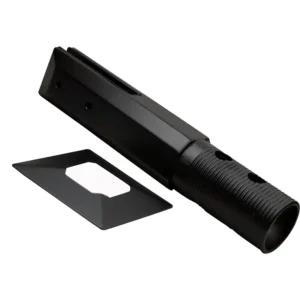
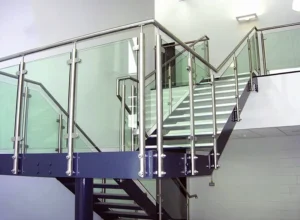
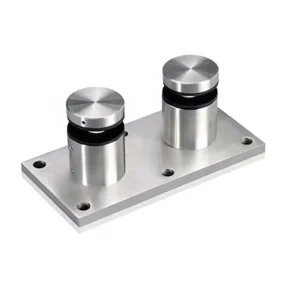
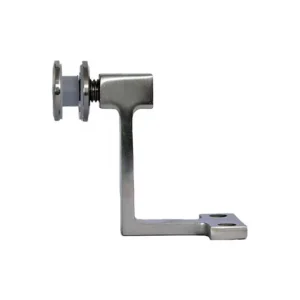
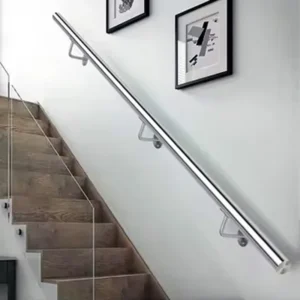
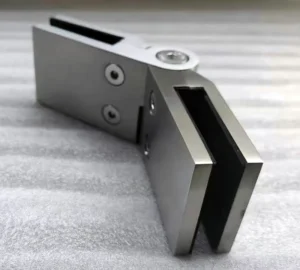
Square glass clamps are selected by the complete interface behind the clean, rectilinear face. Send the glass build-up, support geometry, clamp locations and exposure so the proposed body, inlay and fasteners can be stated together.
Discuss square glass clamps on WhatsApp

Control the visible grid and the hidden seat
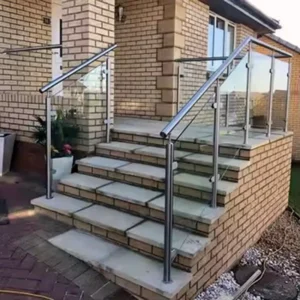
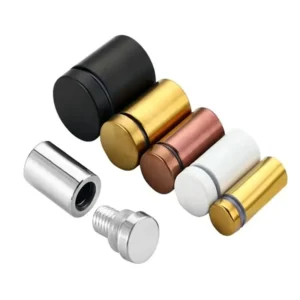
Square clamps are often chosen to align with square posts, straight panel joints and other rectilinear hardware. That visual choice still leaves several mechanical decisions. Record the desired face orientation and reveal, the available clearance around the screw heads, and whether adjacent clamp faces must align on a common datum. A small rotation or an unmatched rear seat can be noticeable across a run of panels.
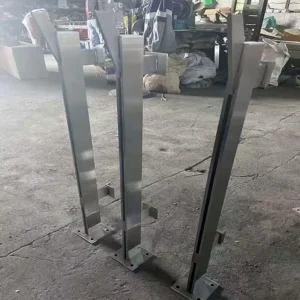
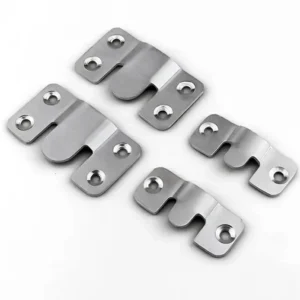
The mounting side must be defined separately. A flat post, hollow square tube, wall plate and curved post do not accept the same back geometry or fastener. Provide the support profile, face width, wall thickness and rear access. If a saddle, adapter or backing plate is required, it should be named as a separate component in the proposed configuration.
Glass build-up decides more than slot width
State whether the panel is monolithic or laminated, its nominal make-up and tolerance, the edge finish and the project-required heat treatment. For laminated glass, include the interlayer and total build-up available from the glass supplier. These inputs affect the matched inlay and the retention strategy; they cannot be replaced by saying only “standard glass.”
Confirm before glass fabrication whether the selected assembly needs:
- a drilled hole and locating or safety pin, including approved hole size and position;
- a no-hole clamping arrangement with an inlay selected for the actual build-up;
- a separate anti-slip or post-breakage retention measure for laminated glass;
- edge or corner clearances that affect the panel drawing.
The final proposal should state the inlay rather than treating it as a generic rubber strip. The inlay is part of the glass contact condition, while the clamp screws and mounting fastener perform different jobs.
Separate the four fastener questions
- Face screws: close the clamp body and apply the approved glass-contact condition.
- Mounting fastener: connects the clamp to the post, plate or other support.
- Locating hardware: positions or retains the glass when the chosen system uses a pin or equivalent feature.
- Support anchorage: connects the post or plate to the building and is outside the clamp unless expressly included.
Do not substitute one role for another. The quotation should identify which fasteners are supplied, their proposed material and interface, and which anchors or backing provisions remain the installer’s or system supplier’s responsibility.
Request 304 or 316 with the exposure brief
The product title provides 304 and 316 as requested material directions, not a promise that every square body, finish and mounting interface is available in both. Describe indoor or outdoor use, salt or de-icing exposure, pool chemicals, industrial cleaning agents and the desired surface appearance. Ask the quotation to identify the proposed grade for the clamp body and exposed fasteners.
If finish continuity matters, include a reference sample or a finish description and state whether adjacent posts and rails must visually match. A brushed or polished appearance in a photograph is not a controlled finish specification, and a material grade by itself does not define surface preparation or maintenance.
Use a configuration schedule to compare offers
| القرار | Information to issue | Quotation response required |
|---|---|---|
| Visible form | Face proportions, orientation and finish intent | Proposed square body and finish |
| زجاج | Construction, thickness/tolerance, edge and hole status | Matched inlay and hole/no-hole route |
| Support | Flat/round profile, dimensions, thickness and access | Back seat, adapter or backing requirement |
| Retention | Required locating, anti-slip and post-breakage strategy | Included pin/device and panel preparation |
| Scope | Component-only or coordinated hardware request | Included fasteners, caps, inlays and exclusions |
The clamp does not certify the railing
Glass dimensions and make-up, clamp count and spacing, hole locations, post stiffness, rails, base plates, anchors and substrate all affect the completed assembly. A square shape or a 304/316 call-out does not establish a load rating, certification or universal compatibility. The responsible project designer or system supplier must approve the complete arrangement against the applicable project requirements.
What to send for a useful quote
- a panel elevation or marked photograph with clamp locations;
- glass make-up, nominal thickness, tolerance and existing hole details;
- support profile, face dimensions, wall thickness and access for fastening;
- required finish and exposure conditions;
- whether a locating pin, anti-slip device or no-hole arrangement is required;
- estimated quantity, destination and required material documentation.
Incomplete early information is acceptable. Mark unknowns clearly; the proposed quote should identify which fields must be frozen before glass release and installation.
Square glass clamp questions
Does a square clamp require a square post?
No. The visible face and the mounting-side geometry are separate decisions. A square-faced clamp may need a flat seat, a curved saddle or an adapter depending on the support.
Can one inlay fit several glass constructions?
Do not assume so. The inlay should be matched to the proposed clamp and actual glass build-up, including laminated make-up and tolerances.
Does 316 make the whole connection suitable for a pool or coast?
No. The exposed fasteners, finish, crevices, cleaning regime and surrounding system also need to be specified for the environment.
What should arrive with a component order?
The quote should state the clamp body, inlays, face screws, mounting fastener, any pin or cap, quantity and exclusions. Posts, glass and anchors are not implied unless listed.