Specifying cable railing for a wood-post assembly without resolving the reinforcement details before framing is complete creates the most predictable retrofit problem in residential railing work. The framing contractor closes up the deck structure, the railing supplier ships through-post fittings sized for a clean bore, and nobody has documented where the blocking goes or how the cable load transfers through the post to the ledger. What follows is a disassembly sequence — finished decking pulled up, posts reset, backing plates added after the fact — that consumes margin and delays occupancy sign-off. The hardware interface between post material and cable fitting is where that problem originates, and understanding what changes between wood and stainless steel is the practical gate for avoiding it.
How Post Material Changes the Hardware Interface
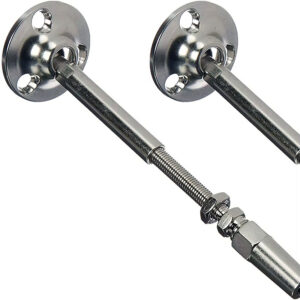
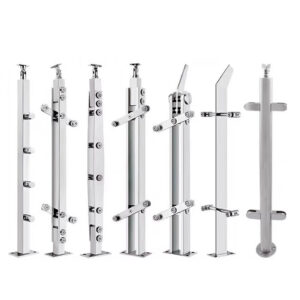
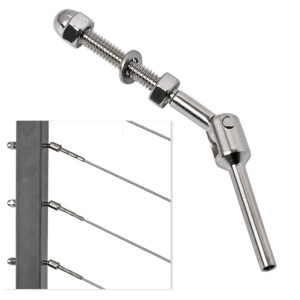
The fundamental difference is not aesthetic — it is whether the hardware and the post were designed to work as a system. Stainless steel posts arrive pre-drilled at consistent bore diameters matched to standard cable fitting geometry. The fitting seats flush, the load path from cable to post is predictable, and the documentation trail from hardware supplier to installer is relatively short. Wood posts arrive as structural lumber, and the hardware kit is assembled around them in the field. Lag screws, through-bolts, and swage end fittings can be combined effectively, but the post itself is not designed for the specific point loads that cable tension introduces at each termination.
That mismatch becomes a failure risk under sustained tension and environmental variation rather than at initial installation. A fitting that seats acceptably on day one may begin to loosen as the wood deflects incrementally under cable pull and cycles through seasonal moisture changes. The opening widens slightly, the fitting loses its bearing contact, and the cable loses tension — not catastrophically, but progressively. The table below captures the key specification differences at the hardware interface.
| العامل | Wood Post | عمود من الفولاذ المقاوم للصدأ |
|---|---|---|
| Hardware type | Kits with lag screws and swage fittings; not an integrated system | Pre-drilled, factory-integrated system designed for cable hardware |
| Installation predictability | Less predictable – wood flex can undermine fitting security | More predictable – components match precisely |
| Code compliance path | May require additional verification of load path and flex resistance | Typically easier to document and meet guardrail codes |
| Flex risk under cable tension | Wood flex can loosen connections over time | Higher stiffness reduces risk of fitting loosening |
Metal post predictability is a product of factory integration, not a substitute for verifying the load path at a specific site. Even with stainless posts, the anchorage to the framing below still requires confirmation against local guardrail load requirements. What the integrated system does provide is a shorter verification path: the hardware geometry is fixed, the bore tolerances are known, and the supplier documentation typically covers the fitting-to-post interface directly.
Reinforcement and Bearing in Wood Assemblies
Where cable tension enters a wood post, it arrives as a concentrated lateral force at a small bearing area — the cable fitting contact zone. Wood fibers under that point load will crush if the bearing area is insufficient, and the result is a widened opening that no amount of retensioning can correct. This is not a marginal risk for undersized or degraded posts; it is a design consideration for any wood-post assembly that has not explicitly accounted for how that force distributes through the member.
The practical planning figure used in trade guidance sets 4×4 as the minimum wood post size for cable railing. That figure reflects the need for enough cross-section to distribute cable tension without immediate fiber distress, but it is not a code-mandated dimension in most jurisdictions — local requirements or a project-specific engineering review may set a different threshold. Stainless steel posts can be specified at slimmer profiles under the same cable loads because the material’s higher strength-to-section ratio handles the point force without the same bearing-area constraint.
Backing plates and additional bracing enter the picture when local code review identifies an inadequate load path through the wood post, or when the post spacing and cable count generate cumulative lateral forces that a bare 4×4 section cannot resist without deflecting. Treating these as automatic add-ons for every wood assembly overstates the case; treating them as a routine compliance review check understates the risk of skipping that review.
| النظر في | Wood Post | عمود من الفولاذ المقاوم للصدأ |
|---|---|---|
| Minimum post size | 4×4 minimum | Can be slimmer due to higher material strength |
| Backing plate requirement | Often needed to distribute cable force and meet code | Typically not required |
| Additional bracing | May be needed for code compliance and to resist deflection | Usually unnecessary |
| Susceptibility to fiber crushing | Fibers can crush under point loads without proper reinforcement | الحد الأدنى من المخاطر |
The handoff between railing supplier and framing contractor is where backing plate and blocking details most reliably get lost. The railing supplier knows the cable forces; the framing contractor knows where the blocking can go. When those two scopes do not overlap on a single drawing set before framing closes, the reinforcement either gets skipped or gets retrofitted at cost. Identifying structural blocking, fastener path, and moisture protection in the drawing package before the deck is framed is the single most effective way to prevent that outcome on a commercial project.
Steel Precision Versus Wood Movement
A stainless steel post holds its geometry. Wood does not — and that behavioral difference has direct consequences for tension retention over the life of the installation. Wood expands across the grain with moisture uptake and contracts as it dries. Those dimensional changes are small in any single cycle, but they accumulate at the cable termination points as progressive tension loss. The cable that was correctly tensioned at installation will be looser after the first winter-summer cycle, and looser still after several years of climate cycling without retensioning.
The more significant deferred risk is deflection under sustained load. Cable railing systems maintain tension continuously; the post is always under lateral pull. Wood’s lower modulus of elasticity means it will deflect more than a stainless steel post under the same sustained force, and that deflection compounds the tension loss already caused by moisture movement. The result is a retensioning maintenance cycle that stainless assemblies largely avoid. For a contractor or building owner assessing long-term performance, that cycle is a real operational cost, not a minor inconvenience.
| Behavior | Wood Post | عمود من الفولاذ المقاوم للصدأ |
|---|---|---|
| Response to sustained cable tension | Can flex, leading to cable sag over time | Resists deflection, maintaining cable alignment |
| Dimensional stability | Expands and contracts with moisture and temperature, loosening tension | Dimensionally stable, preserves tension |
| Modulus of elasticity | Lower – more deflection under the same load | Higher – far less deflection |
| Long-term tension retention | Tension tends to loosen, requiring retightening | Maintains tension with minimal drift |
Metal’s dimensional stability reduces tension drift, but it does not eliminate all need for periodic tension checks. What it does eliminate is the compounding effect of moisture-driven movement layered on top of load-driven deflection. For installations in climates with significant humidity variation or temperature swing, that compounding effect is where wood-post cable railing most consistently underperforms its initial specification.
Framing Coordination Before Cable Installation
Post stiffness is a primary design input for cable railing, not a secondary check after spacing and aesthetics are set. For wood posts, stiffness is a function of species, grade, cross-section, and effective height — variables that must be confirmed before post locations are fixed in the framing plan. A post spacing that works for a select structural Douglas fir 4×4 may not work for a lower-grade hem-fir at the same section, even if both appear compliant on a basic size check. Getting this confirmed before framing rather than after cable installation avoids the scenario where posts deflect beyond acceptable limits under full cable tension and the only remedies are additional intermediate posts or a structural retrofit.
For stainless steel posts, surface-mount and fascia-mount configurations typically require fewer additional reinforcements in the deck framing because the post itself handles the cable loads within the fitting system. That coordination advantage does not mean metal posts never need blocking — base plate anchorage still has to transfer load into the structure — but the blocking detail is usually simpler and better documented by the hardware supplier. The practical implication is that the framing coordination conversation for a stainless post assembly is shorter and less likely to surface surprises than the same conversation for a wood-post assembly.
For through-post cable hardware configurations, the coordination requirement sharpens further: the bore location in the post must align with the cable run geometry, and for wood posts that means confirming bore location, backing detail, and post orientation before any drilling begins. Post stiffness and bore reinforcement are part of the same pre-installation checklist, not sequential concerns.
Approval Evidence for a Wood-Post Load Path
A wood-post cable railing assembly has to demonstrate the same load resistance as any other guardrail system before it passes inspection. IRC Chapter 3 guardrail provisions establish the governing load requirements — including the 200-pound concentrated load at the top rail and the 4-inch sphere infill rule — and those requirements apply regardless of whether the post is wood or stainless steel. The material difference shows up in how easily that compliance can be documented, not in what the standard requires.
For a stainless steel system, the supplier’s documentation typically covers the fitting-to-post load path, and the pre-drilled geometry means the infill spacing is already designed into the system. For a wood-post assembly, the load path documentation has to trace from the cable fitting through the post, through any backing plate or blocking, and into the structural framing. If any link in that chain was not detailed before installation, the inspector is likely to see a gap in the evidence — and a gap in the evidence is a reinspection, not an approval.
ASTM E894 provides a recognized test method for evaluating railing anchorage under load, and it represents the kind of benchmark a wood-post assembly might be compared against during a load path review. It is not a direct compliance path for wood construction, but understanding the load levels it addresses helps clarify whether a proposed wood-post assembly would perform comparably under field inspection criteria. Approval for a wood-post assembly, practically speaking, depends on drawings that explicitly identify the structural blocking, the fastener schedule, and the moisture protection strategy — not just the hardware list.
For projects where the post material has not yet been selected, reviewing the stainless steel post installation and fastener requirements alongside the wood-post design criteria makes the documentation gap concrete before it becomes a procurement decision.
The clearest pre-procurement judgment for any cable railing project is whether the post material decision has been made at the right stage. Wood posts offer field-modification flexibility but carry a hidden constraint: their stiffness, moisture response, and fiber properties have to be confirmed against the cable load path before framing closes, not after hardware arrives on site. Stainless steel posts simplify that coordination because the hardware interface is factory-defined, but the anchorage to the structure still requires a verified load path.
Before approving a wood-post assembly for a commercial project, confirm that the drawings identify structural blocking locations, backing plate or reinforcement requirements, fastener type and spacing, and moisture protection at each post base. If any of those elements are unresolved at the time of hardware procurement, the most likely outcome is a retrofit after installation — at a cost that the hardware selection itself did not create, but the coordination gap did.
الأسئلة الشائعة
Q: What if my deck framing is already finished with wood posts — is it too late to use cable railing?
A: It’s not too late, but you’ll likely face a retrofit process that involves opening finished decking. The load path from each cable termination must still be verified, which often means adding blocking or backing plates from below the deck surface. Engage a structural engineer or your railing supplier early to assess what reinforcement can be installed without a full teardown, because skipping this step leads to progressive tension loss and post damage that’s far more expensive to fix later.
Q: What is the single most immediate step I should take after reading this to prevent coordination problems on a wood-post project?
A: Share your drawing package with the railing hardware supplier for a load-path review before you order any components. For through-post configurations, this means confirming bore locations, backing details, and post orientation against the cable run geometry. A supplier like ESANG can cross-check those details against the cable forces and help you identify missing reinforcement before framing closes — closing that handoff gap is the most reliable way to avoid costly retrofits.
Q: Under what real-world conditions does wood become simply too risky for cable railing?
A: When post height exceeds 36 inches, post spacing pushes past 4 feet, or the installation is in a climate with large seasonal moisture swings, wood’s cumulative deflection and tension loss can overwhelm even well-reinforced assemblies. At that point, the extra blocking, backing plates, and ongoing retensioning maintenance often make stainless steel the more reliable and economically rational choice — especially if the wood species or grade isn’t verified for the specific loads.
Q: Is there any practical scenario where wood posts actually make more sense than stainless steel?
A: Yes — wood posts offer real advantages when the project geometry is irregular and requires field-modification flexibility. If you need to bore custom hole locations on site to accommodate complex deck shapes or existing structures, wood can be easier to modify without specialized tooling. That flexibility comes with a trade-off: you must accept the extra coordination effort, stricter framing verification, and a routine retensioning schedule that stainless largely eliminates.
Q: Is the higher upfront cost of stainless steel posts worth it for a smaller residential deck?
A: For many small residential projects, the cost difference is modest enough that the long-term benefits tip the scale. Stainless steel’s dimensional stability removes the maintenance cycle of retensioning cables through seasonal movement and the risk of callbacks from post deflection. If your deck is simple and you have a qualified framer who can execute detailed reinforcement drawings, wood can work — but the avoided coordination errors and near-zero post maintenance with stainless often justify the premium over the life of the installation.