Fabrication errors with cable railing terminations rarely surface until posts are drilled, coated, or welded—at which point replacing an incorrectly specified fitting requires undoing work that cannot be easily reversed. The most common trigger is a mismatch between what the run schedule specifies and what was actually confirmed before the terminal was ordered or the post was machined: wrong thread length for the post wall thickness, a fixed terminal where the run length required adjustment tolerance, or a flat washer installed at an angled stair penetration where a bevel washer was needed. Each of those errors is recoverable, but not cheaply. The judgment that prevents them is front-loaded: terminal type, cable diameter match, post face detail, and seating geometry all need to be verified before a drill bit touches a post. What follows gives fabricators and installers a structured way to make those confirmations in the right sequence.
Cable and Terminal Compatibility Inputs
The first input that must be confirmed is not the fitting style—it is whether the fitting is actually rated for the cable diameter and construction shown in the run schedule. A fitting marketed for 1/8-inch cable cannot be treated as interchangeable with hardware dimensioned for 3/16-inch cable, and a terminal designed for a 7×7 strand construction may not seat correctly on a 1×19 cable even at the same nominal diameter. These are separate variables, and conflating them is a predictable source of field rework.
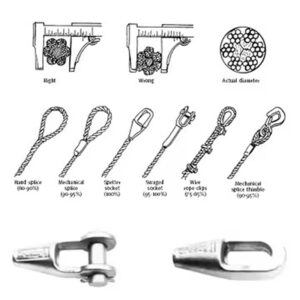
The distinction between swageless and swaged terminations affects more than tool availability—it shapes where in the installation sequence each terminal can be completed. Swageless fittings use internal jaws that engage the cable under tension, which means they can be installed in the field without hydraulic equipment. Swaged fittings require a swaging tool or hydraulic press to compress the fitting mechanically onto the cable. That tooling dependency changes what can be done at the shop versus what must happen on-site, and it affects which terminal in a two-end run gets fixed first. Misaligning the termination method with available tooling creates a field constraint that should have been resolved during procurement, not during installation.
Both termination types require that the terminal specification match the cable before any fabrication proceeds.
| نوع التركيب | طريقة الإنهاء | What to Confirm Before Fabrication |
|---|---|---|
| سواغليس | Internal jaws bite into cable under tension; no swaging tool required. | Fitting must match cable diameter and construction per run schedule; verify terminal is rated for the cable size (e.g., 1/8 in.) and strand type. |
| سواجيد | Fitting is mechanically compressed (swaged) onto the cable using a swaging tool or hydraulic press. | Confirm fitting matches cable diameter; verify which terminal will be machine-swaged vs. hand-swaged; ensure tooling and access are available for the field-swaged end. |
Where wire rope properties are referenced against a standard, ISO 2408 and ASTM A492 provide the testing and material framework for the rope itself—but neither standard governs termination selection. Terminal-to-cable compatibility is a product-level confirmation, not a code lookup.
Thread Engagement Through the Finished Post
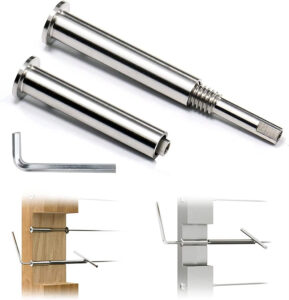
Thread length is a dimension that fabricators often treat as a secondary detail, but it determines whether a terminal can develop adequate engagement through the finished post wall. The relevant variable is not the thread length printed on a product sheet in isolation—it is that length measured against the actual post section the terminal must pass through, including any cladding, trim buildup, or decorative wrap added after the structural post is in place.
Standard threaded terminals are dimensioned for post walls within a typical range. Where a post is oversized—a built-up or wrapped condition that creates a finished wall thickness significantly deeper than the structural member alone—a standard terminal may reach the far face of the post with little or no thread remaining for the nut and washer. Some manufacturers offer extended-thread variants specifically for these conditions, with thread lengths that accommodate larger post cross-sections. Specifying the right variant requires knowing the finished post dimension, not the nominal post size shown in the framing plan.
The failure mode when this check is skipped is straightforward: the terminal bottoms out before the nut can engage sufficient thread, and the fitting cannot be properly tensioned. At that stage, the post is already drilled and finished. Redrilling to a larger bore or sourcing a longer terminal after the fact is both a schedule problem and a potential finish problem if the post has been powder-coated or painted. Confirming the finished post wall dimension before ordering terminals—and before any post machining—removes this risk entirely.
The threshold to watch is not a fixed thread-engagement number that applies universally. It is a project-specific check: does the available thread length, minus the post wall thickness and any required washer stack, leave enough engagement to tension and lock the fitting reliably? That question should be answered from a dimensioned section detail, not estimated from memory.
Fixed Ends Versus Adjustable Terminations
The choice between a fixed terminal and an adjustable one is often framed as an aesthetic decision, but it is primarily a tolerance decision. Fixed terminals produce a clean, low-profile finish at the post face because there is no exposed adjustment hardware. Adjustable terminals—typically threaded rod-and-barrel or turnbuckle-style fittings—allow the effective cable length to be tuned after the fitting is installed, which absorbs variation between the measured run length and the actual field dimension.
The trade-off becomes consequential on longer runs, on decks with irregular post spacing, and on any project where post positions were set before final dimensions were confirmed. A fixed terminal requires the cable to be cut to a length that is correct before the second end is secured. If the cut length is slightly off, there is no recovery mechanism at the terminal itself—the cable must be replaced. An adjustable terminal provides a correction window, but that window comes with visible hardware at the post face that may conflict with the design intent or finish standard the project is targeting.
Neither option is universally preferable. The right choice depends on the tolerances the installer can realistically hold during measurement and cut, the post spacing consistency on that specific run, and the aesthetic standard the design specifies. Where a project has multiple straight runs of consistent length, fixed terminals may be entirely appropriate. Where runs include field-measured spans between posts set in concrete, adjustable terminations reduce the risk of a mis-cut cable requiring full replacement.
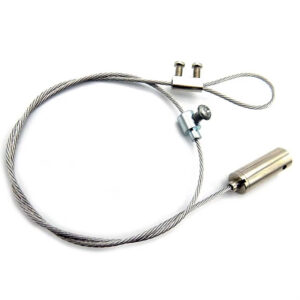
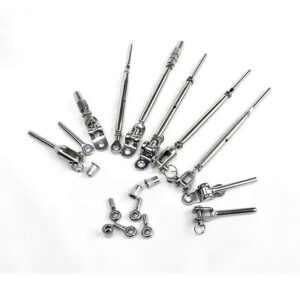
بالنسبة لـ threaded cable end fittings that combine a clean profile with some adjustment range, confirm early in procurement whether the adjustment travel available in a given product is sufficient to cover the field variation the run is likely to encounter—not just the variation expected under ideal conditions.
Fabrication Coordination at Post Interfaces
Post interface conditions are where specification errors concentrate, because they are the point where the terminal, the cable, the post geometry, and the surrounding finish all converge. Fabricators who proceed without a confirmed section detail at each interface are making decisions by inference, and those inferences frequently miss conditions that require a different fitting or a different installation approach.
Three interface conditions consistently produce field rework when they are not caught before fabrication. The first is a hollow metal post where a standard threaded pass-through terminal is not feasible—the fitting has nowhere to bear once it exits the post cavity. The second is a metal post, particularly aluminum, in contact with stainless steel wire rope without isolation, creating a galvanic corrosion risk that degrades the post over time. The third is an angled cable penetration at a stair post, where a flat washer cannot seat square to the thread and distributes load unevenly, risking loosening under tension cycling.
Each condition has a well-established mitigation—an alternative terminal type, an isolation grommet, or a bevel washer—but each mitigation must be specified before the post is drilled and before the fitting order is placed. Discovering a stair angle condition after flat washers have already been installed, or finding that a hollow post does not accommodate the specified pass-through terminal, means the post must be reworked and the fitting order revised.
| Post Interface Condition | Risk/Complication | What Fabricators Must Confirm |
|---|---|---|
| Hollow metal post where pass-through terminal is not feasible | Standard threaded pass-through fitting cannot be secured. | Specify Drop Pin Terminal or Locking Toggle designed for hollow post attachment. |
| Metal post (especially aluminum) in contact with stainless steel wire rope | Galvanic corrosion/electrolysis between dissimilar metals. | Use plastic isolation grommets in post holes to prevent metal-to-metal contact. |
| Stair post where cable passes through at an angle | Flat washer will not sit square, causing uneven load and potential loosening. | Replace flat washer with stainless steel bevel washer to keep the nut square to the thread. |
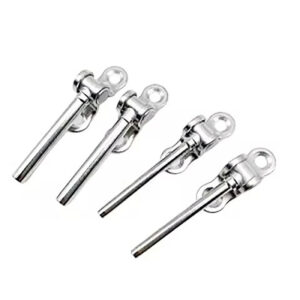
The point of the section detail review is to force these conditions into view before they become field problems. For fork end cable terminals and other end-attachment configurations, the interface geometry at the post face must be part of the drawing review, not an assumption resolved during installation.
Section Detail Checks Before Production
No terminal should be ordered, no post should be drilled, and no cable should be cut until a section detail has confirmed the seating geometry, thread engagement, access for the installation sequence, and finished projection at both ends of each run. That is a coordination gate, not a formality. The section detail is the document that makes all prior checks verifiable—it shows the finished post face, the trim buildup, the bore position, the bearing surface, and the projection of hardware beyond the face that will be visible in the completed installation.
The sequencing of shop-fixed versus field-fixed terminals is a practical example of why this matters. In assemblies where one terminal is swaged at the factory and the second is completed on-site after the cable is run and the final length is measured, the shop-fixed end must be correctly specified and confirmed before fabrication begins. The field-fixed end cannot be completed until the actual cable length is known—cutting the cable before that length is confirmed and approved means the hand-swaging operation may lock in a length that is incorrect. Once a hand-swaged fitting is set, reversing it requires cutting the terminal and reterminating, which wastes cable and fitting material and resets the field operation.
| Terminal Position | Swaging Method | When | Pre-Production Check |
|---|---|---|---|
| First terminal (shop-fixed) | Machine swaged | Factory, during fabrication | Confirm terminal specification matches the run schedule and is correctly swaged. |
| Second terminal (field-fixed) | Hand swaged | On-site, after final cable length is determined | Confirm final cable length is measured, approved, and cut before the hand-swaging operation. |
The review question at this stage is not whether the terminal specification looks correct in the abstract. It is whether the section detail shows the terminal seating correctly against the finished post face, with sufficient thread engagement, appropriate bearing hardware for the penetration angle, and projection that aligns with the design intent. Where any of those conditions is uncertain, the section detail needs to be resolved before fabrication proceeds—not during installation, when the posts are already in the ground.
For a broader view of how terminal selection fits within the full scope of a cable railing project, the complete stainless steel cable railing guide covers material standards, post systems, and installation sequencing in more depth.
The confirmations that prevent rework on cable railing terminations are not technically complex—they are coordination steps that require the right information to be present before the work begins. Thread engagement fails because post wall dimensions were assumed rather than measured from a section detail. Terminal type mismatches occur because the run schedule was not checked against what was actually ordered. Stair interface complications arise because the penetration angle was not identified as a condition requiring different bearing hardware. None of these failures is inevitable.
Before fabrication proceeds, confirm that each terminal matches the cable diameter and construction in the run schedule, that the thread length accommodates the finished post wall, that the termination sequence accounts for which end is shop-fixed versus field-measured, and that every post interface condition—hollow section, dissimilar metal contact, angled penetration—has been identified and specified. Those checks, made in sequence from a confirmed section detail, are what separates a clean installation from one that creates rework after the posts are set.
الأسئلة الشائعة
Q: What if I’ve already drilled and finished my posts before discovering the terminal thread is too short?
A: The safest recovery is to source an extended‑thread variant of the same terminal type if the post wall thickness has simply been underestimated—this avoids altering the post. Drilling out the post to a larger through‑bore may compromise structural integrity and almost certainly damages any applied coating, creating a corrosion risk on metal posts. If a longer thread isn’t available for that fitting series, counterboring the interior face of a solid post is possible but requires refinishing and doesn’t work for hollow sections. At this stage, the least destructive path is to treat the existing terminal as a measurement error and order the correct part, even if it means a schedule delay.
Q: Once I’ve verified every check from the section detail, what is the very next coordination step before I order or drill?
A: Build a run schedule that maps each terminal position to a specific part number, thread length, and interface accessory (grommet, bevel washer, or extended nut). This document translates the section details into a procurement and installation checklist, ensuring no terminal is ordered generically and that the fabricator knows exactly which bore diameter and bearing surface is required at every post. Doing this before ordering catches conflicts—like a stair‑angle penetration still paired with a flat washer—that a drawing review alone may overlook.
Q: At what run length or tolerance condition does an adjustable terminal stop being optional?
A: There’s no fixed span that mandates adjustability, but the tipping point is reached when the expected field‑measurement uncertainty consumes more than roughly half the adjustment travel of the fitting. On a cable cut to a fixed length, a measurement error of ±1/16 inch over a short 6‑foot run may still allow proper tensioning, while the same absolute error over a 30‑foot run can prevent the nut from seating correctly. When post spacing is irregular or posts are set before final dimensions are confirmed, adjustable terminals provide the correction window that a fixed‑end system cannot recover from if the cut is slightly off.
Q: For a large project with many runs, is swageless or swaged termination more cost‑effective overall?
A: Swaged terminations typically win on hardware unit cost, but the real comparison is total installed cost: shop‑swaging one end in a controlled environment reduces field labor to a single hand‑swaged or tensioned operation per cable, which scales well across many identical runs. Swageless fittings have a higher part cost but eliminate the hydraulic press and tooling investment, so they’re often faster for smaller crews or projects where shop access is limited. For projects exceeding roughly 30 runs, the labor reduction from batch‑swaging one end in the shop usually outweighs the higher per‑fitting cost of all‑swageless hardware.
Q: When is it worth paying extra for an extended‑thread terminal on a post that’s only slightly thicker than standard?
A: The decision turns on remaining thread engagement after the post wall and washer stack are subtracted. If the standard thread leaves fewer than four full threads for the nut—especially in stainless‑to‑stainless assemblies where galling risk rises—the probability of a strip or tension failure during installation makes the small incremental cost of an extended‑thread terminal a cheaper bet than reworking a finished post. Many manufacturers, including ESANG, offer variants with enough extra length to cover common over‑thickness conditions, and specifying them early removes the engagement uncertainty entirely.