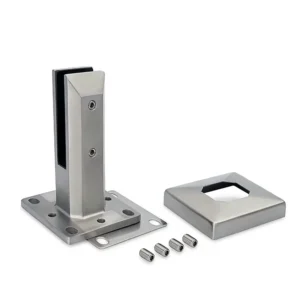
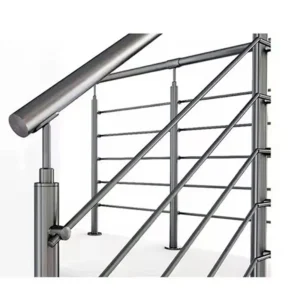
A cable railing run that terminates cleanly between two fixed posts raises a different anchorage question than a cable run that turns a corner, splits into multiple levels, or ends at a terminal post carrying tension from more than one direction. Before that terminal post gets specified or signed off, the project team needs to know what load path actually converges there, not just what the hardware catalog lists as compatible parts. The decision is whether the anchorage evidence in hand matches the actual terminal condition, or whether more project-specific input is still required.
Why terminal posts create a distinct anchorage case
A cable railing system distributes horizontal tension along a run, and intermediate posts generally pass that tension through in a fairly consistent direction. A terminal post works differently. It is the point where cable tension is collected, resolved, and anchored rather than passed along, and where a change in direction, a run split, or an end condition introduces forces that an intermediate post does not see in the same way.
Where a single straight run ends at a single terminal post, the anchorage question is comparatively contained: the post and its base need to resist the tension from that one run. Where multiple runs converge at a terminal post, or where the post sits at a corner and resolves a direction change, the forces acting on the post and its base are no longer a simple extension of one run’s tension. The post must resolve those forces into its base connection, and the base connection must transfer them into whatever substrate it is fastened to. This is why a terminal post cannot be treated as a heavier-duty version of an intermediate post selected by appearance or by a generic load rating. Its anchorage depends on the specific combination of cable layout, direction changes, and tensioning approach that applies at that location.
This also means that anchorage adequacy is not a property of the terminal post component alone. The same terminal post hardware can sit in an anchorage condition that is well within its capacity in one project and in a condition that exceeds it in another, depending on how many runs terminate there, how those runs are angled relative to each other, and what substrate the base is fastened into. Treating the terminal post as a fixed, pre-rated unit independent of these project conditions skips the step that determines whether the anchorage is adequate at all. The structural review that follows has to start from the actual cable layout and the actual base and substrate conditions at that specific terminal location, not from a general assumption about what terminal posts are rated to hold.
Cable routing, run count, and corner geometry inputs
| Project input | What to establish | Why it matters to the review |
|---|---|---|
| Cable route | Actual cable route at the terminal post | Defines the project layout used for structural review |
| Run count | Number of cable runs at the terminal post | Forms part of the actual cable layout required before anchorage signoff |
| Corner geometry | Geometry at each cable direction change | Identifies the direction-change condition the terminal-post review must address |
| Последовательность натяжения | Planned sequence for tensioning the cable runs | Adds the installation-specific input required before anchorage signoff |
Before a terminal-post anchorage review can proceed, the project team needs a fixed description of what happens at that post: where the cable comes from, how many runs land there, and whether the post sits at a direction change or at a plain run end. Each of these inputs changes what the post and its base connection are actually being asked to resist.
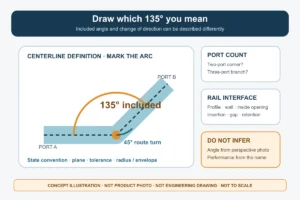
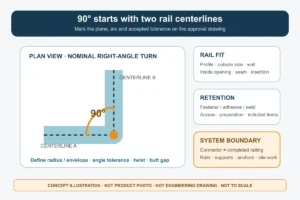
The cable route establishes the baseline geometry the review works from. A terminal post at the end of a straight run resolves tension from one direction. A terminal post positioned where the railing turns a corner resolves tension from two different directions simultaneously, and the resultant force on the post and base is a function of the angle between those two directions, not simply the sum of the individual run tensions. This is a condition that changes the review, not a fixed outcome: a shallow corner angle produces a different resultant than a sharp one, even where the individual cable tensions are otherwise comparable.
Run count compounds this. A terminal post handling a single cable run presents a simpler anchorage case than one handling several runs stacked at different heights, because each additional run adds to the cumulative tension the post and base must resist, and the vertical distribution of those runs affects how that tension loads the post in bending as well as in direct pull.
Tensioning sequence is a related but separate input. The order in which cable runs are tensioned at a terminal post can affect the forces the post experiences during installation, before the full system reaches its final tensioned state. A post and base connection that will perform adequately once all runs are at final tension may see a different, uneven loading condition partway through the tensioning sequence, which is why the planned sequence needs to be established as part of the anchorage review rather than left to field discretion. None of these inputs can be inferred from a product listing; they come from the actual project layout, and the terminal-post components selected for the job need to be matched against that layout rather than against a generic assumption of how terminal posts are typically used.
Terminal, tensioner, post, and base compatibility checks
| Check area | Project-specific check | Граница принятия решения |
|---|---|---|
| Terminal selection | Confirm the terminal type for the planned cable arrangement | Terminal compatibility does not prove terminal-post anchorage capacity |
| Натяжное оборудование | Confirm the tensioner system is compatible with the terminal arrangement | Hardware compatibility does not replace project-specific structural review |
| Post configuration | Confirm the actual terminal-post configuration used with the selected terminal and tensioner | The post remains part of the complete project load path |
| Base configuration | Confirm the actual base geometry and its relationship to the post and substrate | Base geometry is an input to anchorage review, not an anchorage conclusion |
Once the cable layout is fixed, the next judgment is whether the terminal, tensioner, post, and base selected for that layout form a compatible assembly. This is a narrower question than anchorage capacity, and keeping the two separate matters: a terminal and tensioner can be dimensionally and mechanically compatible with each other and with the post, while the anchorage of that assembled post into its base and substrate remains a separate, unresolved question.
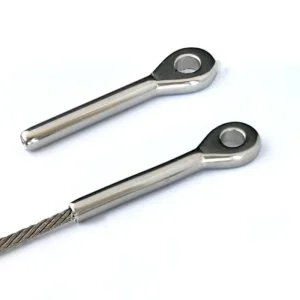
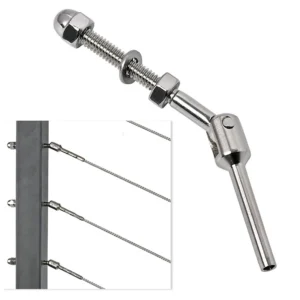
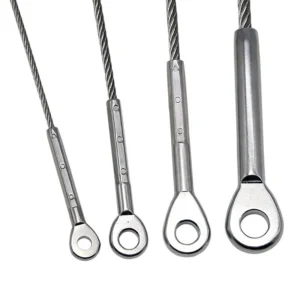
Terminal selection depends on the cable arrangement it needs to serve. A terminal designed for a single run end behaves differently from a configuration intended to receive multiple runs or a direction change, and selecting the wrong terminal type for the arrangement creates a mismatch before anchorage is even considered. Confirming that the terminal type matches the planned cable arrangement is a precondition for the rest of the compatibility check, not a substitute for it.
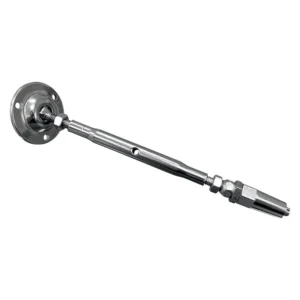
Tensioning hardware introduces its own compatibility question. The tensioner has to suit the terminal it connects to and the adjustment range the project’s tensioning sequence requires. Where tensioner and terminal are mismatched, the installer may be unable to achieve or maintain the intended cable tension, which in turn affects the forces the post and base actually experience in service, since realized tension rather than nominal tension is what the anchorage has to resist.
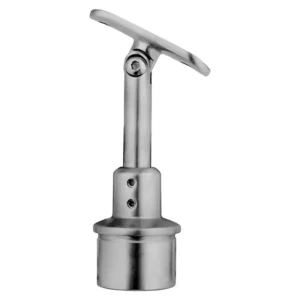
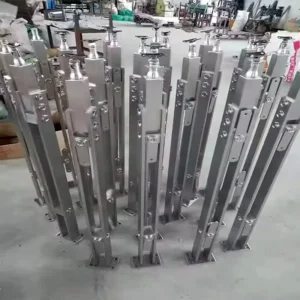
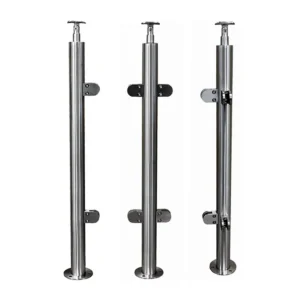
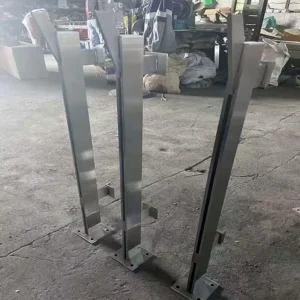
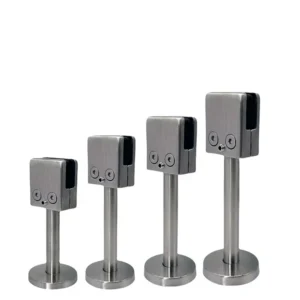
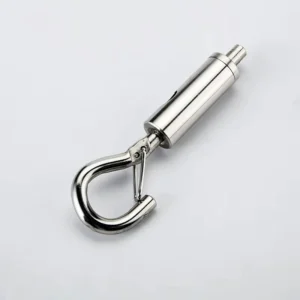
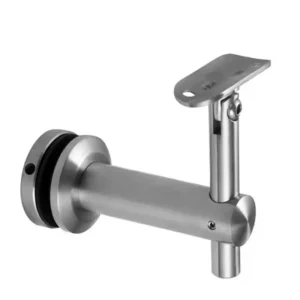
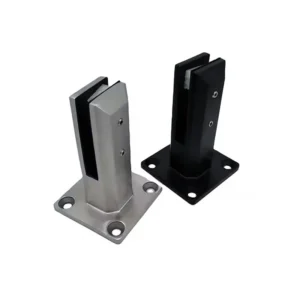
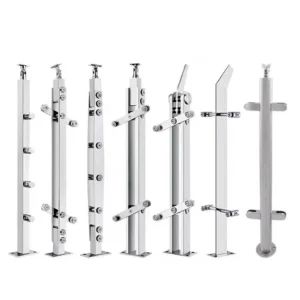
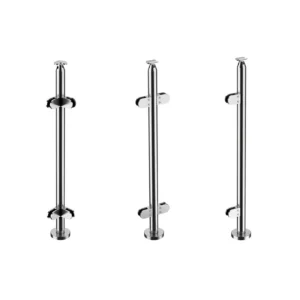
The post configuration and base configuration close the loop. The specific post used with the selected terminal and tensioner has to be the one evaluated for this load path, and the base geometry has to be understood in relation to both the post and the substrate it will be fastened to. Esang’s terminal post components и системы натяжения кабеля can be specified and configured to match a given cable arrangement, but confirming that a terminal, tensioner, post, and base are compatible as a connected configuration establishes that the parts fit and function together. It does not by itself establish that the resulting assembly’s anchorage is adequate for the project’s loads; that is a distinct review covered by the substrate and load conditions at the connection.
Substrate and project-load review for the terminal connection
| Review area | Evidence or question to check | What the check establishes or limits |
|---|---|---|
| Субстрат | What is the actual substrate at the terminal connection? | Identifies the project-specific mounting condition; the connection remains unresolved without it |
| Project loads | What project loads are used for the terminal-post review? | Keeps the decision tied to the project; general railing criteria do not resolve the field condition or terminal-post load path |
| Anchor tension and shear | Does the connection review address both anchor tension and shear? | ASTM E894 metadata identifies these as anchorage subjects but supplies no terminal-post value |
| Post-base testing and mounting verification | Does the applicable evidence address the selected post-base arrangement and its mounting? | Metadata alone is insufficient; any value or conclusion depends on the full source and project engineering |
Compatibility among the terminal, tensioner, post, and base answers whether the parts work together. It does not answer whether the base, once fastened to its actual substrate, can resist the loads the terminal post delivers to it. That is a separate review, and it depends on project information that no hardware specification sheet can supply on its own.
The substrate at the terminal connection point is the first variable. The same base plate and fastening pattern can perform differently depending on what it is anchored into, and the review needs to start from the actual substrate condition at that specific location rather than an assumed or typical one. Because substrate varies by location within a single project, the terminal post at one end of a run may face a different anchorage condition than a terminal post elsewhere on the same job.
Project loads are the second variable, and they need to be the loads applicable to this project and this terminal condition, not a general railing criterion applied without adjustment. ASTM E985, which covers permanent metal railing systems and rails for buildings, addresses basic design and load and deflection criteria for railings generally, but field conditions and the specific load path through a terminal post remain matters for the project’s designer and the governing code authority to confirm for that installation.
Anchor tension and shear are both relevant to how the terminal connection resists its loads, and the review needs to address both rather than treating tension capacity as sufficient on its own. ASTM E894, covering anchorage of permanent metal railing systems, identifies anchor tension and shear, post-base testing, and mounting verification as the subjects an anchorage evaluation needs to address, though this is drawn from the standard’s identified subject matter rather than from its specific values, and no terminal-post figure can be taken from that identification alone. Post-base testing and mounting verification follow the same limit: confirming that the applicable evidence addresses the actual post-base arrangement used on this project, with the full source and project engineering behind it, is what closes this review, not the existence of a relevant standard in general. A related, separate question is whether the compatible cable hardware itself meets recognized wire-rope requirements; ISO 2408 sets requirements for steel wire ropes within its own product scope, but it does not address cable-railing design, terminal capacity, post spacing, or building-code requirements, so meeting it answers a question about the rope, not about the terminal-post anchorage.
Adjustment access and inspection evidence before handover
| Access check | Condition to confirm | Practical consequence |
|---|---|---|
| Adjustment access | The terminal remains accessible for adjustment | The installed assembly can be adjusted without improvised access |
| Tool access | The required tools can reach the terminal and tensioner | The installed assembly can be tensioned without improvisation |
| Inspection access | The terminal connection remains accessible for checking | The installed assembly can be inspected before handover |
Anchorage that is adequate on paper still depends on the terminal connection remaining usable after installation, both for tensioning the system correctly and for checking it later. Access is therefore a distinct condition to confirm, separate from the compatibility and load questions already resolved.
Adjustment access means the terminal remains reachable so that cable tension can be set and reset without having to remove adjacent finishes, infill, or other elements that were not designed to be disturbed. Where a terminal post is detailed into a tight architectural condition, this access can be reduced unintentionally, even though the terminal hardware itself is fully functional. Tool access is a related but distinct check: the tensioner may be reachable by hand while the specific tool required to adjust it is not, depending on clearances around the post and base. Where either adjustment or tool access is compromised, the installer may need to improvise a method to tension the connection, which works against the controlled tensioning sequence established earlier in the project review.
Inspection access carries this forward past handover. A terminal connection that can be tensioned during installation but cannot be visually or physically checked afterward limits what future inspection can confirm about anchorage condition over time. Maintaining this access is relevant to how Esang’s anchoring systems and terminal post components integrate into the completed assembly, since the physical configuration selected at specification stage determines whether adjustment, tool, and inspection access remain available once the railing is finished and the surrounding construction is complete. Confirming these three forms of access before handover is what allows the installed terminal assembly to be tensioned, adjusted, and inspected as intended, rather than requiring workarounds that were not part of the original design.
Часто задаваемые вопросы
Вопрос: When is terminal-post anchorage ready for signoff?
A: It is ready only after project-specific structural review addresses the actual cable layout, terminal and tensioner selection, post and base configuration, substrate, and project loads. Component compatibility alone does not close the anchorage decision.
Вопрос: Can ISO 2408 be used to confirm terminal-post anchorage capacity?
A: No. ISO 2408 addresses steel wire-rope requirements within its scope; it does not establish railing-system design, post spacing, or terminal-post anchorage capacity. Keep the wire-rope check separate from the project anchorage review.
Вопрос: What information should be fixed before submitting the terminal-post connection for review?
A: Document the cable route, number of runs, every direction change, terminal type, tensioner system, tensioning sequence, post and base geometry, substrate, and project loads. This gives the reviewer the actual configuration rather than a generic component list.
Вопрос: How should a cable direction change be represented in the anchorage review?
A: Show the actual corner geometry and cable path at each direction change. Terminal posts collect cable forces and direction changes, so a straight-run assumption cannot resolve a corner condition.
Вопрос: What access should remain available at the terminal after installation?
A: Preserve enough access for the selected adjustment method, required tools, and inspection of the terminal connection. Confirm these access paths before handover so tensioning and checking do not depend on improvised access.