Submittal rejection is one of the more expensive surprises in a glass railing project, and it almost always traces back to the same source: documentation assembled for one market being used to support approval in the other. A buyer requests hardware from a supplier, the supplier provides a product page with glass thickness recommendations and a finish specification, and the submittal goes in — only to come back when the plan reviewer asks for ICC-ES evaluation reports, engineering tables showing post spacing at each glass thickness, and load evidence that the product page never contained. That gap is not a paperwork formality. It stalls the project, forces the supplier to produce documentation they weren’t asked to prepare at RFQ, and sometimes surfaces material or configuration decisions that have to be unwound. Understanding which thresholds, hardware configurations, and documentation standards separate commercial from residential review is what allows a procurement team to classify the project correctly before the RFQ goes out.
Commercial guard requirements that change hardware selection
The height difference between commercial and residential guards is the most visible divergence, but it carries downstream consequences that extend well beyond panel length. A 42-inch guard height under IBC-aligned requirements, compared to the 36-inch residential threshold, changes the effective moment arm at the base — meaning post embedment, base shoe width, and anchorage design all carry more load at the same post spacing. Specifying a residential-configured post at a commercial height is not a minor adjustment; it resets the hardware geometry.
Load thresholds compound this. The commercial concentrated load expectation of 200 lbf in any direction — push, pull, downward — combined with a 50 plf uniform load, defines the structural basis for glass thickness, post spacing, and base shoe design. These are design thresholds drawn from IBC provisions, not universal absolutes that apply identically in every jurisdiction, but they represent the default assumption a commercial plan reviewer will bring to the submittal. Residential product pages often carry no equivalent load evidence, because residential installations are typically not reviewed against the same standard.
Glass type introduces a third hardware-level decision. When glass serves as a structural baluster without a top rail, commercial installations typically require laminated tempered glass — a requirement that affects how the base shoe captures the panel, what edge clearance is needed, and how the hardware accommodates the added thickness and weight of the interlayer assembly. Tempered-only glass may be acceptable when a structural top rail is present to capture the panel, but that distinction must be resolved before hardware is selected, not after fabrication.
| المتطلبات | المعيار التجاري | Residential Typical | Hardware Selection Impact |
|---|---|---|---|
| ارتفاع الحارس | 42 in. above walking surface | 36 in. | Changes glass panel length, post height, and hardware configuration |
| سعة الحمولة | 200 lbf concentrated (any direction) and 50 plf uniform | Often not tested to the same documented level; product pages may omit multi-direction proof | Dictates glass thickness, post spacing, and anchorage design |
| Glass type when no top rail | Laminated tempered glass required | Tempered-only glass often accepted | Laminated glass demands different hardware capture and increases cost |
| Coastal corrosion resistance | 316 marine-grade stainless steel | 304 stainless or aluminum | Wrong grade leads to corrosion failures; hardware material must be specified accordingly |
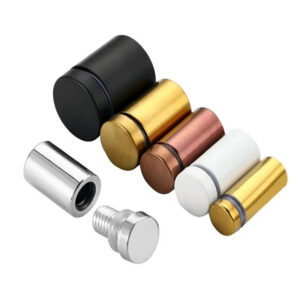
The coastal corrosion specification adds a fourth planning criterion. 316 marine-grade stainless steel is the correct material specification for commercial hardware in coastal environments; 304 or aluminum is not equivalent in chloride exposure conditions. This matters at the procurement stage because it affects not only base shoes and posts but every exposed fitting: standoffs, brackets, and fasteners. A project that substitutes 304 for 316 on a coastal commercial installation creates a corrosion failure timeline that surfaces years after installation — after the procurement decision is long past.
Documentation gaps between residential and commercial balcony projects
The friction between residential and commercial documentation is structural, not incidental. Residential glass railing projects often move forward on product pages, general spec sheets, and a glass thickness callout. Commercial reviewers expect something different: ICC-ES evaluation reports that include load evidence, glass type evidence, and anchorage evidence as a package. Treating a product page as a substitute for that package is the most common early failure mode in mixed-market procurement, and it rarely surfaces until the submittal is returned.
Engineering tables are the specific gap that creates the most downstream disruption. A commercial submittal should include tables showing post spacing, base shoe width, and standoff configurations verified against the 200 lbf concentrated and 50 plf uniform load thresholds at each glass thickness being used on the project. These tables are project-specific in the sense that they must reflect the actual hardware configuration — not a generic product range. Residential documentation typically omits them entirely, offering only generic thickness recommendations that give a commercial reviewer nothing to verify.
| Documentation Element | Commercial Requirement | Residential Documentation | Risk If Missing for Commercial |
|---|---|---|---|
| تقرير تقييم ICC-ES | Required; includes load, glass, and anchorage evidence | Often relies on product pages and general specs | Submittal rejection or delay |
| Engineering tables | Must show post spacing, base-shoe width, and standoff configurations satisfying 200 lbf and 50 plf at each glass thickness | Typically omitted; only generic thickness recommendations | Approval friction and additional information requests |
| Finite Element Analysis (FEA) models | May be required by local AHJ (e.g., Chicago) for glass guardrails | Rarely needed | Delayed approval if not provided |
FEA models represent a further escalation risk in certain jurisdictions. Chicago is a documented example where local AHJs have required Finite Element Analysis models for glass guardrail systems — a requirement that goes beyond what ICC-ES reports alone typically cover. This is not a universal commercial expectation, but it is a documentation escalation that a buyer should flag at RFQ if the project is in a jurisdiction with a history of elevated review requirements. If the supplier has not been asked to prepare FEA documentation and the AHJ requests it mid-review, the delay is significant and the cost of preparing the models after the fact is greater than preparing them early.
The practical consequence is straightforward: the documentation standard follows the project classification, not the buyer’s procurement habits. If a commercial submittal requires ICC-ES evaluation reports and the supplier’s package contains only a product page, the submittal will be incomplete on its face regardless of whether the hardware itself is adequate.
Load, height and public-use assumptions in supplier review
Commercial occupancy introduces a safety retention assumption that changes how glass is evaluated as a structural element. Public access means that if a glass panel breaks, it needs to stay in the opening — laminated glass satisfies this because the interlayer holds the fragments in place after fracture. Tempered-only glass shatters and falls, which is acceptable in some residential and some commercial contexts where a top rail carries the load, but it does not meet the retention expectation for a structural baluster application in a public-access guard. This is not a blanket prohibition on tempered glass in all commercial contexts; it is a function of how the glass is carrying load and what the occupancy assumption requires. The distinction matters for supplier selection because not every supplier who stocks tempered glass also stocks laminated tempered at the thicknesses commercial applications require.
| Review Area | Commercial Assumption | Residential Assumption | الأمور التي يجب توضيحها مع المورد |
|---|---|---|---|
| Glass retention after breakage | Laminated glass stays in place (public safety) | Tempered-only glass often accepted | Confirm glass type meets laminated requirement for commercial guard |
| Load test direction | 200 lbf concentrated load applied in any direction (push, pull, downward) | Product pages may not specify multi-direction testing | Ask for documentation confirming the load test covers all directions |
| Wind‑load and glass thickness | High‑rise/coastal may require 3/4″ or 7/8″ tempered‑laminated | Thinner glass (e.g., 1/2″ or 3/8″) often acceptable | Verify supplier can accommodate thicker glass and adjust post spacing/base‑shoe design |
The multi-direction load test is the review check most often missing from residential product documentation. A 200 lbf concentrated load applied in any direction — not just the obvious lateral push — means the hardware and anchorage must be reviewed against pull-out and downward loading as well. This is a testing assumption that residential product pages rarely detail, because the residential review path does not require it. A buyer relying on residential specs to support a commercial installation may not realize the gap until a reviewer asks for the test direction evidence.
Wind load and glass thickness interact with hardware geometry in a way that amplifies both cost and lead time. High-rise and coastal commercial installations may require 3/4-inch or 7/8-inch tempered laminated glass — thicknesses that exceed the capacity of base shoe systems designed for residential-range glass. Before confirming a hardware package for a commercial project, the post spacing, base shoe channel width, and clamp or shoe depth need to be verified against the actual glass thickness being specified. A base shoe sized for 1/2-inch glass is not a minor field adjustment away from accommodating 7/8-inch tempered laminated. That is a different product.
Esang’s قضبان قاعدية زجاجية هيكلية are designed to accommodate varying glass thicknesses, but confirming compatibility with the specific glass callout and post spacing for a commercial project requires reviewing the engineering tables — not the product page alone.
Approval friction when product pages replace submittals
The gap between what a residential product page contains and what a commercial reviewer needs is not a gray area. Product pages for glass railing hardware are written to support procurement decisions: they carry dimensions, material grades, finish options, and general glass thickness ranges. They are not written to satisfy a plan review. A commercial reviewer is looking for load evidence, glass type evidence, anchorage configurations, and ICC-ES report numbers — none of which appear on a standard product page.
When a commercial submittal is assembled from product pages instead of engineered documentation, rejection is a likely outcome, not a remote risk. The reviewer cannot verify the 200 lbf concentrated load compliance from a product description, and they cannot verify laminated glass compatibility from a generic thickness recommendation. The submittal comes back with an information request that requires the supplier to produce documentation they were never asked to prepare — engineering tables, load calculations, sometimes FEA models — and the project stalls while that documentation is developed.
The compounding problem is timing. Re-documentation requests arrive during the approval phase, which typically overlaps with procurement lead time. If the project schedule assumed a linear path from submittal to permit to fabrication, a documentation rejection disrupts that sequence in a way that is difficult to recover without extending either the permit window or the fabrication start date. For distributors and importers placing orders on behalf of end customers, that delay creates a supply risk that was not priced into the original procurement timeline.
The behavior that creates this friction is predictable: the buyer assumes the same hardware listing covers both markets. Residential jobs routinely close on product pages and general specs, so the assumption transfers. But commercial reviewers operate against a different evidence standard, and that standard is not negotiable in the submittal phase. Classifying the project correctly before RFQ — and asking the supplier explicitly for commercial-grade documentation at that stage — is the only point in the process where the friction can be prevented rather than managed.
Project triggers that require commercial-grade hardware evidence
Early project classification is a procurement decision, not a post-design formality. The three conditions most likely to require commercial-grade hardware evidence are: guard height or public access that exceeds residential parameters, a stair railing in a commercial space, and a multi-family building type that defaults to IBC rules regardless of how the buyer describes the project.
The guard height trigger is the most straightforward. If the guard height exceeds 36 inches, public access is anticipated, or the AHJ has indicated that formal submittals and inspections will be required, the project should be treated as commercial from the first hardware conversation. Entering an RFQ with residential assumptions and then discovering the approval path requires commercial documentation means the supplier may not have the required package ready, and the buyer may be holding hardware that was specified against the wrong load thresholds.
| Project Condition | Why It Requires Commercial Evidence | ما الذي يجب تأكيده |
|---|---|---|
| Guard height >36 in., public access anticipated, or AHJ requires formal submittals/inspections | Residential hardware documentation often insufficient for approval | Confirm supplier can provide commercial-grade evidence (load, glass type, engineering tables) |
| Stair railing in a commercial space | ADA handrail required (34–38 in. height, 1.5 in. clearance) adds design constraints | Verify hardware includes compliant handrail brackets and clearances |
| Multi‑family building (condos, apartments) | Often falls under IBC commercial rules even if labeled “residential” | Treat as commercial from the outset; request IBC‑compliant documentation |
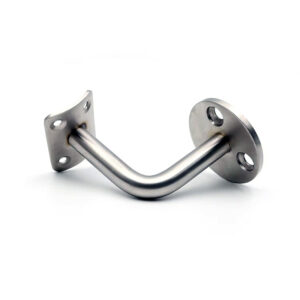
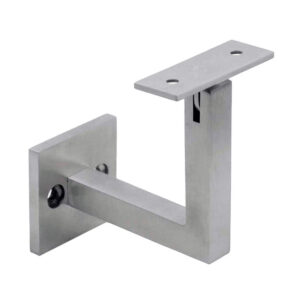
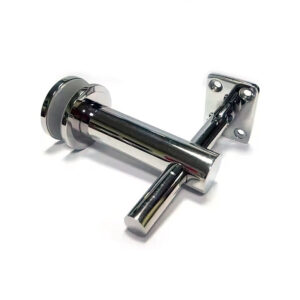
The ADA handrail trigger applies specifically to stairs in commercial occupancies and adds a layer of hardware constraints that residential stair railings typically don’t carry: graspable profile requirements, 34 to 38-inch height range, and 1.5-inch wall clearance. These requirements change bracket selection, wall-mount fitting geometry, and the overall handrail profile specification. A hardware package assembled for residential stair conditions is not automatically transferable to a commercial stair, even if the visual appearance is similar.
The multi-family classification risk is the most frequently underestimated trigger. Condominiums and apartment buildings are routinely described by buyers as “residential” projects, and the hardware procurement follows that assumption. But multi-family buildings of the type and height that trigger IBC jurisdiction typically require commercial-grade documentation for guardrail systems — meaning the evidence standard follows building classification, not the buyer’s informal label. This is a common outcome, not a universally settled rule, and the correct step is to confirm the applicable code with the AHJ before assuming which documentation standard applies. Treating a multi-family project as commercial from the outset, and requesting IBC-compliant documentation at RFQ, is the lower-risk default.
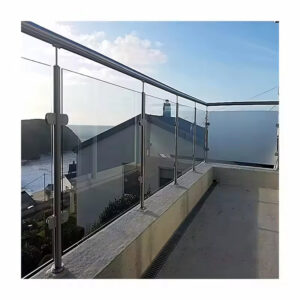
For projects where outdoor exposure and building classification intersect, Esang’s balcony railing systems in 316 stainless are designed for environments where both corrosion resistance and commercial-grade documentation may be required — but confirming the documentation package against the specific project approval path remains the buyer’s due diligence step.
For additional context on how IBC and IRC classifications affect stainless glass railing specification in multi-family settings, the IRC vs IBC stainless steel glass railing code differences for multi-family projects article covers the classification decision in more detail.
The central judgment this article supports is project classification before RFQ — specifically, identifying whether the approval path will require ICC-ES evaluation reports, engineering tables at each glass thickness, multi-direction load evidence, and laminated glass documentation before the hardware conversation begins. Once a submittal is assembled from residential-grade documentation and submitted to a commercial reviewer, the project is already in the most expensive correction sequence: rejection, re-documentation, and schedule disruption that compounds against fabrication and delivery lead time.
Before placing a hardware order for any project that involves public access, guard heights above 36 inches, ADA stair handrail requirements, or a multi-family building type, confirm with the supplier what commercial documentation is available — not what the product page contains, but what engineering tables, load calculations, and evaluation reports exist for the specific configuration being specified. That conversation at RFQ is the decision point that determines whether the approval path runs smoothly or stalls at submittal review.
الأسئلة الشائعة
Q: Does a condominium or apartment project always follow residential code, or can it fall under IBC commercial requirements?
A: Multi-family buildings frequently fall under IBC jurisdiction regardless of how the buyer describes the project — meaning commercial-grade documentation may be required even when the end use feels residential. The correct step is to confirm the applicable code with the AHJ before assuming which standard applies, because the evidence threshold follows building classification, not the buyer’s informal label. Treating a multi-family project as commercial from the outset and requesting IBC-compliant documentation at RFQ is the lower-risk default.
Q: If the hardware itself meets commercial load thresholds, will a plan reviewer accept a product page as proof of compliance?
A: No — hardware performance and documentation are separate reviewer requirements. A commercial plan reviewer cannot verify 200 lbf concentrated load compliance or laminated glass compatibility from a product description, regardless of whether the underlying hardware is adequate. The reviewer needs ICC-ES evaluation reports, engineering tables at each glass thickness, and anchorage evidence as a package. Hardware that meets the standard but arrives without that documentation will still generate an information request and stall the submittal.
Q: At what point in the project should the supplier be asked to confirm commercial documentation availability?
A: At RFQ, before hardware is specified or ordered. Once a submittal assembled from residential-grade documentation is returned by a commercial reviewer, the project enters a re-documentation sequence that overlaps with fabrication and delivery lead time — a disruption that is difficult to recover without extending either the permit window or the fabrication start date. Asking the supplier explicitly for commercial-grade documentation at RFQ is the only stage where that friction can be prevented rather than managed after the fact.
Q: Is laminated tempered glass always required for commercial glass guardrail applications, or does it depend on the configuration?
A: It depends on whether a structural top rail is present. Laminated tempered glass is required when glass serves as a structural baluster without a top rail, because the interlayer holds fragments in place after fracture in a public-access guard. When a structural top rail captures the panel and carries the load, tempered-only glass may be acceptable in some commercial contexts. This distinction must be resolved before hardware is selected, because it affects base shoe design, edge clearance, and the glass thickness the hardware must accommodate.
Q: How does specifying thicker commercial glass — such as 3/4-inch or 7/8-inch tempered laminated — affect the rest of the hardware package?
A: It changes the base shoe, post spacing, and anchorage geometry, and it cannot be resolved by field adjustment. A base shoe channel sized for residential-range glass thickness is a different product from one engineered for 7/8-inch tempered laminated — the channel width, clamp depth, and load transfer path all differ. Before confirming a hardware package for a high-rise or coastal commercial installation where wind load drives thicker glass, the entire hardware configuration needs to be re-verified against the actual glass callout using the supplier’s engineering tables, not the product page.