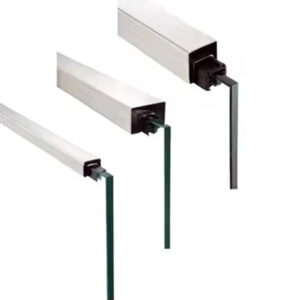
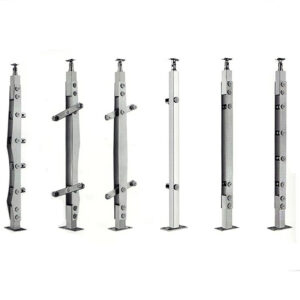
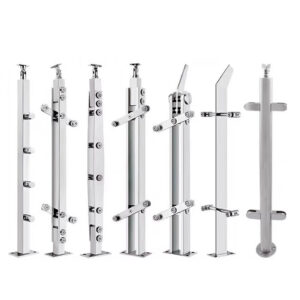
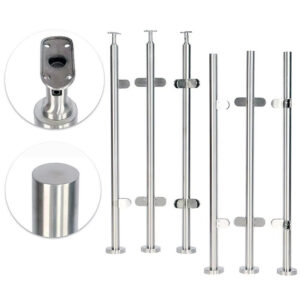
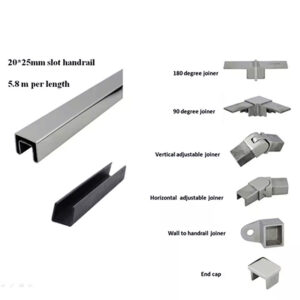
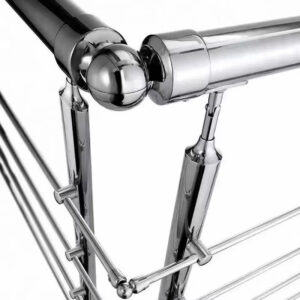
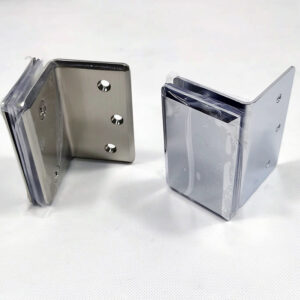
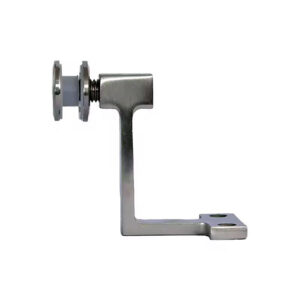
A railing run can include a handrail, a guard, an infill, or some combination of the three, and each of those terms answers a different question about what the installed assembly must do. Before comparing stainless steel finishes, mounting styles, or infill materials, the buyer needs to know which function the run is actually required to perform. Skipping that step leads to a hardware comparison that never resolves, because products that look similar on a spec sheet may be answering different functional questions entirely.
Functional question to answer before comparing visible railing options
The question that precedes any product comparison is simple to state and easy to skip: what is this run of railing required to do? A handrail exists to give a hand something continuous and graspable to hold while a person moves along a path. A guard exists to prevent a fall or passage through an open side. An infill exists to close the space between structural members, whether or not anyone is meant to grip it. These are three different functional demands, and a single run of railing may need to satisfy one, two, or all three at once, depending on where it sits and who or what passes by it.
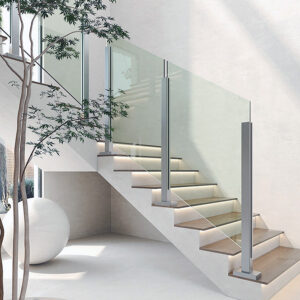
The reason this question has to come first is that visible railing options do not sort themselves by function. A photograph of a glass railing with a round profile on top does not tell the viewer whether that profile is there to serve as a graspable handrail, to cap a guard assembly, or to do both. Two assemblies can look nearly identical and still answer different functional questions, because the required function is a property of the project location and its use, not a property of the hardware’s appearance. Where the required function is graspable support, the selection criteria center on the user’s hand and path. Where the required function is fall protection, the criteria center on the open side and what must be kept from passing through it. Conflating these two leads to a search for “the right railing” when the real task is to define, run by run, what each section of railing is there to do.
This matters because the practitioner task is not to pick a product family first and then check whether it satisfies the site. It is to define the required function at each run, then compare the handrail, guard, and infill scope each implies. A combination condition, where one run must provide a gripping surface and also serve as the fall-protection boundary, imposes requirements from both functions simultaneously, and no single visible feature of a product announces that it satisfies both. The practitioner has to confirm that it does, for that location, before treating the product choice as settled.
Graspable support along stairs, ramps, and circulation routes
Where the required function is graspable support, the decision centers on the person’s hand and their path through the space, not on the structure at the open side. A handrail is judged by whether a hand can maintain continuous, confident contact with it from one end of the route to the other. That standard brings several interconnected considerations into play, and they do not function independently of one another.
O gripping surface is the part of the handrail a hand actually closes around, and its profile and surface condition determine whether that contact is secure and sustained, or interrupted and uncertain. Continuity means the graspable surface does not break, drop away, or change shape at a point where the hand is still relying on it, such as across a transition between a stair and a landing. Where continuity is broken without an intentional return or transition detail, the user’s hand loses support exactly where the change in grade or direction makes support most needed.
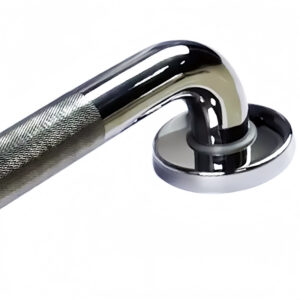
Clearance refers to the space between the gripping surface and any adjacent wall or obstruction; where clearance is too tight, a hand cannot wrap the rail, and where it is too generous, grip security is also reduced. Returns are the detail at the ends of a handrail run, where the rail turns back toward the wall or supporting structure rather than terminating as an open end; this detail affects whether loose clothing, bags, or a hand sliding to the end of the rail can catch on a projecting termination. Supports are the brackets and fixings that hold the handrail at the correct height and keep it rigid enough that a hand bearing weight on it does not feel deflection.
Each of these considerations is specific to the handrail’s role as a graspable element and is evaluated independently from what happens at the open side of the same run. A route with full gripping-surface continuity can still fail the guard requirement if there is also an open side; graspable support and edge protection are separate judgments made about the same physical run. The Access Board’s accessible-stairway guidance addresses handrail continuity, gripping surface, clearance, and extension provisions for covered US accessible stairs, and where a project falls under that coverage, the specific continuity and clearance provisions in that guidance are the reference point, subject to confirming which code is currently adopted for the project.
Edge protection and system performance at open sides
Where the required function is fall protection, the governing question shifts from the hand to the open side itself: what must be kept from passing through, and what load must the assembly resist if someone leans, falls against, or is pushed toward that edge. This is a guard, and a guard decision brings edge protection and system performance into scope in a way that a pure handrail decision does not.
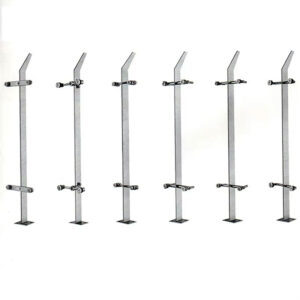
System performance means the guard is evaluated as an assembly, not as an isolated top rail. The posts, their spacing, their connection to the structural substrate, the infill between them, and the top member all have to work together to resist the forces applied at the open side. A component that looks adequate in isolation does not establish that the assembled guard performs as a system; the posts might be correctly specified while the connection to the structure beneath them is not, and the assembly’s behavior under load depends on all of these interfaces together, not on any single part.
This is the point at which the handrail and guard questions can occupy the same physical rail without being the same judgment. A top rail at an open stair edge may need to serve as the graspable handrail and also cap the guard assembly that provides fall protection at that edge. Where that is the case, the rail has to satisfy the handrail’s gripping-surface and continuity criteria and separately satisfy the guard’s edge-protection and system-performance criteria; meeting one does not establish the other. ASTM E985-24 addresses permanent guardrails, stair rails, ramp rails, and handrails in building applications at the level of its public scope, though the field-specific criteria for a given project remain with the project parties, and the full detail sits behind the standard’s paywalled text.
The practical consequence is that a guard cannot be selected on the strength of its visible top-rail profile alone. The buyer needs to confirm how the posts, infill, and base connection are specified to work together at that open side, because the guard’s performance is a property of the complete installed system, not of any single visible component.
Infill choice versus the need for a separate handrail
Glass and cable are both infill materials, and choosing between them is a decision about how the open space within a guard or railing assembly is closed, not a decision about whether the run also needs a separate handrail. This distinction gets lost when a glass or cable railing is marketed and discussed as a single product category, because the infill is the most visually distinctive part of the assembly and easily stands in, in the buyer’s mind, for the whole functional question.
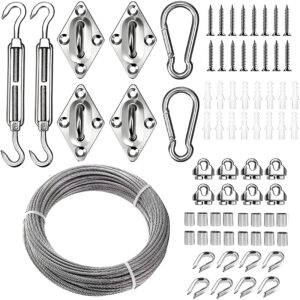
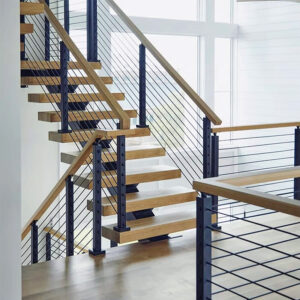
An infill’s job is to close the gap between structural members so that a person, object, or in some applications a sphere of a defined size cannot pass through the open side. Glass infill does this with a continuous panel; cable infill does it with horizontal or vertical runs of tensioned cable at defined spacing. Both are legitimate answers to the infill question. Neither answer says anything about whether the same run also requires a graspable handrail, because that is governed by whether a hand is expected to use that run for support while moving along it, which is a separate functional question tied to the circulation path, not to how the open side is infilled.
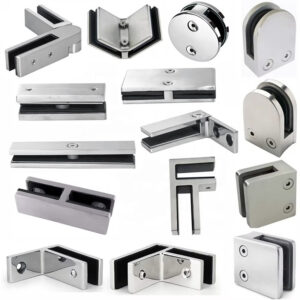
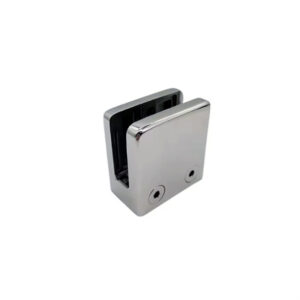
Where a run requires both an infill and a separate handrail, the top of the guard assembly and the handrail may be the same physical member, or the handrail may be a distinct element mounted separately from the guard, set at a different height and profile suited to the hand rather than to the infill below it. The choice between combining them and separating them depends on the circulation function at that location, not on which infill material was selected. A cable-infill guard does not imply a particular handrail treatment, and a glass-infill guard does not exempt the run from needing one; the infill decision and the handrail decision are made independently, even when they end up sharing hardware. Esang’s ferragens para guarda-corpo de vidro e cable railing systems both function as infill and assembly choices within this broader framework, and selecting between them is properly a question of infill performance and appearance, addressed after the handrail requirement for that run has already been determined separately.
Location-by-location changes at landings, balconies, and transitions
The required function at a given point in a project is not constant along a single continuous-looking railing run. It changes at landings, at balconies, and at transitions between different circulation conditions, and each change has to be identified before the buyer treats the railing as one uniform specification problem.
A stair run demands graspable support along its full length, including the clearance and continuity considerations relevant to a hand in motion. Where that stair arrives at a landing, the circulation condition changes from a sloped, directional path to a level area, and the handrail’s continuity and return details have to be reconsidered for that transition rather than assumed to carry over automatically. A balcony or other open-sided level area may have no handrail function at all if no continuous circulation path requires graspable support there, while still carrying a full fall-protection requirement because the open side is present regardless of whether anyone is expected to walk a defined path along it.
This means a single project can require a handrail in one location, a guard with no handrail function in another, and both functions combined in a third, all within what a casual observer would describe as “the same railing.” The practitioner’s task at each of these points is to ask what changes about the function at that specific location, not to assume the specification established at the stair carries forward to the balcony, or that the guard requirement at the balcony implies anything about the landing’s handrail detailing. Where the circulation path ends and an open edge begins without a path crossing it, the function in play shifts from graspable support to edge protection, and the selection criteria shift with it.
This location-by-location review is also where a project’s dimensions, elevations, and use conditions enter the hardware decision. The information the buyer or specifier assembles about each location along the run, including where the path changes and where open edges begin, is the input a supplier needs in order to confirm which handrail, guard, and infill scope applies at each point, rather than quoting a single uniform assembly across a project that in fact changes function from one location to the next.
Selection path from required function to handrail, guard, and infill scope
| Required function at the run | Scope to evaluate | Selection focus | Limite de decisão |
|---|---|---|---|
| Suporte para agarrar | Corrimão | User path, gripping surface, continuity, clearance, returns, and supports | This function alone does not establish edge-protection or infill scope. |
| Fall protection | Guarda | Edge protection and system performance at the open side | Product type alone does not establish project compliance; field-specific criteria remain with the project parties. |
| Infill | Glass or cable as an infill or assembly choice | The infill role within the railing or guard scope | The infill choice does not establish whether a separate handrail is required. |
| Combination of functions | Handrail, guard, and infill roles as applicable | Define each role for the same run before comparing visible options | Final criteria depend on project coverage and the current adopted code. |
The decision sequence runs from function to scope, not from product to function. The buyer first identifies the required function at a given run: graspable support, fall protection, infill, or some combination of these tasks occurring at the same location. Only after that function is defined does it make sense to evaluate the handrail, guard, or infill scope that answers it, because each scope carries its own selection focus and its own boundary on what that scope alone establishes.
Where graspable support is the function, the selection focus is the user’s path, the gripping surface, continuity, clearance, returns, and supports, and satisfying these does not by itself establish that the same run provides edge protection or resolves the infill condition. Where fall protection is the function, the focus moves to edge protection and the performance of the assembled guard system, and meeting a product description alone does not establish project compliance, since field-specific criteria remain with the project parties under whichever standard or code applies. Where infill is the function, the focus is the infill’s role within the railing or guard scope, glass or cable alike, and that role does not answer whether the run also needs a separate handrail. Where a run presents a combination of these functions, each role has to be defined and satisfied for that same run rather than assuming that satisfying one implies the others.
This sequence is what keeps a project from arriving at a handrail product that performs well as graspable support but was never evaluated against the open side it sits beside, or a guard assembly that resists load at the edge but offers no continuous gripping surface where one is required. It also keeps the infill decision in its proper place, as a choice made within whichever scope, railing or guard, actually governs that run, rather than as a stand-in for the handrail decision.
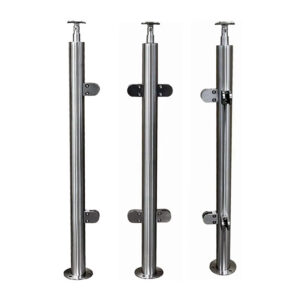
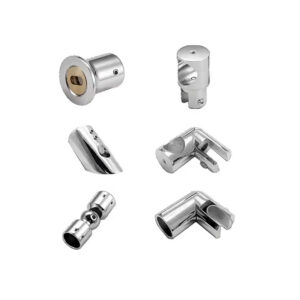
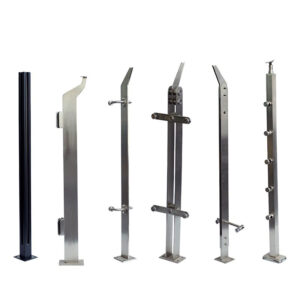
Da Esang’s sistemas de corrimãos and glass railing hardware are organized around this same functional split, so that the scope a buyer is evaluating, whether it is the graspable-support criteria for a handrail or the edge-protection and system criteria for a guard, can be matched to the function the project has already defined for that run. The remaining project-specific step is to confirm, location by location, which of these functions applies, and to carry that confirmed scope into the hardware comparison rather than letting a shared visual profile across handrail, guard, and infill products stand in for that confirmation.
Perguntas frequentes
P: How do I decide whether a railing run needs a handrail, a guard, or both?
A: Define the required function first. Graspable support points to handrail scope, open-side fall protection points to guard scope, and a run that serves both purposes requires both roles to be evaluated together.
P: Does choosing glass or cable determine whether a separate handrail is required?
A: No. Glass and cable describe an infill or assembly choice; the need for a separate handrail depends on whether the run must provide graspable support along the user path and on the criteria that apply to the project.
P: What should be mapped before comparing visible railing options?
A: Mark every stair, ramp, landing, balcony, open edge, and transition, then assign the required function at each run. This exposes where handrail, guard, and infill roles change instead of treating the project as one uniform railing condition.
P: What should I compare when the required function is graspable support?
A: Compare the user path, gripping surface, continuity, clearance, returns, and supports. Check these factors against the project’s coverage and current adopted requirements before selecting the visible system or mounting hardware.
P: Can ASTM E985-24 or the Access Board stairway guide establish that a selected system complies?
A: No. They can help identify relevant guardrail, stair rail, ramp rail, handrail, and US accessibility topics, but the applicable code, project coverage, field-specific criteria, and any required standard details still need project-specific confirmation.