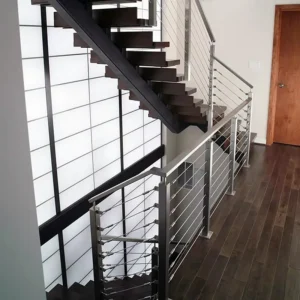
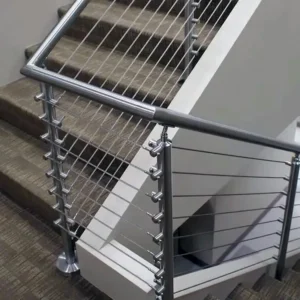
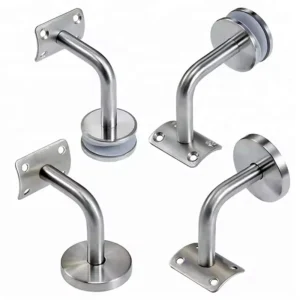
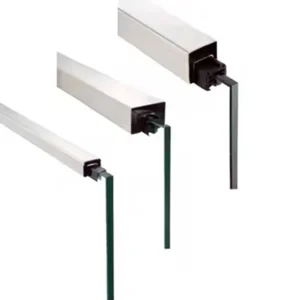
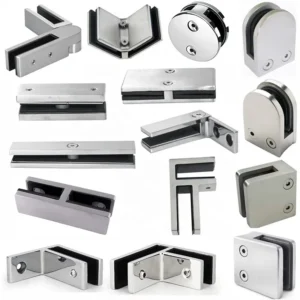
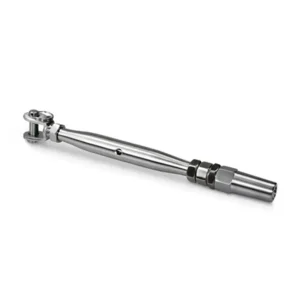
A surface-mount handrail RFQ needs four things before a supplier can price it: drawings that identify each run and the quantity basis, connection sections that show how the rail, its supports and the structure meet, a stated grade and finish reference tied to the exposure, and a written boundary between component supply and site work. Without those, quotations differ in what they include rather than in what they cost. Surface-mount here means the rail’s supports land on a finished surface — a tread, landing, nosing or slab — and transfer load through a base plate and anchors into whatever structure sits beneath that finish, which is why the substrate matters as much as the rail profile.
Define each run and the quotation quantity basis
Start the package with a plan and elevations that identify every run by a reference mark, so the quantity is read from the drawing rather than inferred from a single linear figure. An unqualified “40 m of handrail” tells a supplier nothing about how many terminations, returns, transitions and bases sit within that length, and those fittings carry more of the cost and the fabrication time than the tube does.
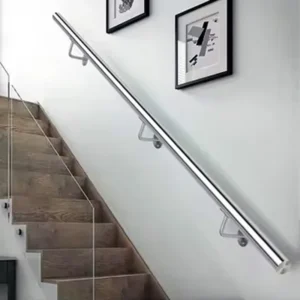
On the plan, show where each run starts and stops, which side of the stair or landing it serves, and how runs relate to each other at corners and half-landings. On the elevations, show the stair or level geometry: going and rise set the rail’s rake, and the change from raking to level at a landing is where a transition fitting or a site-formed bend appears. Mark the intended post or bracket positions on both views. Where a base must sit clear of a nosing or avoid a slab edge, that position is a constraint the supplier has to design around, not a detail to be resolved later.
State the quantity basis plainly: how many runs, how many assemblies per run, and whether tube lengths are to be supplied cut to drawing or in stock lengths for site cutting. Those are different deliverables with different tolerance consequences, and suppliers will otherwise choose for you.
Where a dimension is still preliminary — a stair not yet poured, a landing level not yet confirmed — label it as preliminary and say when it will be confirmed. A labeled provisional dimension lets the supplier price the assembly and flag the items that cannot be cut until the figure is fixed. An unlabeled one gets priced as though it were final, and the difference surfaces as a variation after award.
Show the rail, mounting and substrate interfaces
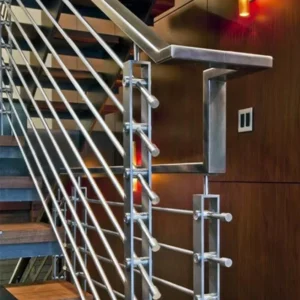
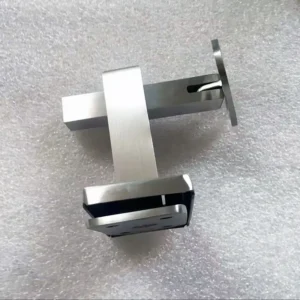
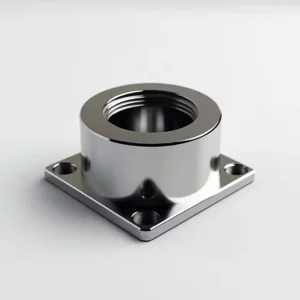
Connection sections are the part of a surface-mount handrail RFQ most often missing, and they are what turn a rail elevation into a priceable mounting package. For each distinct condition — raking run on a tread, level run on a landing, base near a slab edge, bracket into a wall return — draw a section through the connection showing four things together: the rail profile and diameter, the support profile (post, stanchion or bracket arm), the base geometry, and the structural substrate below the finish.
The substrate layer is the one that decides what you can actually fit. A base plate that works on a cast concrete slab behaves differently on a composite deck, a screed over insulation, or a timber stringer, because the anchor type, embedment and the usable edge distance all change with it. Show the finish thickness separately from the structure: 60 mm of screed above a slab means the anchor has to reach through non-structural material, and it changes both the fixing selection and the base plate height relative to the finished floor line. If the finish is not yet chosen, say so and give the structural level, since that is the dimension the mounting detail is set from.
Edge distance deserves its own note on the section. Surface-mounted bases placed near a stair nosing or a slab edge are constrained by how close an anchor can sit to free concrete, and that constraint can move the base inboard, change the base plate footprint, or force a different support position than the elevation showed. Giving the edge dimension lets the supplier tell you at quotation stage whether the drawn position works with the base they propose.
Anchor design itself may be a separate project deliverable, allocated to the structural engineer rather than the component supplier. That allocation is fine, but the RFQ should say it, because it determines whether the supplier is quoting a base plate with a defined hole pattern for someone else’s anchors, or quoting the fixings as well. Guard loads, anchorage capacity and the acceptance of the installed connection are decided by the project’s approved design and its designated approver; the quotation’s job is to say what hardware it covers and on what substrate assumption.
State material, finish and document requirements
Grade, finish reference, exposure and the documents you want to see should appear together in one block, because each one changes what the others mean. “Stainless steel, satin finish” is three words that can describe several different products at several different prices.
Give the proposed grade as a designation, not as a category. Exposure is what justifies it: interior dry, exterior inland, or coastal with salt-laden air and wind-driven spray, where chloride attack on stainless is a material selection question rather than a cleaning question. State the exposure even when you have already nominated a grade, because the supplier can then tell you whether the nominated grade, weld treatment and finish are consistent with each other for that environment. Final selection stays subject to the project specification and the environment the designer has assessed.
The finish needs a reference the supplier can measure against, not just a name. A grit designation, a surface roughness value, or a named sample all work; “brushed” or “satin” on their own do not, because the appearance of a mechanically polished tube varies with grit, direction and whether the finish is applied before or after fabrication. Say whether the finish direction is specified on raking runs and whether welds are to be dressed back to match. Then state what evidence you expect: a physical sample for approval, a sample panel retained for comparison at delivery, or an inspection record against the agreed sample.
Material certification belongs in the same block. Say which components require mill test certificates — tubes only, or tubes, brackets, bases and fasteners — and whether certificates must be traceable to the delivered heat or batch. Requesting certification across the whole assembly costs more and takes longer than requesting it on the load-bearing components, so state what you need and why. Submitting a certificate is evidence of the material supplied; whether it satisfies the specification is decided when the project reviews it.
Separate component supply from site and design work
Write the scope boundary into the RFQ rather than leaving it for the quotation to assume, because a hardware price and an installed connection price describe different work. A component supplier quoting rails, posts, bases and brackets is not, by default, quoting substrate preparation, coring, waterproofing reinstatement, or making good a membrane or finish penetrated by an anchor.
Ask the quotation to state, in its own words, five things: which fixings are included and which are excluded, what substrate the base design assumes, what site work is outside the quoted price, what site access and handling the delivery assumes, and where responsibility sits at each interface with another trade. The envelope and waterproofing interface is the one that most often falls between scopes on exterior surface-mount work, since a base anchored through a roof or balcony deck involves a penetration someone has to detail and warrant. Naming that interface in the RFQ is cheaper than discovering it during installation.
Design and verification documents follow the same logic. Identify which drawings you expect — general arrangement, fabrication, setting-out — what calculation scope is being asked for and by whom it will be reviewed, which material documents are required, and what test evidence, if any, applies. Asking for “all relevant certificates” produces incomparable paperwork from different suppliers and leaves the review task unassigned. Asking for a defined list with a named purpose produces documents you can actually check against each other. A request for particular evidence is not an indication that any proposed product already holds it; the supplier’s response tells you what exists today.
The actual contractual allocation governs all of this. If the main contract already assigns anchor design, substrate preparation or installation to a named party, repeat that allocation in the RFQ so the quotation is built on the same split.
Compare quotations with a keyed scope schedule
| Scope line | What to match between quotations | Qualification to keep visible |
|---|---|---|
| Run assemblies | Run identifiers, quantity basis, stair or level geometry, and post or bracket positions | Preliminary dimensions and quantities; a confirmed straight run versus a stair transition awaiting dimensions |
| Mounting package | Rail and support profiles, base geometry, structural substrate and included fixings | Substrate assumptions and any separately allocated anchor design |
| Material and finish | Proposed grade, finish reference, exposure, and sample or inspection documents | Final selection remains subject to the project environment and specification |
| Design and verification documents | Drawings, calculation scope, material documents, test evidence and review responsibility | Requested approval or evidence is not confirmation that the proposed product already has it |
| Site work and interfaces | Excluded site work, substrate preparation, envelope work, access needs and interface responsibilities | Hardware supply and installed connection scope depend on the actual contractual allocation |
| Quotation variations and terms | Proposed substitutions, unresolved inputs, packing assumptions and commercial terms | Lead time, minimum order and warranty must come from the quotation rather than assumed standard terms |
Ask every supplier to return their price against a keyed scope schedule that uses your run references, so each line of their quotation maps to a line of your drawing set. Free-format quotations invite a comparison of totals; a keyed schedule forces a comparison of deliverables, which is the only comparison that tells you anything.
The value of the schedule is that it keeps the unresolved items visible instead of absorbing them into the price. A confirmed straight run with fixed dimensions and a stair transition still awaiting a landing level are not the same commercial item, and separating them stops a low total from concealing an omitted interface. The same applies to proposed substitutions: if a supplier offers a different base profile, bracket type or tube wall than the drawing showed, that substitution needs to appear as a line you can assess rather than as an unannounced equivalence. ASTM E985-24 covers permanent metal railings, stair rails, ramp rails and handrails for buildings, including basic design and load and deflection criteria, and it is the kind of reference worth naming in the schedule when a substitution touches a load-bearing element — though which criteria apply to your project remains a project decision. UFGS 05 52 00, the US government guide specification for metal railings, is a useful illustration of how a railing specification and its submittal list can be structured for project-specific editing; it is not a universal requirement.
Require packing and delivery assumptions on the schedule too. Long raking assemblies, finished tube and pre-welded transitions are vulnerable in transit, and whether a supplier has priced crated, protected, labeled-by-run delivery or bundled stock lengths changes both the price and the condition of the material when it reaches the floor. Commercial terms — lead time, minimum order quantity, warranty and the point at which dimensions must be frozen — should come from each quotation as written. Do not normalize them against an assumed industry standard; a shorter stated lead time usually carries a different set of conditions.
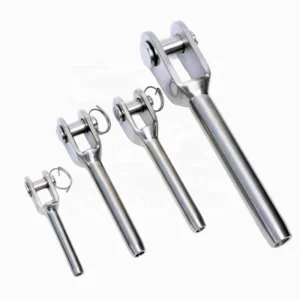
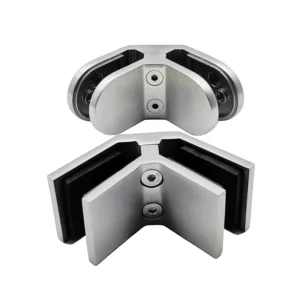
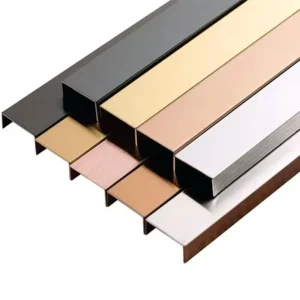
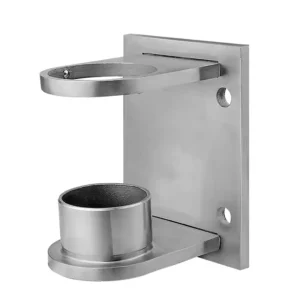
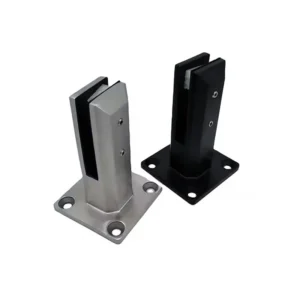
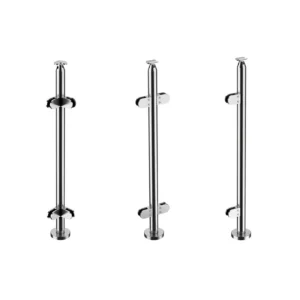
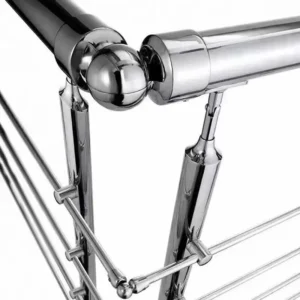
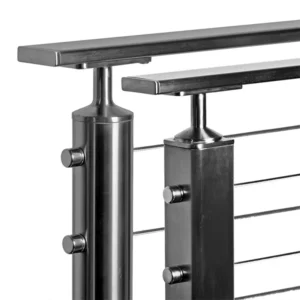
Before issuing the inquiry, assemble the package you will send with it: plan and elevations with run references and quantity basis, connection sections showing rail profile, support, base geometry and structural substrate with finish thickness and edge distances, the exposure and proposed grade with a finish reference or sample, the document list with its review responsibility, the scope boundary for fixings and site work, and the identified assembly family — ESANG’s surface-mount handrail range, for instance — so the hardware being quoted matches the detail being drawn. Mark what is preliminary. A quotation built on a labeled assumption is one you can correct; a quotation built on an unstated one is one you argue about later.
Frequently Asked Questions
Q: Can I request pricing while some run dimensions are still preliminary?
A: Yes, provided the provisional dimensions and quantities are clearly labeled. Separate confirmed runs from unresolved details, such as a stair transition awaiting dimensions, and keep those qualifications visible in the quotation so a provisional scope is not compared as a fully confirmed offer.
Q: Are two price-per-metre quotations directly comparable?
A: Only when they cover the same assemblies and scope. Align run identifiers, quantity basis and support positions, then check included mounting hardware and any separately allocated design or site work. Matching handrail length alone does not establish matching hardware or installation scope.
Q: Can I compare a proposed material or finish substitution on price alone?
A: No. Compare the proposed grade and finish reference against the project’s exposure and sample or inspection requirements before treating the substitution as equivalent. Keep the proposed change explicit; final selection remains subject to the project environment and specification.
Q: Should the inquiry simply request every available certificate?
A: No. Define what each requested document must establish and who will review it. Specify the relevant drawings, calculation scope, material documents and test evidence rather than treating a larger paperwork package as a better offer. A request for approval evidence does not confirm that the proposed product already has that approval.