A distributor placing a repeat order for OEM cable tensioners is really deciding how much fit, function, and traceability remains fixed once a supplier’s branding, packaging, or internal process changes. The written purchase package is what carries that decision from one order to the next, and gaps in it only become visible when a shipment arrives and the tensioner does not sit, thread, or adjust the way the last one did.
Identify the Cable, Terminal, Thread, and Mating-Post Interfaces
| Interface | Ordering detail to freeze | Compatibility question |
|---|---|---|
| Cable | Cable construction and diameter | Is the tensioner specified for the intended cable? |
| Terminal | Terminal method | Does the terminal method match the ordered tensioner? |
| Thread | Tamaño y tipo de rosca | Will the threaded parts engage as intended? |
| Mating post | Mating-post details | Will the tensioner interface with the intended post detail? |
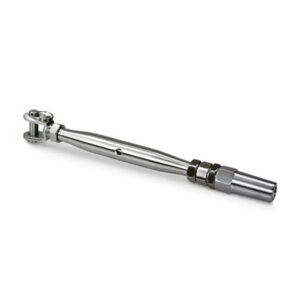
A cable tensioner does not function as an isolated part. It exists inside a chain of interfaces: the cable it grips, the terminal method used to form that grip, the thread that lets the fitting draw up or release, and the mating post or receiver it tensions against. Each of these interfaces carries its own tolerance logic, and a tensioner can be dimensionally correct in isolation while still failing to perform correctly once it meets the rest of the assembly.
Cable construction and diameter determine how the tensioner’s gripping or swaging feature engages the cable. A tensioner built for one cable construction will not necessarily perform the same way on a cable of a different construction, even where the outer diameter matches, because the internal lay and core behavior affect how the fitting seats and holds under load. Where the distributor has not confirmed the cable construction and diameter the tensioner is specified for, that single gap can carry through an entire repeat order undetected until field assembly.
Terminal method is a separate variable from the tensioner body itself. A swageless terminal interface and a swaged terminal interface are not interchangeable, and a tensioner designed around one method will not deliver the same result if paired with cable prepared for the other. This distinction matters more at reorder time than at first order, because a supplier substitution in terminal hardware can appear compatible on a drawing while actually changing the assembly method the installer must use in the field.
Thread size and hand govern whether the threaded parts will engage as intended. A reversed hand, a mismatched pitch, or a thread class that falls outside the mating part’s tolerance will either bind, strip, or fail to reach the intended adjustment position. Thread engagement questions become more significant where the tensioner is sourced from a different supplier than the mating post or receiver, since the two parts are then being coordinated across two separate manufacturing sources rather than one.
Mating-post details close the loop. The tensioner’s working end must interface correctly with whatever post, baluster, or receiving fitting the system uses downstream. Where the mating post geometry changes, even slightly, the tensioner that worked in a prior order may not seat, align, or tension correctly in the current one. A distributor confirming interfaces for repeat orders should treat the cable, terminal, thread, and mating post as four separate compatibility questions rather than one, because a correct answer on three of them does not guarantee the fourth.
Separate Fixed Fit and Adjustment Requirements from Branding and Packaging Options
Not every attribute of an OEM cable tensioner carries the same consequence if it changes. Cable fit, thread engagement, and adjustment travel are fixed functional requirements: they determine whether the part performs correctly inside the assembly, and a change to any of them can alter how the tensioner behaves once installed. Branding marks, labeling, and packaging format sit in a different category. They affect how the product is identified and presented, not how it functions once installed.
The practical risk appears when these two categories are not kept separate in the purchase agreement. A supplier may treat a request to update a logo, change a package insert, or adjust carton labeling as a minor administrative change, and in isolation it is. But where that same change process is not bounded, it becomes easier for adjacent changes, such as a revised production method or alternate component source, to pass through alongside it without the same scrutiny a fit-critical revision would receive. The distributor’s purchase package should state explicitly that branding and packaging changes may proceed under a lighter review path, while any change touching cable fit, thread engagement, or adjustment travel requires the same approval sequence used for the original specification.
This separation also protects the distributor’s downstream customers. A fabricator or installer who has already validated an assembly around a specific tensioner does not expect a repeat order to behave differently because the supplier updated artwork or switched a retail carton. Where the distributor’s documentation draws a clear line between what can change without notice and what cannot, that expectation is protected by the ordering process itself rather than by hoping no functional change accompanies a cosmetic one.
Document Travel, Material, Finish, Tolerances, and Markings in the Purchase Drawing
| Purchase-drawing item | Project-specific value to state |
|---|---|
| Adjustment travel | Required adjustment travel |
| Material | Specified material |
| Acabado | Specified finish |
| Dimensions and tolerances | Drawing dimensions and applicable tolerances |
| Markings | Required product markings, with optional branding identified separately |
The purchase drawing is the document a supplier manufactures against, and anything left implicit in it becomes a variable the supplier is free to resolve on their own terms. Adjustment travel is one of the values most easily left unstated, because a tensioner’s general appearance does not reveal how much take-up range it provides. Two tensioners that look identical can offer different travel, and where the project’s cable run length and installation sequence depend on a specific travel range, that figure needs to be stated on the drawing rather than assumed from a sample or a prior shipment.
Material and finish are related but distinct specifications. Material affects structural and corrosion behavior; finish affects appearance and, in some environments, the protective layer sitting over the base material. A drawing that specifies only a finish without confirming the underlying material leaves room for a supplier to substitute a different base material that happens to accept the same surface treatment. Where the installation environment places particular demands on corrosion resistance, the material callout carries more weight than the finish callout, and both should be stated independently rather than treated as a single specification.
Dimensions and tolerances tell the supplier what variation is acceptable, not just what the nominal size is. A tensioner’s critical dimensions, those affecting cable fit, thread engagement, and mating-post interface, need tolerances tight enough to protect function, while non-critical dimensions can carry looser tolerances without consequence. Leaving tolerances unstated invites the supplier to apply their own standard practice, which may not align with what the assembly requires.
Markings deserve the same explicit treatment. Required product markings, such as identification, batch, or traceability marks, should be stated separately from any optional branding the buyer wants applied. Where these two are merged into a single instruction, a future change to the branding mark can inadvertently alter or remove a marking the distributor actually relies on for traceability. Stating the required markings and the optional branding as two distinct line items keeps a packaging-level change from touching a traceability-level requirement.
Approve a Functional Sample with the Intended Cable, Tools, and Opposing Fitting
A drawing approval confirms that the supplier understood the specification; a functional sample approval confirms that the specification, as built, actually works. These are not the same test, and treating drawing sign-off as sufficient skips the step where real compatibility problems surface. The functional sample should be evaluated using the intended cable, the tools the installer will actually use, and the opposing fitting it will mate against in service, because a tensioner can pass visual and dimensional inspection while still binding, slipping, or under-tensioning once it meets the actual assembly.
Testing with the intended cable matters because cable construction affects how a gripping or swaging feature seats, and a sample tested against a substitute cable does not confirm behavior against the cable the project will actually use. Testing with the intended tools matters because some tensioner designs depend on a specific tool geometry or access clearance to reach full adjustment, and a sample adjusted with a different tool may not reveal a clearance problem that appears later on site. Testing with the opposing fitting matters because thread engagement and mating-post interface are two-sided relationships; a tensioner that appears correct on its own can still fail to draw up properly against the specific post or receiver it is meant to pair with.
Once a sample passes this combined test, the approved revision becomes the reference point for everything that follows. Every subsequent order should trace back to that specific approved sample and its revision level, not to the general part description or a prior shipment’s appearance. Where the distributor later evaluates a new or alternate source for the same tensioner, the same functional test, intended cable, intended tools, intended opposing fitting, should be repeated before that source is approved, because passing the drawing does not establish that the new source’s output behaves the same way under the mating conditions the assembly actually uses. This is also the stage at which the project information the distributor has gathered, the cable specification, the terminal method, the mating post details, enters the supplier’s quotation and configuration review in a form specific enough to produce a sample worth testing, rather than a general request that leaves those variables for the supplier to assume.
Specify Inspection Documents and Revision Records for Each Delivery
| Delivery control | Required content or linkage | Evidence boundary |
|---|---|---|
| Inspection document | Inspection-document type specified in the purchase order under ISO 10474:2013 | The document type alone does not prove traceability, test validity, grade conformity, or certificate authenticity. |
| Inspection record | Approved drawing revision linked to the delivery inspection record | The linkage identifies the approved baseline; it does not authorize a later revision. |
| Repeat-order record | Approved drawing revision carried into the repeat-order record | The record does not remove the need to review supplier changes that could affect fit or service behavior. |
Approving a sample establishes what correct looks like once; specifying inspection documents and revision records is what confirms that every subsequent delivery still matches it. The purchase order should state which inspection-document type accompanies each delivery, and ISO 10474:2013 describes the types of inspection documents that can be supplied for steel-product deliveries according to the purchaser’s order requirements. Naming a document type in the order gives the distributor a basis for what to expect on each shipment, but the document type itself does not prove traceability, confirm that testing was actually performed as described, verify grade conformity, or authenticate the certificate. Those remain separate questions the distributor needs to resolve through the supplier relationship, not something the document type alone resolves.
Equally important is linking the delivery’s inspection record to the specific approved drawing revision, not simply to the tensioner’s general part number. A part number can remain unchanged across several drawing revisions if the supplier has made incremental adjustments, so an inspection record that references only the part number does not confirm which revision the delivered parts were actually built to. Tying the inspection record to the approved revision closes that gap, though it only identifies the baseline the parts were meant to match; it does not by itself authorize a later revision to replace that baseline without the distributor’s review.
The same linkage needs to carry forward into repeat-order records. Each time the distributor reorders, the approved drawing revision should be the reference point the new order cites, not the prior shipment or a general catalog description. This keeps a chain of custody between what was originally approved and what continues to be delivered. It does not, however, remove the need to review supplier-side changes, material, process, tooling, subcontractor, or drawing, that could affect fit or service behavior even where the revision number has not changed on paper. A revision record shows what was agreed; it does not monitor whether the agreement still holds on the supplier’s production floor.
Set Supplier-Change Notification and Reapproval Triggers Before Repeat Orders
The functional sample and the revision record establish a baseline, but a baseline only holds if the distributor knows when the supplier departs from it. Material, process, tooling, subcontractor, and drawing changes can each independently alter how a tensioner fits, threads, or adjusts, even where the part number and general appearance remain unchanged. Setting advance-notice and reapproval triggers for each of these categories before placing repeat orders is what keeps that risk visible rather than discovered at installation.
A material change can shift corrosion behavior or dimensional response even where the finish appears identical, since finish and material are independent specifications. A process change, such as an altered machining or forming sequence, can shift a critical dimension without changing anything the supplier considers worth reporting on its own. A tooling change can introduce a different draft angle or wear pattern that shifts tolerance at the margins. A subcontractor change moves part or all of production to a different facility, which can carry its own variation in equipment and process control even when working from the same drawing. A drawing change is the most direct of the five, but only if the distributor is notified before it takes effect rather than discovering it once parts arrive.
Where the distributor requires advance notice and reapproval for all five categories, any one of them triggers a return to the functional sample step before the changed configuration enters repeat-order delivery. Where that requirement is absent, the supplier is free to treat these as internal decisions, and a change that would have required reapproval under a stricter agreement instead passes through unreported. This is the stage where the distributor’s own purchasing authority connects most directly to the fittings’ performance once installed and to how later maintenance or replacement sourcing is handled, since an unflagged change in any of these five areas can turn a routine reorder into a part that no longer matches the assembly it is meant to join.
Preguntas frecuentes
P: How should a distributor compare quotations for OEM cable tensioners?
A: Compare each quotation against the same controlled purchase package. Check cable construction and diameter, terminal method, thread size and hand, mating-post details, adjustment travel, material, finish, tolerances, markings, inspection documents, and revision controls, and require any deviation to be identified before sample approval.
P: Can a drawing review alone approve an OEM cable tensioner for repeat orders?
A: No. Approve a functional sample with the intended cable, tools, and opposing fitting, then record the approved drawing revision in inspection and repeat-order records. A later material, process, tooling, subcontractor, or drawing change that could affect fit or service behavior still requires review.
P: Does an ISO 10474 inspection document prove that the delivered tensioners conform to every purchase requirement?
A: No. The purchase order should specify the required ISO 10474:2013 inspection-document type, but that label alone does not prove traceability, test validity, grade conformity, or certificate authenticity. Check the document against the delivery, the approved drawing revision, and the inspection record required for the order.
P: How can private-label packaging or branding be changed without losing control of cable fit?
A: Keep branding and packaging as separately identified options while the fit-critical interfaces and adjustment requirements remain fixed in the approved purchase package. If a proposed customization changes cable compatibility, thread engagement, adjustment travel, or another controlled functional detail, route it through review and sample reapproval before the next order.