Define the compatibility envelope before calling a rail connector “universal”
A universal rail connector is useful only when its compatible rail profile, mating dimensions, joint geometry and retention method are stated. “Universal” does not mean that one body fits every round, square or rectangular rail. For a replacement or a new modular rail package, begin with the rail section, the connector’s job and the installation access. ESANG can then prepare a proposed configuration whose compatibility limits are explicit.
A photo, one measured rail dimension and an estimated quantity are enough to start. Before manufacture, the rail drawing or sample, wall thickness, joint location and fastening plan normally need to be fixed.

The four boundaries that make compatibility real
1. Rail profile and mating dimensions
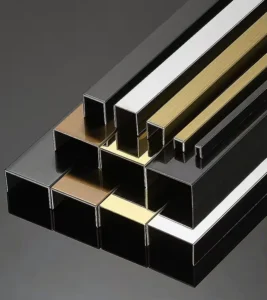
State whether the rail is round, square, rectangular or another section. An external socket is selected from the rail’s outside shape and dimensions. An internal spigot or sleeve is controlled by the inside opening, so nominal outside size alone is not enough: wall thickness, corner radii, coatings and an internal weld seam can all reduce clearance. If two rail families are meant to share one connector, list both sections rather than relying on a generic “standard size.”
2. Connection job and geometry
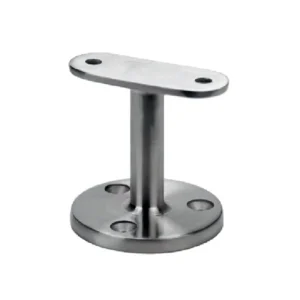
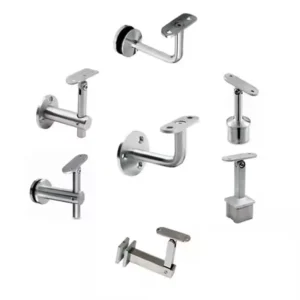
Identify whether the part joins rail to rail, rail to post, rail to wall hardware or another defined interface. Then state whether the run is straight, a fixed corner, a limited adjustable angle or a branch. A connector qualified for one interface or angle does not automatically cover the others, even when the visible socket looks similar.
3. Engagement and retention
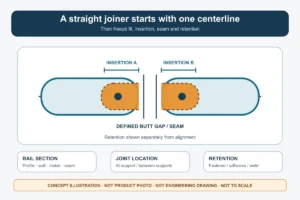
The offer should show how far each rail enters or overlaps the connector, the permitted butt gap and the method that retains the parts. Set screws, through-fasteners, adhesive bonding and welding create different preparation, access and inspection requirements; they are alternatives to define, not interchangeable features to assume. Ask which fasteners or consumables are included and which rail holes, slots, surface preparation or weld finishing remain site work.
4. Installed role and evidence
A connector body cannot establish the capacity or compliance of the completed handrail or guard. Rail sections, supports, brackets, fasteners, anchors, substrate, joint spacing and installation all contribute to the system result. State the intended role and project criteria so any requested drawings, material documents or test evidence can be matched to the proposed assembly rather than transferred from a different configuration.
Use a compatibility schedule instead of a universal claim
| Field | What the inquiry should provide | What the quotation should state |
|---|---|---|
| Rail family | Profile, outside dimensions, wall thickness, inside opening, corner radius and weld-seam position | Each approved mating section and the controlling tolerance |
| Interface | Rail-to-rail, rail-to-post or another exact joint; internal or external fit | Connector form, socket/spigot dimensions and engagement on every side |
| Geometría | Straight, fixed angle, branch or limited adjustment; plane and centerline angle where relevant | Approved geometry, orientation and angular tolerance or adjustment limit |
| Retention | Preferred site process, available access and prohibited hot work or adhesive use | Fastener, weld or bonding method; hole pattern; torque/process requirement; included consumables |
| Joint appearance | Visible or concealed joint, allowable step and gap, grain/polish direction | Expected seam, alignment tolerance and finish reference |
| Exposure | Interior, exterior, coastal, pool or chemical conditions; cleaning regime; adjacent materials | Proposed material/finish basis and any required isolation or care conditions |
If a requested rail falls outside this schedule, treat it as a new fit review. Do not extend the word “universal” beyond the sections and joint conditions recorded in the approved drawing or sample.
Internal fit and external fit solve different problems
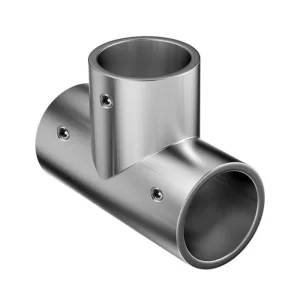
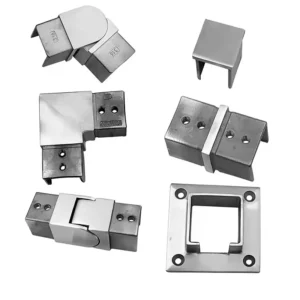
Internal spigot or sleeve: keeps most of the connector inside the rail and can preserve a cleaner outer line. It requires reliable inside dimensions, sufficient insertion and clearance for weld seams or coatings. The assembly sequence must allow the rail to slide over the connector.
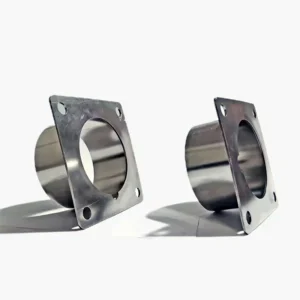
External socket or collar: references the outside profile and keeps the joint visible. It can make fastener access and inspection easier, but the step, seam and finish transition must be accepted. A socket sized only from a nominal tube description can still be loose or impossible to assemble.
Hybrid or adapter arrangement: may connect two defined interfaces that differ, but it is not proof of open-ended compatibility. The drawing should identify each side separately and show which end goes to which rail or support.
Freeze factory work and site work in the same document
| Work item | Possible factory scope to confirm | Possible site scope to confirm |
|---|---|---|
| Conector | Body geometry, mating dimensions, holes/threads, finish and identification | Final orientation, insertion and access check |
| Rails | Supply, cutting, drilling/slotting and finish matching only if itemized | Measurement of existing rail, trimming and correction unless itemized otherwise |
| Retention | Specified screws, pins, inserts or approved consumables if listed | Fastening, adhesive preparation, welding and finishing according to the agreed process |
| System interface | Matched bracket or post adapter only if shown in the supply list | Supports, anchors, substrate verification, setting out and completed-system approval |
Send enough information to prevent a false match
For a first review, send an overall photo, a close-up of the joint, one known rail dimension, the connector’s job and the approximate quantity. Add the service environment and whether the rail is new or existing. Before a production configuration is released, expect to freeze:
- every rail profile and the inside/outside dimensions that control the fit;
- internal or external engagement, insertion on each side and the allowable butt gap;
- joint plane, angle or branch orientation and the permitted alignment tolerance;
- retention method, holes or slots, fasteners/consumables, installation access and sequence;
- proposed material and finish, exposure basis and any dissimilar-material interface;
- connector quantity, included rail/support items, spares, marking and packing;
- system role, project criteria and configuration-specific evidence or approval sample required.
Compare quotations against the same compatibility schedule. A body-only price is not equivalent to a package that includes prepared rails, matched fasteners, a fit sample or documented joint limits.
Frequently asked questions
Does universal mean it fits both round and square rails?
Only when both profiles and their mating dimensions are specifically listed. A round socket does not become compatible with a square rail through the product name, and adapters must be shown as separate interfaces.
Is the rail outside diameter enough for selection?
It can help with an external socket. An internal spigot also needs wall thickness, inside opening, weld-seam clearance and corner geometry. A section drawing or sample is the safer approval reference.
Can the same connector be screwed, glued or welded?
Do not assume so. Each method changes geometry, preparation, access and inspection. The proposed drawing and quotation should name one approved retention route and its included hardware or consumables.
Can a universal connector be treated as a movement joint?
No. Movement requires a defined direction, displacement, gap, support arrangement and suitable assembly. Treat the joint as fixed unless a movement function is explicitly designed and substantiated.
Does the connector material prove the railing is suitable for a coastal site?
No. Suitability also depends on the exact material/finish, crevices, fasteners, adjacent metals, exposure and maintenance. Ask the offer to state the proposed basis for the actual environment.
Start with one rail section and one joint
You do not need a complete project package to begin. Send the best photo or sketch available, one measured dimension and the quantity range. The useful outcome is a proposal that defines where “universal” stops: approved rail sections, interface, geometry, engagement, retention, finish, included items and open approval fields.