Pre-shipment defects in glass railing hardware rarely announce themselves as obvious breakage. They arrive as wrong-thread screws paired with the correct spigot bodies, silicone gaskets cut for a different glass thickness, or satin-finish clamps mixed into a brushed consignment — none of which triggers a shipping alert, but all of which stop installation once hardware has been allocated to specific zones. The cost isn’t the unit price of the defective part; it’s the replacement freight, the installer downtime, and the schedule exposure on a project that was already staged for glazing. The checkpoint that prevents this is a structured pre-shipment inspection that replicates the actual hardware assembly condition rather than treating each component as an isolated SKU. By the end of this article, you will have a clearer basis for judging which checkpoints are non-negotiable, where sampling introduces process-stability risk, and what documentation gaps can stall a project at permit or final inspection even when the hardware itself is dimensionally correct.
Inspection should simulate the project hardware use case
The default failure in pre-shipment inspection is checking components individually rather than checking them as an assembly. A clamp body may pass a standalone dimensional check while the gasket supplied with it is cut for a different nominal glass thickness — a mismatch that won’t surface until an installer tries to torque it down on 12mm glass and finds either play in the grip or glass contact without gasket coverage. The inspection setup should physically reproduce the load path: mount the hardware to a representative substrate, use actual project glass thickness (or a calibrated gauge block of that thickness), install the gasket, and run the fastener to the specified torque range. This is a planning criterion, not a formal standard requirement, but it is the only condition under which fit failures, gasket compression inconsistency, and thread engagement depth become visible before shipment.
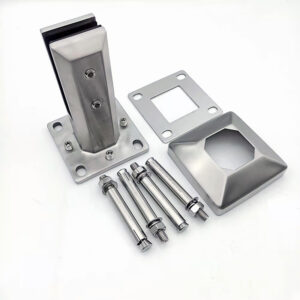
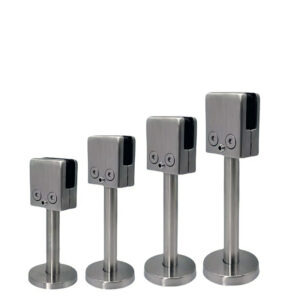
The use-case simulation also identifies compatibility problems that no single-component check can catch. Grifos de vidrio de alta resistencia and their paired mounting hardware need to be checked together against the actual base plate pattern and anchor bolt spacing in the project drawings — not just against generic product dimensions. When the inspection treats components as a system assembled under project conditions, the probability of discovering a mismatch at the factory rather than the site increases substantially. That shift in discovery point is the core objective of any pre-shipment check worth the scheduling time it takes.
Dimensional, thread, gasket and finish checkpoints
Most dimensional defects that reach the site were detectable at the factory with basic instruments and a defined checkpoint sequence. The friction is that inspection teams under time pressure tend to default to visual checks, which catch surface scratches and obvious finish inconsistencies but miss thread condition, gasket dimensional compliance, and glass thickness deviation — all of which require calipers, thread gauges, or a torque wrench rather than visual assessment alone. Fastener torque is a particular failure mode with two distinct failure directions: undertightening leaves structural connections below design engagement, while overtightening on glass-contact assemblies risks cracking the panel at the clamp point or stripping threads in the fitting body. Neither failure mode is inevitable in every instance, but both are directly preventable at the inspection stage when torque is verified against the manufacturer’s specified range.
Edge condition and sealant joint integrity are frequently treated as aesthetic checks but carry structural and safety consequences. An un-arrised glass edge that passes visual inspection under warehouse lighting may present a handling hazard during site installation and will fail a finish inspection under direct light. Sealant gaps around base shoes create moisture ingress pathways that compromise long-term performance, particularly in exterior or coastal applications where 316-grade hardware is specified specifically because the environment is corrosive — using the wrong grade, or failing to verify the grade against the material certification, produces a deferred failure that no inspection can recover from after shipment.
| Checkpoint Area | Requirement / Threshold | Risk if Not Met |
|---|---|---|
| Grosor del vidrio | Minimum 1/4 in (6.4 mm) per IBC; verify with calipers against approved plans | Fit failure at site; code non-compliance |
| Safety Glazing Label | Permanent, legible, includes manufacturer, glass type, thickness, and reference to ANSI Z97.1 or CPSC 16 CFR 1201 | Code rejection, shipment rejection |
| Hardware Grade (Stainless Steel) | Match environmental exposure; use marine-grade 316 for coastal/corrosive conditions | Premature corrosion, railing failure |
| Par de apriete | Screw/nut torque per manufacturer specs; avoid under- or over-tightening | Structural weakness or glass breakage/thread stripping |
| Glass Edge Condition | Edges arrised or polished to remove sharp edges | Safety hazard, finish inspection failure |
| Sealant Joints | No gaps or holes around base shoes and mounting points | Moisture ingress, compromised sealant |
| Laminated Glass Composition | At least two equal-thickness glass plies with approved interlayer | Structural integrity failure |
Safety glazing label requirements are regulatory checkpoints tied to ANSI Z97.1 and CPSC 16 CFR Part 1201, and their absence or illegibility at the factory translates directly to code rejection at the site — a consequence that cannot be resolved by retroactively supplying a certificate of conformance in most plan review workflows.
Sampling versus full inspection risk control
The choice between sampling and full inspection is a risk-management decision that depends on order size, component criticality, and verified supplier process stability — not a preference for speed or cost savings. Full inspection of every unit tightens defect detection but adds measurable lead time, and for large-volume shipments of structural components like base rails or post anchors, it may not be operationally practical. Sampling accepts a statistically controlled probability of defect pass-through, which is a legitimate approach when the supplier’s process control is documented and stable. The gap in most buyer relationships is that process stability is assumed rather than verified: a supplier who has delivered three defect-free shipments may have introduced a tooling change or a new batch of raw material between those shipments and the current order, and a sampling plan that was calibrated to the previous process will not catch the shift.
For components with direct structural or glazing contact — abrazaderas de cristal de alta resistencia, spigot base plates, and laminated glass panels — the risk profile of a single defective unit reaching the site is higher than for secondary trim or cover caps, which justifies tightening the sampling intensity or moving to full inspection on those specific line items even within a larger mixed shipment. The practical approach is to tier inspection intensity by component criticality: tighter sampling or full inspection on load-path and glass-contact items, standard AQL sampling on non-structural hardware, and visual spot-checks on packaging and labeling. That tiered structure controls risk without treating every component as equally consequential — which, under time pressure, produces inspection fatigue and reduces the reliability of the check itself.
Zone allocation before defects reach the site
The most expensive defect is one discovered after hardware has already been sorted and staged by project zone. Once a mixed-finish batch has been allocated to a specific elevation or a mismatched gasket set has been binned to a particular run of panels, the correction requires both a replacement order and a re-sort of material that is now partially committed — and in some project schedules, that delay affects downstream trades, not just the railing installation itself. Zone allocation before shipment departure is a containment method that reduces this exposure: hardware is sorted, checked, and confirmed against zone-specific quantities and specifications before it is packed by zone, so that any defect discovered at this stage is still a factory problem rather than a site logistics problem.
The operational detail that makes this effective is labeling integrity at the zone level, not just the shipment level. Carton labels that carry zone reference, component type, hardware grade, and quantity allow receiving teams at the site to verify allocation without opening every box. When a receiving check finds a labeling discrepancy, it can be resolved against the factory inspection record — which is only possible if the inspection record was created at the zone sort stage. Without that record, a discrepancy on site becomes an ambiguity about whether the problem is a factory defect, a packing error, or a receiving error, and resolving that ambiguity costs time regardless of which explanation is correct. The benefit of zone-level inspection and labeling is a likely reduction in downstream defect exposure, not a guaranteed prevention — but the cost of implementing it at the factory is substantially lower than the cost of resolving any one of the scenarios it is designed to prevent.
Shipment approval after packing and labeling checks
Shipment approval should function as a structured gate, not a default green light after a visual spot-check confirms the carton count. The distinction matters because documentation failures — missing safety glazing labels, absent material certifications, and missing test reports for system-level claims — do not block freight the way a dimensional failure might, yet they are precisely what building inspectors and plan reviewers require at permit and final inspection. A shipment that clears the loading dock with a labeling gap or a missing ASTM E2353 report for a system claiming the top rail exception arrives on site legally but not compliantly, and the correction pathway at that point involves either sourcing replacement documentation from the manufacturer under project timeline pressure or, in the case of unreadable or absent safety glazing labels, potentially replacing the glass panels themselves.
The distinction between document types also matters for how the gate review is structured. Material certifications and safety glazing labels are per-shipment compliance items tied to the actual product in the consignment. An ICC-ES Evaluation Report confirms IBC/IRC compliance at the system level and is typically required for plan review and building permit acceptance — but it is a system-level document, not a per-unit inspection record, and its presence does not substitute for the per-unit labeling and certification checks. Treating these as a single documentation bundle rather than distinct verification layers is a common shortcut that creates audit exposure when inspectors request them separately. For documentation requirements related to material traceability and certification structure, the review logic applicable to MTR and mill cert workflows is covered in the Requisitos del informe de ensayo de materiales (MTR) de los herrajes de acero inoxidable para la documentación de conformidad recurso.
| Document / Check | Requisito | Why It Matters for Shipment Approval |
|---|---|---|
| Permanent Safety Glazing Labels | Present, legible; missing/unreadable labels require manufacturer test documents or glass replacement | Prevents shipment of non-compliant product rejected at site |
| Certificaciones de materiales | Prove safety glazing meets code requirements | Required for code enforcement and plan review approval |
| Product Testing Reports (e.g., ASTM E2353) | Required for systems claiming top rail exception | Without reports, exception claim cannot be verified |
| Informe de evaluación del ICC-ES (ESR) | Confirms product compliance with IBC/IRC | Essential for building permit and inspector acceptance |
The packing check closes the gate: carton integrity, cushioning adequacy for glass-contact components, and label legibility under handling conditions are the final confirmation that the shipment will arrive in the condition the inspection verified at the factory.
The core implication of a structured pre-shipment inspection is not defect detection in isolation — it is discovery-point control. Defects found at the factory are factory problems with factory-cost solutions. The same defects found at the site, after zone allocation and partial installation staging, carry costs that compound with every hour of installer downtime and every leg of replacement freight. The decision framing for any project supply relationship should therefore treat inspection investment as a schedule-protection measure rather than a quality-control overhead.
Before approving shipment, confirm that the inspection record closes all five verification layers together: critical dimensions checked against project drawings, finish confirmed against the approved sample, quantity verified by zone, labeling legible and complete including safety glazing label content, and packing integrity confirmed under load conditions that simulate transit. If any of those five layers is documented as a spot-check rather than a systematic verification, the risk level of that layer has been accepted by assumption rather than managed by evidence — and that distinction is worth making explicitly before the consignment leaves the factory.
Preguntas frecuentes
Q: What happens if a supplier refuses or cannot accommodate a pre-shipment assembly simulation — is there an acceptable alternative?
A: A supplier who cannot facilitate assembly simulation under project conditions represents an unresolved process risk, not just a scheduling inconvenience. The minimum acceptable alternative is a documented wet-fit check using calibrated gauge blocks matched to the specified glass thickness, combined with a thread engagement verification on representative fasteners — but this only partially substitutes for a live assembly. If the supplier’s facility cannot support even that, the practical response is to tighten sampling intensity on all glass-contact and load-path components and require third-party inspection rather than relying on the supplier’s own QC records.
Q: At what point does switching from sampling to full inspection stop being worth the added lead time?
A: Full inspection remains justified as long as the cost of a single defective unit reaching the site — measured in replacement freight, installer downtime, and schedule exposure — exceeds the cost of the additional inspection time. For structural components with direct glass contact, that threshold is almost always met because one mismatched gasket set or wrong-thread fastener batch can halt installation across an entire project zone. Full inspection becomes harder to justify only on non-structural secondary hardware with a verified, stable supplier process and a documented defect history near zero across multiple consecutive shipments.
Q: Is 316-grade stainless steel required for all coastal projects, or does it depend on how close to the waterline the railing is installed?
A: Grade selection depends on exposure severity rather than a fixed distance rule. The article identifies coastal and corrosive environments as the condition requiring 316-grade hardware, but proximity to saltwater, prevailing wind direction, and whether the installation is sheltered or fully exposed all affect actual chloride load. In borderline inland-coastal conditions, the decision should be driven by the material certification confirming the specified grade — not by a general proximity assumption — because the failure mode of using an incorrect grade is deferred corrosion that no post-shipment inspection can reverse.
Q: How does an ICC-ES Evaluation Report interact with per-unit safety glazing labels — can one substitute for the other during plan review?
A: No, they serve distinct verification functions and building officials typically request them separately. An ICC-ES ESR confirms that the system design complies with IBC or IRC at the product category level; it does not certify the specific glass panels in a given shipment. Safety glazing labels on individual panels — referencing ANSI Z97.1 or CPSC 16 CFR Part 1201 — confirm that those specific units meet the code requirement for the glazing material itself. Presenting only the ESR when an inspector requests panel-level labeling does not satisfy the request, and the reverse is equally true. Both must be present and treated as separate line items in the shipment approval gate.
Q: If a defect is discovered after zone allocation has already been completed at the site, what is the realistic correction sequence?
A: The correction sequence at that stage involves three parallel actions, all of which compress available project time: isolating the affected zone to prevent partial installation that would require later rework, initiating a replacement order for the defective component — which resets freight lead time from the factory — and reconciling the inspection record to determine whether the defect is a factory QC failure, a packing error, or a receiving discrepancy. Without a factory-stage inspection record tied to zone-level labeling, that reconciliation cannot be completed quickly, and the ambiguity itself extends the delay. There is no site-side shortcut that eliminates the replacement lead time; the only leverage point was the factory inspection that was not completed before shipment.