Misclassifying a combined guard-and-handrail assembly as only a handrail is one of the more common plan-review failures on commercial stair projects—not because teams are unfamiliar with handrail rules, but because the distinction between a handrail and a guardrail is easy to blur when a single rail tube serves both functions. The cost of that blur isn’t always visible until a building official returns the submittal with a 42-inch height comment on what was specified as a 38-inch handrail. Resolving it before specification begins requires knowing which assembly type the project condition actually triggers, which code edition the jurisdiction has adopted, and what documentation the supplier can realistically provide versus what the engineer of record must confirm. Reading through this breakdown will sharpen your ability to separate those three responsibilities before product selection starts.
IBC handrail scope before specification support
The most consequential question to answer before requesting product data is whether the assembly is a handrail, a guardrail, or a combined condition requiring both sets of criteria to be satisfied simultaneously. Treating a combined assembly as only a handrail omits the 42-inch guardrail height check and the infill opening sphere limits—errors that are structural and dimensional, not administrative, and that typically surface at plan review rather than during design.
The practical distinction matters because the two assembly types carry different performance obligations. A handrail operates within a 34–38 inch height range measured from stair tread nosing or ramp surface and must meet specific graspability criteria. A guardrail operates at 42 inches above the walking surface and must satisfy infill opening limits rather than graspability criteria. A combined condition must satisfy both, which affects tube diameter selection, infill spacing, and the structural load basis the engineer applies to the connection design.
Continuity is a separate planning criterion that often receives less attention than height and graspability. Handrails must run without newel post interruption along the full stair run—dwelling units are an exception under IBC—and must not rotate within their fittings. That requirement is not a structural performance threshold with a testable metric; it is a design constraint that shapes bracket selection, fitting type, and rail layout before any load calculation begins. Identifying whether the continuity requirement applies to a specific project condition is a step that belongs in scope definition, not in submittal preparation.
The figures across these assembly types reflect IBC 2021 Chapter 10 as a model code framework. They are design thresholds to be confirmed against the adopted code edition for the project’s jurisdiction, not self-executing minimums that apply uniformly.
| Requisito | Handrail (IBC) | Guardrail (IBC) |
|---|---|---|
| Minimum height | 34–38 in (above stair tread nosing or ramp surface) | 42 in (above walking surface) |
| Graspability / cross‑section | Circular 1.25–2 in diameter; non‑circular perimeter 4–6.25 in, depth 1–2.25 in | Not applicable (handrail graspability only) |
| Infill opening | Not applicable (guardrail infill required) | 4.375‑in sphere (high), 4‑in sphere (low) |
| Continuidade | Continuous without newel post interruption (dwelling units excepted); must not rotate within fittings | Not subject to the same continuity rule, but must maintain fall‑protection coverage |
| Structural load | Not required to satisfy guard‑load criteria | Required to meet guard‑load checks (guard mandate) |
Height and load questions contractors should raise early
Height measurement method is where misalignment between design intent and installed condition most often appears. The 34–38 inch handrail height is measured from stair tread nosing or the ramp slope surface—not from the tread base, the structural substrate, or any other convenient reference point. Using the wrong datum shifts the installed height by the riser-to-nosing offset, which can be enough to produce a noncompliant condition even when the bracket placement looked correct during layout.
The IBC-versus-ADA extension difference at stair bottoms is a hidden trade-off that needs to be resolved before product selection, not during submittal. IBC requires the bottom extension to run one tread depth sloped beyond the bottom riser. ADA requires one tread depth plus 12 inches horizontal. On accessible egress stairs, the ADA condition controls—and product data showing only the IBC bottom extension dimension will generate a code comment even if every other dimension in the package is correct. The question of which standard governs is not always self-evident from a project description alone; it requires early confirmation based on the project type, occupancy, and applicable federal or state accessibility requirements.
Bracket placement decisions are also affected by the 1.5-inch minimum clearance between the handrail and the wall surface, and by the constraint that handrails may not project more than 4.5 inches into the required stair width at or below handrail height. Both figures have direct implications for bracket standoff depth and for whether the bracket selection changes if the stair width is at its minimum. On wide stairs, the 30-inch maximum reach-to-handrail rule and the 60-inch maximum intermediate handrail spacing determine how many handrails the condition requires—a layout question that affects quantity and post placement before fabrication begins.
| Verificar | Requisito do IBC | Por que é importante |
|---|---|---|
| Handrail height measurement | 34–38 in measured from stair tread nosing or ramp slope surface | Prevents vertical misalignment during installation |
| Extensions – top | 12 in horizontal beyond top riser | Confirms proper termination and graspable length |
| Extensions – bottom | One tread depth sloped beyond bottom riser (ADA may require one tread depth + 12 in) | Early clarification avoids rework on accessible projects |
| Clearance from wall | At least 1.5 in between handrail and wall | Affects bracket placement and graspability |
| Projection into stair width | Handrail ≤ 4.5 in into required stair width at or below handrail height | Maintains stair width compliance |
| Reach to handrail / intermediate spacing | All points within 30 in of a handrail; intermediate handrails ≤ 60 in apart on wide stairs | Determines handrail count and layout |
For projects with accessible egress conditions, the IBC and ADA stainless steel handrail code requirements comparison covers the extension and clearance differences in more detail.
Supplier documentation that supports but does not replace code review
A supplier can provide dimensional drawings, material certifications, graspability cross-section data, finish specifications, and load test results referenced to a testing framework. What a supplier cannot provide is confirmation that those dimensions satisfy the code edition adopted by a specific jurisdiction, because that determination depends on whether the local authority has adopted IBC 2021, an earlier edition, or a state-specific variant with amendments.
The failure pattern here is predictable: a cutsheet marked “IBC compliant” enters a plan review for a jurisdiction operating under a different code edition, or one that has added local exceptions to the standard handrail graspability criteria. The cutsheet carries no built-in awareness of those deviations. It is a starting reference for dimensional conformance to the model code, not evidence of compliance with the adopted code for any specific project. Over-reliance on supplier documentation to carry compliance weight that belongs to the engineer of record is the structural error—not the documentation itself.
The practical boundary between supplier scope and engineer scope needs to be established explicitly before submittal preparation begins. The supplier furnishes the product data package: tube diameter, bracket dimensions, surface finish, material grade, and whatever test references apply to the assembly. The engineer of record confirms the adopted code edition, identifies any local amendments, and determines whether the product data satisfies the installed condition as regulated. Those two roles do not overlap, and treating supplier documentation as a substitute for that confirmation creates exposure at plan review that is difficult to recover from quickly.
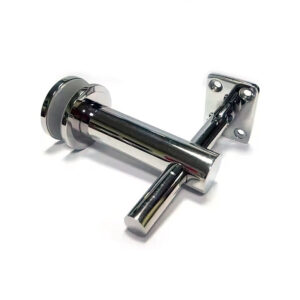
Heavy-duty wall handrails with documented cross-section and bracket dimensions are one example of where supplier data can be structured to support—rather than claim to replace—that project-side review.
Mismatch risks between product data and project jurisdiction
Product data that accurately reflects IBC 2021 model code provisions can still be rejected at plan review if the project jurisdiction has adopted a different edition or added amendments. That is not a theoretical risk—building codes are adopted at the state and local level, not nationally, and the gap between a generic “IBC compliant” notation and the jurisdiction’s actual adopted requirements may include different graspability dimensions, different extension requirements, or supplementary provisions tied to local conditions. The mismatch is invisible in the product data itself, which is what makes it a plan-review surprise rather than a design-stage correction.
The ADA extension override is a separate and more predictable failure pattern. The Access Board’s ADA-IBC comparison makes clear that where ADA applies, the bottom extension requirement is one tread depth plus 12 inches—not the IBC-only figure of one tread depth. Product data assembled against IBC language alone will show the shorter dimension. On an accessible egress stair, that generates a code comment that requires either a revised product configuration or a redesign of the bracket layout to accommodate the longer extension. Identifying early whether the project is subject to ADA—or to a state accessibility standard that mirrors it—prevents that comment from appearing after the submittal is already in review.
Occupancy classification introduces a third axis of mismatch. IBC stair and handrail requirements vary across occupancy groups, and generic product data referenced to the model code without occupancy context may not address the specific requirements that apply to a Group A assembly, a Group E educational facility, or another occupancy with supplementary provisions. Submitting product data that doesn’t acknowledge the project’s occupancy classification creates a gap that the plan reviewer will likely flag.
| Mismatch Risk | Por que é importante | O que confirmar |
|---|---|---|
| Local code edition replaces or amends generic IBC provisions | Supplier cutsheet stating “IBC compliant” may not reflect the adopted state/city code, risking plan‑review rejection | Confirm adopted code edition and amendments with the authority having jurisdiction |
| ADA handrail extension requirements override IBC for accessible projects | Product data showing only the IBC bottom extension (one tread depth) is insufficient where ADA applies, leading to code comments and redesign | Verify whether ADA (or local accessibility standards) governs, and if so, confirm extension lengths (bottom one tread depth + 12 in) |
| Occupancy‑specific stair requirements not addressed in product data | IBC stair and handrail criteria vary by occupancy classification; generic data may be rejected for a specific occupancy | Confirm the project’s occupancy group and any supplementary handrail requirements tied to that classification |
Submittal readiness after code basis and test evidence are aligned
A submittal package becomes defensible when the product data is anchored to the specific IBC sections the project engineer has confirmed as applicable—not before. The dimensional checklist that follows is only useful when the project’s adopted code edition matches the IBC figures it references, and when the engineer has separately confirmed whether ADA extension requirements apply.
For handrail height, §1014.2 is the reference section; the figure to document is 34–38 inches measured from stair tread nosing or ramp surface. For graspability, §1014.3.1 governs; the dimensions to document depend on whether the handrail tube is circular (1.25–2 inch diameter) or non-circular (perimeter 4–6.25 inches, cross-section depth 1–2.25 inches). For extensions, §1014.6 is the applicable section, but the bottom extension dimension documented must reflect whether ADA controls—if it does, one tread depth plus 12 inches is the required figure, not the IBC-only one tread depth. The 1.5-inch minimum wall clearance should also appear in the package as a documented dimension tied to bracket standoff selection.
| IBC Section | Requisito | Dimension / Criteria to Document |
|---|---|---|
| §1014.2 | Altura do corrimão | 34–38 in above stair tread nosing or ramp surface |
| §1014.3.1 | Handrail graspability | Circular 1.25–2 in diameter; non‑circular perimeter 4–6.25 in, depth 1–2.25 in |
| §1014.6 | Handrail extensions | Top: 12 in horizontal; Bottom: one tread depth sloped (confirm if ADA requires one tread depth + 12 in) |
| – | Clearance from wall | Minimum 1.5 in between handrail and wall |
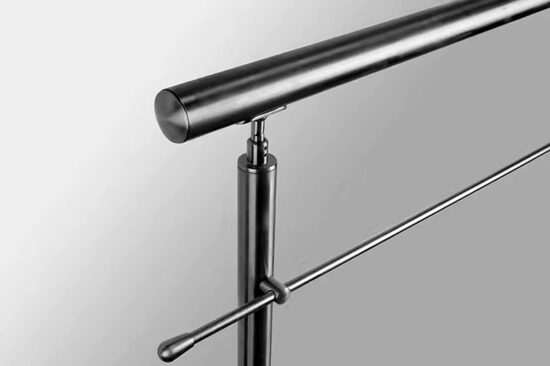
Treating these section references as documentation anchors rather than compliance guarantees is the right framing. The engineer of record confirms adopted code and installed compliance; the submittal package demonstrates that the product data is organized to support that confirmation. ADA-compliant wall handrails with documented cross-section profiles and bracket standoff dimensions allow that comparison to happen without requiring dimensional inference from a general product image.
For a focused breakdown of the IBC 1014 height provisions, the IBC 1014 height requirements for commercial stainless steel handrails article covers the measurement basis and tolerance questions in more detail.
The clearest pre-specification checkpoint is assembly type identification: confirming whether the condition is a handrail only, a guardrail only, or a combined assembly determines which height figures, load criteria, and infill limits apply before any product search begins. Getting that wrong at the start doesn’t produce a minor correction—it produces a redesign after submittal.
After assembly type is confirmed, the questions that matter most before ordering product data are jurisdiction-specific: which code edition has the authority having jurisdiction adopted, whether ADA or a state accessibility standard governs the extension requirements, and whether the project’s occupancy classification introduces supplementary handrail provisions not captured in generic IBC references. A supplier can structure dimensional drawings and material data to support those answers, but the answers themselves belong to the project team. Separating those responsibilities early reduces the likelihood that a compliant product ends up in a noncompliant submittal.
Perguntas frequentes
Q: What happens if the project jurisdiction has not yet adopted IBC 2021—does the specification process change significantly?
A: Yes, the entire dimensional reference set shifts. If the jurisdiction operates under an earlier IBC edition or a state-specific code with amendments, figures like the 1.25–2 inch circular graspability range or the extension requirements may differ from the 2021 model code. The correct approach is to request the adopted code edition and any local amendments from the authority having jurisdiction before compiling product data, so the submittal is anchored to the right document rather than to the model code by default.
Q: Once the engineer of record confirms the adopted code edition and ADA applicability, what is the immediate next step before requesting supplier documentation?
A: The next step is to finalize the assembly classification—handrail only, guardrail only, or combined—because that determination controls which dimensional package the supplier needs to prepare. Requesting product data before that classification is resolved risks receiving documentation organized around the wrong criteria, which delays the submittal rather than advancing it.
Q: At what point does a stainless steel handrail system stop being a reasonable fit for the project and require a different material or structural solution?
A: Stainless steel handrail systems become a poor fit when the connection load demand—from occupancy type, span, or combined guard-and-handrail loading—exceeds what standard bracket configurations can document with available test data. At that threshold, the engineer of record may require custom engineered connections or a structural system that falls outside the supplier’s standard product scope, meaning the supplier’s documentation role shrinks and the engineer’s design scope expands significantly.
Q: Is it better to use a single combined guard-and-handrail assembly or separate systems when both guardrail height and handrail graspability are required?
A: There is no universal answer—the trade-off depends on the project condition. A combined assembly reduces the number of post penetrations and simplifies the installation, but it must simultaneously satisfy 42-inch guardrail height, infill sphere limits, and handrail graspability criteria, which constrains tube diameter and infill options more tightly than a single-function system. Separate systems offer more design flexibility for each function but introduce more anchorage points and coordination complexity. The project’s structural conditions, aesthetic requirements, and budget tolerance for custom fabrication are the deciding factors.
Q: How should a contractor evaluate whether a supplier’s product data package is actually organized well enough to support plan review, before submitting it?
A: A package is ready for plan review when every code-sensitive dimension—height range, tube diameter or perimeter, wall clearance, and extension length—is explicitly labeled in the drawings and traceable to a specific IBC section or ADA requirement that the engineer has confirmed as applicable. If any dimension requires inference from a general product image, or if the package uses only a generic “IBC compliant” notation without section references, the plan reviewer will likely flag it. Running the package against the engineer’s confirmed section list before submission catches those gaps without waiting for a code comment to identify them.