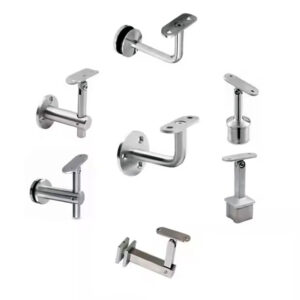
Specifying the wrong alloy for a bracket system in an exterior application rarely fails at inspection — it fails six to eighteen months later, after moisture has worked its way into a threaded joint or behind a cover plate and started what looks, by the time anyone notices, like a surface finish problem. The callback cost is rarely just the bracket: it involves mobilizing to site, cutting out anchors, resealing penetrations, and defending a specification decision that seemed reasonable on paper. The grade decision that prevents this is not about the rail tube — it is about the bracket’s actual exposure pocket, which is usually wetter, more confined, and more chloride-concentrated than anything visible at handover. Understanding where 304 is a defensible choice and where 316 or 316L reduces callback exposure requires working through four specific conditions: chloride level, wet-dry cycling frequency, crevice geometry at the anchor, and whether dissimilar metals are present nearby.
What bracket exposure should drive grade selection
Grade selection for brackets should start from exposure facts, not from what the visible rail assembly looks like. A bracket installed on an interior stair in a conditioned building and a bracket anchored to a concrete wall on a coastal boardwalk are structurally similar components occupying entirely different corrosion environments, and specifying them from the same grade assumption is where the downstream risk begins.
Four conditions should drive the decision. First, chloride level: proximity to ocean spray, road deicing salts, or chlorinated pool water elevates the corrosion driving force at every wet surface, particularly at confined joints that cannot dry between cycles. Second, wet-dry cycling: a bracket in a climate that dries quickly after rain behaves differently from one in a humid environment or one positioned where roof drainage, irrigation, or condensation keeps it intermittently wet. Third, crevice geometry at the anchor: the grade decision for the bracket itself should account for what is happening at the hidden interface with the structure, not just what is visible at the rail. Fourth, dissimilar metal contact: if the fastener, the anchor insert, or any adjacent hardware is a different alloy, the less noble metal in the couple will corrode preferentially — and in a wet crevice, that process accelerates.
Manufacturers with product lines explicitly differentiated for coastal settings reflect a real market judgment: coastal exposure is a distinct planning condition, not a marginal variation on standard exterior use. Treating it as the same environment as a protected interior installation — because both technically involve stainless steel — is the specification shortcut that produces callbacks. ISO 9223:2012 provides a framework for classifying atmospheric corrosivity by chloride deposition rate and other factors; while it does not dictate bracket grade selection directly, it confirms that the exposure variable the market recognizes informally — coastal versus non-coastal — corresponds to a meaningful and measurable difference in corrosion driving force.
How hidden crevice conditions differ from exposed rail tubes
The open rail tube and the bracket anchor zone are not the same corrosion environment, even when they are manufactured from the same alloy. This is the most consistently underweighted distinction in bracket specification, and it is where grade mismatch most often originates.
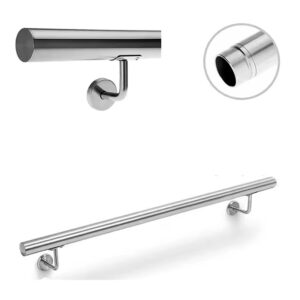
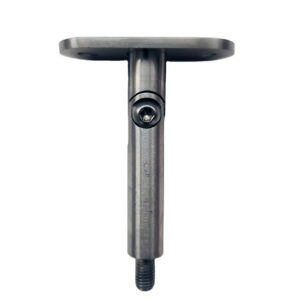
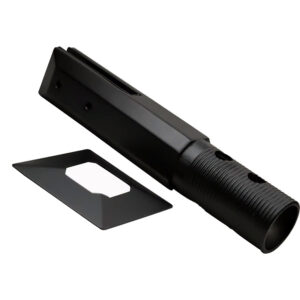
An exposed rail tube faces the atmosphere. It gets wet when it rains, it dries when conditions allow, and — for a hollow tube — drainage is generally possible through the ends or weep points. The surface may accumulate contamination over time, but the geometry is not trapping it. The anchor zone is different in nearly every respect. A threaded bolt connection inside a flow-drilled post creates a hidden mechanical joint where moisture can enter and chlorides can concentrate without the drainage available at the open tube. The sealant edge behind a wall-bracket cover plate creates a similar geometry: tight, intermittently wet, and not visible during routine inspection. Research on crevice corrosion susceptibility in stainless steel joints confirms that confined geometries — even in grades that perform reliably in open-air exposure — can sustain localized corrosion conditions that the bulk material would otherwise resist (PMC9105556). This is not a theoretical concern; it is the mechanism behind a specific pattern of anchor-zone failures that read at the surface as rust staining or bracket loosening.
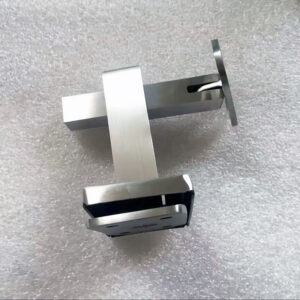
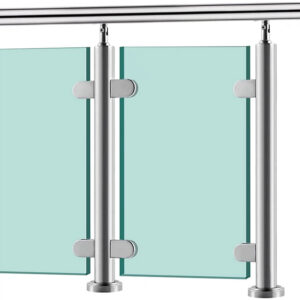
The practical implication is that a bracket’s crevice exposure depends on its mounting geometry, not just its environment. Post-mounted brackets with threaded internal connections and wall-mounted brackets with substrate interfaces represent different crevice configurations, but both create concealed joints that the visible rail tube does not replicate.
| Condition | Exposure Environment | Drainage | Corrosion Risk |
|---|---|---|---|
| Post-Mounted Bracket (Threaded Connection) | Trapped moisture and chlorides inside the threaded joint of the post. | Poor; moisture is trapped in the mechanical joint. | High; creates a more aggressive environment than the open rail. |
| Wall-Mounted Bracket (Bracket-to-Structure Junction) | Trapped moisture at the hidden interface with the wall (wood stud, steel stud, brick, concrete, etc.). | Poor; varies by attachment method and sealing. | High; a critical risk point not present on the exposed rail. |
| Exposed Rail Tube | Open to air and environmental elements. | Good; tube is open and can drain. | Low; less aggressive than hidden crevice sites. |
What the table makes clear is not just that the anchor zones are higher risk — it is that they are higher risk for a structural reason, not a surface finishing reason. An upgrade in polish or coating at the visible rail does nothing to change what is happening at the threaded joint or behind the cover plate. Grade selection needs to address that geometry directly.
Where 304 remains acceptable and where 316 or 316L is safer
Grade 304 is not a poor material choice — it is a material choice that stops being appropriate when the exposure conditions move past what its chromium-molybdenum composition can reliably handle. Getting this boundary wrong in either direction has consequences: specifying 316 universally in low-risk settings is an unnecessary cost premium; specifying 304 universally in higher-risk settings is a callback risk that arrives well after installation.
304 remains a defensible selection when brackets are installed in protected or semi-exposed settings: interior handrail systems, covered walkways, commercial spaces with controlled humidity, and exterior applications in low-chloride inland environments where the bracket dries reliably between wetting events. In these conditions, the passive oxide layer that gives stainless steel its corrosion resistance is stable, and the performance difference between 304 and 316 is unlikely to be visible over a typical service life.
The case for 316 or 316L strengthens progressively as any of the four exposure conditions tighten. Coastal proximity — even without direct spray — is the most commonly cited threshold, and manufacturers specify 316 explicitly for higher-corrosion-resistance applications in recognition of this. But chloride deposition is not the only trigger. Brackets exposed to poolside environments, persistent condensation cycles, or chemical cleaning agents may experience corrosion conditions that push 304 past its reliable performance range even without proximity to the ocean. 316L — the low-carbon variant — is particularly relevant where welding is involved in the installation or fabrication process, since the reduced carbon content limits sensitization at heat-affected zones that would otherwise create localized corrosion vulnerability. In practice, the 316 versus 316L distinction matters most when the bracket geometry involves welded attachments rather than bolted or pressed connections.
For exterior bracket specification, the cleaner framing is not “when is 304 acceptable?” but “what are the conditions that eliminate the margin of error 304 depends on?” If the anchor is in a tight crevice, in a coastal environment, with wet-dry cycling and a mixed hardware stack — any one of those conditions narrows the margin, and more than one in combination makes 316 or 316L the lower-risk specification.
Why anchor zones are often the first corrosion point
The anchor zone concentrates three conditions that, individually, would each increase corrosion risk — and in the field they occur together. Mechanical stress at a drilled hole or a fastener interface alters the local microstructure in ways that can compromise the passive film. The confined geometry traps moisture and prevents the oxygen replenishment that the passive film needs to maintain itself. And the combination of sealant edges, wet substrates, and embedded fasteners creates exactly the crevice geometry where chloride concentration can build far beyond what the surrounding atmosphere would suggest.
Drilled holes and screw interfaces at the anchor zone should be understood as corrosion initiation sites that are prime by geometry, not by accident. The act of pre-drilling for a machine screw attachment introduces both a stress concentration and a micro-crevice at the interface between the fastener head and the bracket plate. If that interface traps moisture — which depends on how well it was sealed at installation and whether that seal has remained intact — the initiation conditions are present regardless of what grade was specified for the visible rail above it. Salt spray testing protocols under ISO 9227:2022 are specifically designed to accelerate and reveal this kind of vulnerability at fastener interfaces; the relative performance difference between 304 and 316 at anchor zones under these protocols reflects what field experience in high-chloride environments also shows over longer timeframes.
The downstream consequence for installation practice is that anchor zone protection is not solved by grade alone. Proper sealing at the bracket-to-structure junction, correct fastener grade matching, and substrate-specific detailing (concrete, brick, and steel frame each present different moisture behavior behind the bracket face) all affect whether even a 316 bracket performs as expected at the anchor. But grade sets the baseline resistance — and starting with an insufficient baseline at the highest-risk point in the assembly is a harder problem to solve retroactively than getting the specification right at procurement.
How to specify bracket alloy with the full hardware stack
A bracket specified at 316 with 304 fasteners, or a 316 rail tube mated to 304 brackets, is not a 316 system — it is a system with a grade mismatch that concentrates its weakest alloy at its highest-risk interface. This is the procurement shortcut most likely to produce field failures that are genuinely difficult to diagnose, because the visible component may look correct while the downgraded hidden component is already corroding.
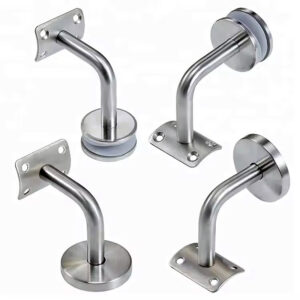
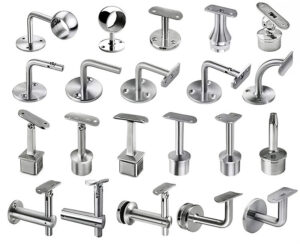
Specifying stainless steel handrail brackets as part of a complete hardware stack — bracket, fastener, anchor insert, and rail — rather than as an isolated line item reduces this exposure. When bracket, fastener, and rail grades are aligned, there is no preferential corrosion pathway created by a galvanic couple between dissimilar alloys in contact in a wet environment. When they are not aligned, the less noble alloy in the couple corrodes at an accelerated rate relative to what it would experience in isolation. In a crevice environment — which, as discussed, is what the anchor zone often is — that acceleration is not marginal.
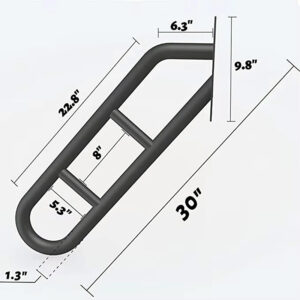
The practical specification check for a mixed exterior system is to confirm grade across every component that will be embedded, anchored, or in contact at a concealed joint, not just the components that will be visible post-installation. For projects where adjustable wall handrail brackets are used to accommodate varying wall geometry, this check is especially important because adjustment range and site-cut fasteners can introduce unplanned material variation if the specification does not explicitly extend to hardware. Stating the alloy requirement at the system level — not just at the rail tube — is what gives that check teeth in the field.
The grade-matching principle also applies to the interface with the substrate. A stainless bracket anchored into a galvanized anchor channel, or in contact with carbon steel framing, introduces a dissimilar metal condition at the most moisture-exposed point in the assembly. If the specification does not account for this, the grade decision made for the bracket itself may be undermined by the conditions it is anchored into. For projects where full-system grade consistency is specified for grade-sensitive environments, reviewing the 304 vs 316 material grade selection guide at the design stage can help align these decisions before procurement locks in component grades independently.
When grade mismatch turns into callbacks
The callback pattern for grade-mismatch failures has a consistent shape: the failure is not visible at inspection or at the first-year review, because the corrosion is occurring in the hidden anchor zone where no one looks during a walkthrough. By the time rust staining tracks down from behind a cover plate or a bracket begins to work loose, the corrosion is advanced enough that surface remediation is not a solution. The corrective work — mobilizing to site, removing and replacing anchored hardware, resealing penetrations, possibly refinishing adjacent surfaces — costs substantially more than the alloy upgrade would have at procurement.
The initial error that produces this pattern is usually one of two things. Either the specification treated grade selection as a finish or appearance decision and defaulted to 304 across the system because the visual rail inspection looked acceptable, without accounting for the anchor zone’s actual exposure. Or the procurement process applied the correct grade to the visible components — rail tube, newel posts — and downgraded the bracket hardware to reduce cost, leaving the highest-crevice-risk components in the lower-grade alloy. Both paths arrive at the same place: a premium paid on visible components that is effectively wasted because the weak link in the assembly is the hidden hardware anchoring those components to structure.
Confusion between bracket types — post-mount versus wall-mount, for example — during specification or installation can compound this risk. A bracket selected for one mounting geometry but installed in another may create a different crevice configuration than the specification assumed, changing the exposure conditions for which the grade was chosen. This is a preventable error, but it requires that the specification be explicit about bracket type and alloy at the component level, not just at the category level. Grade mismatch and product-type confusion are distinct errors that can occur independently, but in combination they meaningfully increase the likelihood of a field failure that traces back to the specification document rather than to installation quality alone.
The most useful pre-procurement check for exterior bracket systems is to map the grade decision not from the rail down, but from the anchor zone out. Identify the crevice conditions at each bracket’s hidden interface — the fastener pocket, the sealant edge, the substrate contact — and specify grade for those conditions first. If those conditions justify 316 or 316L, the full hardware stack should match: bracket, fastener, anchor insert, and any hardware in wet contact with the assembly. The visible rail’s grade should then be consistent with that decision, not the input that drives it.
Where the environment sits clearly in low-chloride, protected, or inland territory with reliable drying between wetting events, 304 remains a sound and economical choice. The argument for 316 or 316L is strongest where the anchor zone is in a crevice geometry and the environment adds chloride, persistent moisture, or dissimilar metal contact. That combination — not any single factor in isolation — is what the grade decision needs to resolve before procurement, not after the first callback.
Frequently Asked Questions
Q: Does specifying 316 brackets eliminate the need for careful installation sealing at the anchor zone?
A: No — grade selection sets the baseline resistance, but it does not replace proper sealing practice. Even a 316 bracket can fail prematurely at the anchor zone if the bracket-to-structure junction is poorly sealed, because the crevice geometry that traps moisture and concentrates chlorides is a structural condition created by the mounting detail, not one that alloy chemistry alone can overcome. Grade and installation sealing work together; one does not substitute for the other.
Q: If a project uses adjustable wall handrail brackets to accommodate variable wall geometry, does the adjustment mechanism introduce additional grade risk?
A: Yes, and it is a commonly overlooked one. Adjustable brackets involve moving parts, slots, or fasteners that are site-set during installation, which means unplanned material variation can enter the assembly if the specification does not explicitly extend the alloy requirement to every hardware component used in the adjustment. A bracket body specified at 316 can be undermined by a 304 set screw or a mismatched locking fastener introduced during fit-out. The grade requirement should be stated at the system level and confirmed across all hardware before installation.
Q: At what point does the cost premium for 316 over 304 brackets become difficult to justify for a mid-rise residential exterior project away from the coast?
A: The premium becomes harder to justify when all four exposure conditions — chloride level, wet-dry cycling, crevice geometry, and dissimilar metal contact — sit firmly in the low-risk range. For an inland mid-rise exterior with reliable drying between rain events, anchors properly sealed to a single substrate type, and a grade-consistent hardware stack, the performance difference between 304 and 316 over a typical service life is unlikely to be visible. The cost argument for 316 strengthens only as those conditions tighten; where none of them is elevated, 304 is an economically defensible specification rather than a risk-driven shortcut.
Q: How should a contractor handle a situation where the structural substrate — such as a galvanized anchor channel or carbon steel framing — creates a dissimilar metal condition that the bracket grade alone cannot resolve?
A: The substrate interface needs to be addressed at the detailing stage, not treated as a fixed condition after the bracket grade is chosen. Options include isolating the stainless bracket from the dissimilar metal substrate using non-conductive barrier materials, replacing the problematic substrate component with a grade-compatible alternative where feasible, or coordinating with the specifier to flag the condition before procurement locks in grades independently. Ignoring the galvanic couple and relying on a higher bracket grade to compensate does not eliminate the accelerated corrosion at the contact point — it only changes which component corrodes first.
Q: Once a contractor identifies rust staining tracking from behind a cover plate, is bracket replacement the only corrective path or can the anchor zone be remediated in place?
A: By the time staining is visible, the corrosion at the anchor zone is typically advanced enough that surface remediation is not a reliable fix. The staining indicates that moisture has been working into a confined joint — likely for months — and that the passive film has already broken down locally. Cleaning or recoating the visible surface does not address the corroded fastener interface or the degraded sealant edge behind the plate. In most cases the corrective path involves removing the bracket, inspecting and replacing anchors and fasteners, resealing the penetration, and reinstalling with correctly specified hardware — the same scope that makes a grade-mismatch callback substantially more costly than the alloy upgrade would have been at procurement.