For architects, engineers, and facility managers, specifying handrail extensions for outdoor stairs is a high-stakes compliance task. A minor miscalculation in the 12-inch top extension or the one-tread bottom rule can lead to failed inspections, accessibility litigation, and costly rework. The challenge is compounded by the need to apply distinct technical rules for stairs versus ramps and to navigate exceptions for existing conditions, all while ensuring the final installation is both safe and constructible.
Attention to these details is non-negotiable now. The regulatory focus on accessible egress routes includes exterior stairs, and the standard of care for design professionals has risen. A holistic understanding of the ADA’s functional requirements, precise dimensional specifications, and practical conflict-resolution strategies is essential for delivering compliant, safe outdoor environments that serve all users.
Core ADA Handrail Extension Requirements Explained
Defining the Functional Mandate
The ADA’s requirement for handrail extensions is not a blanket rule for all stairs. It applies specifically to stairs that form part of a “required means of egress,” such as an exit discharge from a public building to an exterior landing. This evidence-based insight clarifies that the mandate governs function, not merely location. A decorative garden stair or a non-public industrial access stair may be explicitly exempt. The first step in any compliance assessment is correctly classifying the stair’s function within the accessible route.
The Purpose Behind the Rule
The core purpose is transitional safety. Extensions provide continuous support during the critical moments when a user moves between the sloped plane of the stairs and the level plane of the landing. At the top, it offers stable support to complete an ascent securely before releasing the rail. At the bottom, it guides and supports the first step onto the stairs. This requirement is fundamentally about preventing falls at the points of greatest biomechanical adjustment.
Application to Outdoor Environments
For outdoor stairs, all detailed requirements apply when the stairs are part of an accessible route or required exit discharge. There is no minimum number of risers that triggers the rule; a single step on an egress path must comply. Industry experts recommend that professionals treat any exterior stair connecting public spaces as subject to compliance until a formal code analysis confirms otherwise, erring on the side of inclusive design.
Top Handrail Extension: The 12-Inch Horizontal Rule
The Horizontal Measurement
At the top of a stair flight, the handrail must extend horizontally above the landing for a minimum of 12 inches (305 mm). This measurement starts directly above the nosing of the top step and continues parallel to the floor. The extension must be horizontal, not sloped, to provide a stable, predictable grasp point. A common field error is measuring the 12 inches along the slope of the handrail itself, which results in a non-compliant, shorter horizontal projection.
Distinct from Ramp Requirements
A critical, easily overlooked detail is that this 12-inch rule for stairs differs from the requirement for ramps. For ramps, a 12-inch horizontal extension is required at both the top and bottom. This distinction means designers and installers must apply distinct calculation methods and detailing for stairs versus ramps. Confusing the two is a frequent source of non-compliant installations that require costly modification.
Function and Implementation
The horizontal segment’s primary function is to allow a user who has reached the landing to maintain a firm grasp while their body fully transitions to level ground. In my experience reviewing construction documents, I consistently find that details which clearly call out the “12-inch horizontal from nosing” measurement, separate from ramp details, prevent the most common fabrication errors.
The following table summarizes the key specifications for the top extension:
| Requirement | Specification | Key Application Note |
|---|---|---|
| Minimum Extension Length | 12 inches (305 mm) | Horizontal from top nosing |
| Starting Point | Above top step nosing | Measured horizontally |
| Extension Direction | Horizontal only | Not sloped |
| Primary Function | Secure landing transition | Provides stable grasp point |
| Comparison to Ramps | Distinct calculation method | Avoids non-compliant installation |
Source: ADA Standards for Accessible Design. This standard mandates the 12-inch horizontal handrail extension at the top of stairs, a critical safety provision for accessible routes. It provides the enforceable technical specification that forms the basis for compliant design.
Bottom Handrail Extension: The One-Tread Depth Rule
Calculation Based on Tread Depth
Unlike the top, the bottom extension follows the stair’s slope. The handrail must continue at this slope for a horizontal distance at least equal to one tread depth beyond the last riser nosing. For a stair with an 11-inch tread, the handrail extends downward for an additional 11 inches horizontally past the bottom step. This calculation is a known high-risk area; using the riser height or a standard 12 inches is a frequent and critical mistake.
The Critical Transition Support
This sloped extension provides crucial support as a user initiates descent, offering a grasp point before the first step down. It effectively “guides” the user onto the stairs. The termination of this sloped segment must be carefully designed to meet safety requirements for returns or continuity, which we will detail in a later section.
Inspection and Compliance Focus
Due to its complexity, the bottom extension is a focal point for plan reviewers and field inspectors. According to research from accessibility consultants, miscalculation here is a leading cause of compliance failures and a common trigger for litigation. Proactive design reviews must specifically validate this “one tread depth” calculation against the documented stair geometry.
The parameters for the bottom extension are outlined below:
| Parameter | Measurement Rule | Compliance Risk Level |
|---|---|---|
| Extension Basis | One tread depth | Horizontal distance equivalent |
| Example for 11″ Tread | 11 inches minimum | Sloped extension |
| Starting Point | Beyond last riser nosing | Follows stair slope |
| Primary Function | Support onto landing | Critical transition area |
| Inspection Focus | High-risk calculation | Common failure point |
Source: ICC A117.1 Accessible and Usable Buildings and Facilities. This incorporated standard provides the detailed technical specification for calculating the bottom handrail extension based on tread depth, a key component for full stair compliance.
Proper Termination: Returns, Continuity, and Safety
Mandatory Termination Methods
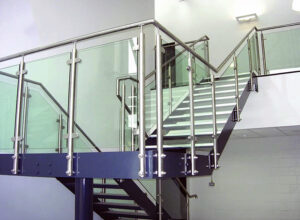
Extensions cannot end abruptly, creating a snagging hazard. The standards require they terminate by returning smoothly to a wall, returning to the floor or guard surface, or continuing to become the handrail of an adjacent flight (as in a switchback). The specified extension length (12 inches or one tread) is measured to the point where this return or continuity begins.
Avoiding Circulation Conflicts
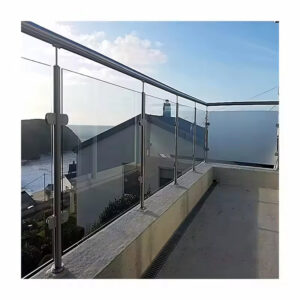
A paramount concern is that extensions cannot obstruct required maneuvering clearances at doors, a common conflict in tight vestibules or landing areas. When a straight extension would project into a door swing or clearance zone, the solution is to turn or wrap the extension back along the guard or wall. This mitigates the hazard while maintaining compliance.
The Shift to Modular Solutions
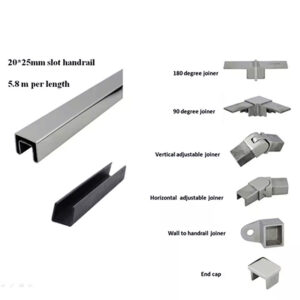
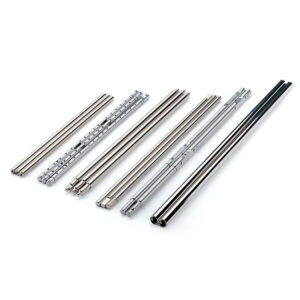
The market is responding to these precise termination rules with engineered systems. Pre-fabricated handrail kits featuring pre-engineered returns and loops are becoming standard, shifting the compliance burden from complex field fabrication and welding to simpler, verified component assembly. This approach reduces error and accelerates installation for projects involving modular outdoor railing systems.
Key Exceptions and Alterations for Existing Stairs
The Switchback Exception
Full extensions are not required where handrails are continuous at the inside turn of switchback stairs. The continuity itself provides the necessary support through the transition. This exception simplifies design and fabrication in these specific configurations.
The Hazard-Based Alteration Exception
In alteration projects, the ADA Standards permit extensions to be waived if providing them would create a hazard due to existing plan configuration—for instance, if an extension would project sharply into a main circulation path. This hazard-based exception provides necessary flexibility but introduces subjective judgment. Project teams must meticulously document and justify such exceptions with plans and photos, as this discretionary clause can be contentious during inspections.
Phased Compliance Strategy
This exception reflects an enforcement strategy focused on updates during renovation. It allows building owners to manage phased compliance by bundling handrail upgrades with other planned alterations, rather than mandating immediate, standalone modifications that might create new safety issues.
Essential Related Handrail Specifications for Compliance
Interrelated Dimensional Criteria
A compliant handrail system is more than its extensions. Multiple interrelated criteria must be met concurrently. Handrails are required on both sides of the stair and must be continuous for the full flight length. The gripping surface height must be between 34 and 38 inches above the stair nosings, measured vertically.
Clearance and Geometry
The standards enforce precise dimensional rules that dictate material selection and fabrication. These include a 1.5-inch minimum clearance between the gripping surface and any adjacent wall, and specific cross-section requirements (e.g., 1.25 to 2 inches in diameter for circular shapes). The gripping surface must be continuous and unobstructed, without decorative elements that interrupt graspability.
The table below details these essential related specifications:
| Specification Category | Required Parameter | Key Detail |
|---|---|---|
| Mounting Height | 34 to 38 inches | Above stair nosings |
| Wall Clearance | 1.5 inches minimum | From gripping surface |
| Cross-Section (Circular) | 1.25 to 2 inches | Diameter range |
| Continuity | Full flight length | Both sides required |
| Surface Characteristic | Continuous & unobstructed | No interruptions |
Source: ADA Standards for Accessible Design. These interrelated dimensional and geometric criteria for handrails are codified within the ADA Standards, and all must be met concurrently with extension rules for a fully compliant system.
Common Implementation Challenges and Solutions
Resolving Spatial Conflicts
The primary challenge is spatial conflict, most often where extensions interfere with door maneuvering clearances. The prescribed solution is to turn or wrap the extension to mitigate the hazard. This requires careful coordination early in the design phase to allocate sufficient landing space.
Serving Diverse User Groups
For facilities serving children, such as schools or parks, a dual-handrail strategy is recommended. This involves installing a second rail at a maximum height of 28 inches above the stair nosings, with at least 9 inches of vertical clearance between the two rails. This blends ADA guidelines with child safety best practices outlined in other standards.
Exceeding the Minimum for Safety
While visual contrast on stair nosings is a powerful aid for low-vision individuals, it is not mandated by the ADA Standards for stairs. This creates a liability consideration; specifying high-contrast nosing strips is a recommended best practice that exceeds the minimum code, enhancing safety and aligning with principles of universal design.
Recommended solutions for common challenges are summarized here:
| Challenge | Recommended Solution | Specification / Note |
|---|---|---|
| Door Clearance Conflict | Turn or wrap extension | Mitigates hazard |
| Serving Children | Dual-handrail strategy | Adds second rail |
| Child Rail Height | Maximum 28 inches | Above stair nosings |
| Vertical Clearance (Dual Rails) | 9 inches minimum | Between rails |
| Stair Nosing Contrast | Recommended best practice | Exceeds ADA minimum |
Source: ASTM F1637 Standard Practice for Safe Walking Surfaces. This standard provides broader safety context and best practices, such as visual contrast on nosings, which complement and can enhance the minimum requirements of accessibility standards.
Ensuring Compliance for Outdoor Stairs and Landings
A Holistic Compliance Protocol
Ensuring compliance for outdoor stairs requires a systematic protocol. First, correctly classify the stair’s function within the accessible route. Second, apply the precise technical specifications for extensions, height, clearance, and continuity. Third, integrate pre-engineered modular solutions where efficient to reduce field error. Finally, document any justified exceptions with robust rationale.
The Raised Standard of Care
The increasing inclusion of explanatory advisories in model codes signals a move toward clarity, which benefits the industry. However, it also raises the minimum expected standard of care for design and construction professionals. Ignorance of the distinct rules for top versus bottom extensions, or for stairs versus ramps, is increasingly viewed as professional negligence.
Coordination for Constructibility
Successful implementation hinges on early coordination between architecture, landscape architecture, and detailing trades. The handrail extension details must be resolved in schematic design to ensure adequate landing dimensions and to avoid clashes with doors, lighting, or signage. This coordination is the final, practical step in translating code text into a safe, accessible built environment.
Successful implementation hinges on three core priorities: first, validate the stair’s functional classification as part of an accessible egress route. Second, apply the distinct 12-inch horizontal and one-tread depth rules with precision, using them as a checklist during both design and installation verification. Third, proactively resolve spatial conflicts through early coordination, opting for engineered termination solutions that eliminate field guesswork.
Need professional guidance specifying compliant handrail systems for your next project? The experts at Esang can provide technical support and product solutions tailored to meet both ADA requirements and your design intent.
For a detailed review of your project specifications, Contact Us.
Frequently Asked Questions
Q: Do ADA handrail extensions apply to all outdoor stairs, or are there exceptions?
A: No, the requirement is based on the stair’s function, not its location. Extensions are mandatory only for stairs that are part of a “required means of egress,” such as an exit discharge from a public building. Decorative or non-public industrial stairs are explicitly exempt. This means your first compliance step is to correctly classify the stair’s functional role in the accessible route, as defined in the ADA Standards for Accessible Design.
Q: How do you calculate the required handrail extension at the bottom of a stair flight?
A: The bottom extension is calculated by continuing the handrail at the stair’s slope for a horizontal distance equal to at least one tread depth beyond the last riser nosing. For a stair with an 11-inch tread, the handrail must extend 11 inches horizontally past the bottom step. This technical nuance is a high-risk area for miscalculation. For projects where field measurements are complex, expect to prioritize this calculation in design reviews to prevent compliance failures and litigation risk.
Q: What are the rules for safely terminating a handrail extension to prevent snagging?
A: Extensions must terminate by returning smoothly to a wall, returning to the floor or guard surface, or continuing to an adjacent flight’s handrail. The required extension length is measured to the start of this return. This specification dictates fabrication methods, leading many to use modular kits with pre-engineered returns. If your project involves custom fabrication, plan for detailed shop drawings to validate termination geometry and clearances.
Q: Can handrail extensions be waived during an alteration project to an existing building?
A: Yes, extensions can be waived in alterations if they would create a hazard due to the existing plan configuration, such as projecting into a main circulation path. This hazard-based exception provides flexibility but requires subjective judgment and meticulous documentation to justify. This means project teams undertaking renovations should proactively document site conditions and prepare a rationale for any exception, as this clause is often scrutinized during inspections.
Q: How do you handle a spatial conflict where a handrail extension interferes with a door’s maneuvering clearance?
A: When an extension obstructs required door clearances, a common solution in alteration projects is to have the extension turn or wrap to mitigate the hazard. This requires careful spatial coordination during design to integrate the handrail’s path with other egress elements. For projects with tight clearances, you should prioritize early clash detection in your models or drawings to identify and resolve these conflicts before fabrication.
Q: Are visual contrast strips on stair nosings required by the ADA for outdoor stairs?
A: No, visual contrast on stair nosings is a recommended best practice to aid low vision but is not mandated by the ADA Standards for stairs. This creates a liability consideration where exceeding the minimum code can enhance safety and universal design. This means facilities managers and designers should evaluate adding high-contrast nosing as a risk mitigation strategy, especially in areas with high public traffic or variable lighting conditions.