Specifying an outdoor glass railing system for an interior space is one of the more expensive planning errors in architectural hardware procurement—not because the system fails structurally, but because it carries cost that serves no function indoors while leaving out the controls that interior conditions actually demand. Drainage components, marine-grade alloys, and weather sealing add line items that an interior environment will never stress, while the finish tolerances and dimensional coordination that finished interiors expose at close range often receive no additional attention. The judgment that separates a well-specified indoor glass railing from an over-engineered or under-detailed one comes down to three things: which outdoor features can be legitimately stripped, which controls must be added in their place, and where the dimensional interface with stair openings and mezzanine edges leaves no margin for error. What follows helps you evaluate those trade-offs before procurement, not after fabrication.
Interior traffic patterns that affect railing detailing
The occupancy pattern of an interior space shapes railing detailing in ways that outdoor conditions do not, because indoor use brings people into sustained, close, and often repetitive contact with the same surfaces. A lobby guard rail sees hundreds of hands daily; a mezzanine edge in a residential loft may see only casual leaning. Neither of those use patterns is wrong, but they produce different detailing requirements for glass panel mounting, edge treatment, and hardware finish.
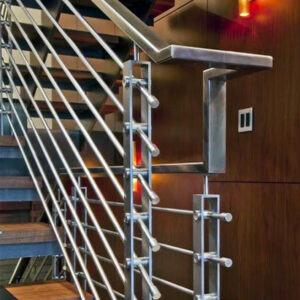
High-contact interior applications—retail environments, hospitality, commercial office mezzanines—benefit from frame or channel systems that reduce the exposed glass edge area and limit the leverage that a casual lean or impact can apply to a panel. Frameless standoff systems can work in those environments, but the selection of standoff hardware and the glass thickness specification should account for lateral loading from sustained contact, not just the design loads the system is rated to carry. The difference often shows up as a finish decision rather than a structural one: hardware in contact zones needs a finish durable enough to resist repeated cleaning cycles and incidental abrasion from bags, carts, and maintenance equipment.
Cleaning method is a practical criterion that rarely appears in a specification but controls long-term appearance in ways that material selection cannot fix retroactively. Abrasive cleaning on brushed stainless leaves directional scratches that are visible under interior lighting at close range. Knowing how a space will be cleaned—and by whom—should influence whether a brushed, satin, or mirror finish is appropriate before the hardware is ordered, not after the first maintenance cycle reveals a problem.
Weatherproof features that can be removed indoors
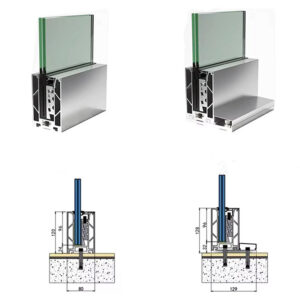
The most direct cost opportunity in an indoor glass railing specification is the removal of components that exist solely to manage outdoor moisture exposure. Base shoe drainage systems, designed to channel water away from the shoe cavity and prevent standing moisture at the glass base, serve no function in a climate-controlled interior where the floor surface does not accumulate water. Carrying those components into an indoor detail adds material cost and installation complexity without improving system performance.
The material substitution that follows the same logic involves stainless steel grade selection for standoff and clamp components. Outdoor assemblies in coastal or industrial environments typically specify 316-grade stainless for its resistance to chloride-driven corrosion. In a controlled interior without chemical exposure, salt air, or persistent humidity, 304-grade stainless provides adequate corrosion resistance at a lower material cost. That substitution is legitimate when the indoor environment genuinely lacks those stressors—it is not a blanket upgrade path. Spaces near indoor pools, commercial kitchens, or high-humidity environments should be evaluated individually before stepping down the alloy grade.
| Exterior Feature or Material | Indoor Substitution | Por qué es importante |
|---|---|---|
| Base shoe drainage components designed for outdoor moisture | Omit drainage parts | Reduces system cost and complexity without affecting indoor function |
| 316-grade stainless steel for standoff systems | 304-grade stainless steel | Lowers material cost while maintaining adequate corrosion resistance in non-corrosive indoor air |
The practical implication is that the indoor specification is not simply a subtracted version of an outdoor one. Removing drainage and stepping down the alloy grade frees budget, but those savings are most useful when redirected toward tighter finish control and surface protection—areas where interior installations are consistently under-specified relative to what close viewing distance actually reveals.
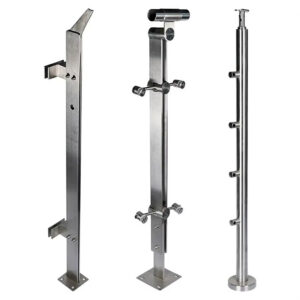
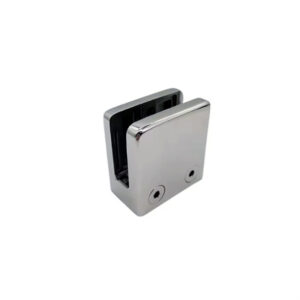
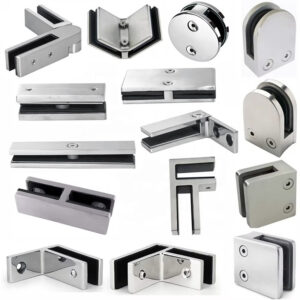
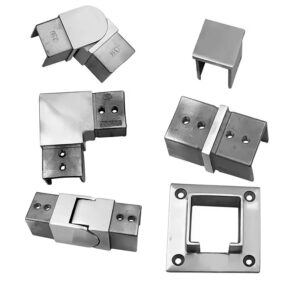
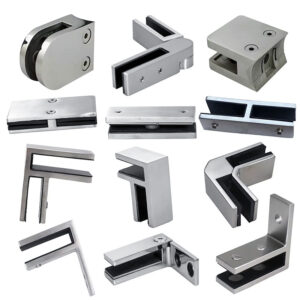
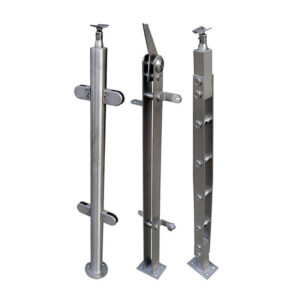
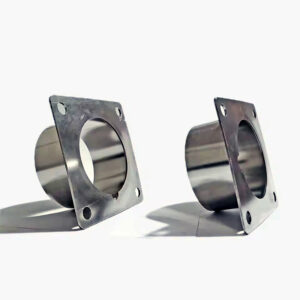
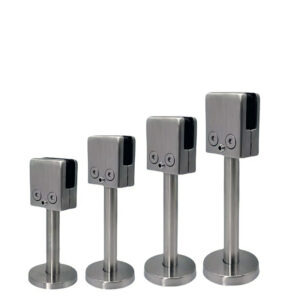
For interior standoff systems where 304-grade stainless is appropriate, round glass clamps in 304 or 316 allow the grade to be matched to the actual environment rather than defaulting to the higher-cost exterior spec across the entire assembly.
Finish control issues seen at close viewing distance
Interior light conditions and proximity create an inspection environment that outdoor railings rarely face. A scratch or surface inconsistency that goes unnoticed on an exterior terrace at arm’s length is immediately visible on a lobby railing at eye level under recessed lighting. That difference in viewing condition is the primary reason interior installations require stricter surface protection than their outdoor equivalents, even when the structural and corrosion requirements are relaxed.
Scratch risk enters the project at multiple stages: during panel installation when glass edges contact hardware, during post-installation construction activity when unprotected panels are adjacent to other trades, and during ongoing occupancy when furniture repositioning or cleaning equipment makes incidental contact with glass or metal surfaces. Any one of those events can produce a mark that is permanently visible in a finished interior and difficult to address without component replacement. The implication for specification is that surface protection—panel edge guards during installation, hardware finish selection, and post-installation protection protocols—should be written into the project plan rather than left to installer discretion.
Glass panels in occupied interior spaces also accumulate smudge and dust at a rate that most project teams underestimate. Based on practitioner experience, maintaining a clean appearance in a regularly occupied interior may require cleaning every two to three days. That is not a manufacturer-certified standard, but it is a realistic planning reference that should shape occupant expectations and inform the choice of glass coating or treatment. Anti-smudge coatings are not a substitute for a cleaning schedule, but they extend the interval between visible degradation.
| Issue at Close View | Detalle de llaves | Implication for Specification |
|---|---|---|
| Smudge and dust buildup on glass panels | Cleaning required every 2–3 days to maintain appearance | Maintenance schedule must influence finish choice and set occupant expectations |
| Highly visible scratches from furniture or handling | Scratches permanently ruin the interior aesthetic | Protective detailing or durable material selection needed to avoid costly replacement |
The downstream procurement consequence is straightforward: if scratch risk and maintenance frequency are not addressed in the specification, they will be addressed in the maintenance budget after installation—typically at higher cost and with less control over the outcome.
Mezzanine and stair edge coordination gaps
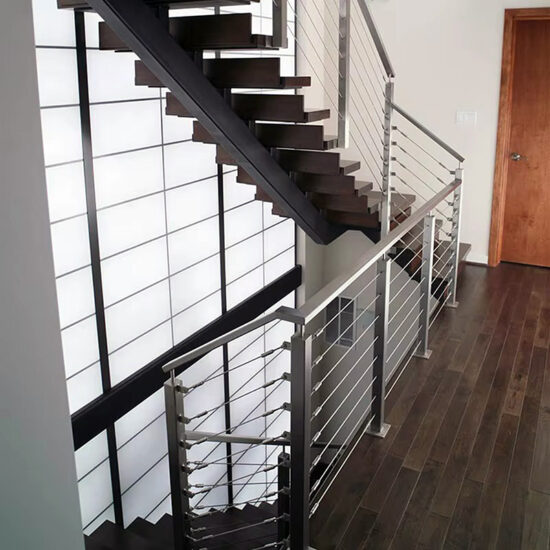
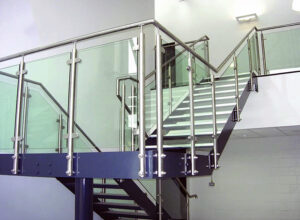
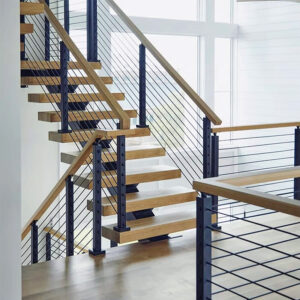
Stair and mezzanine edges are where interior glass railing projects most often produce visible rework, because the dimensional interface between glass panels, structural edges, and adjacent handrails is unforgiving in a finished interior. Outdoor installations tolerate small misalignments more easily because viewing distance, lighting, and surrounding context reduce the visibility of gaps and mismatches. Indoors, those same gaps are exposed under controlled lighting at close range, often against precision-finished flooring and millwork that makes any deviation obvious.
Full glass panel systems on stairs require custom fabrication, and the measurement tolerance that governs fit is tight. Based on fabrication practice, custom panel dimensions on stair runs and mezzanine edges need to stay within one quarter of an inch to ensure proper seating in the mounting system and flush alignment at adjacent surfaces. Exceeding that tolerance does not typically produce a structural problem—it produces a visible gap or edge misalignment that requires re-fabrication to correct. The consequence of a measurement error at this stage is not a field adjustment; it is a re-order with the associated lead time and cost.
| Coordination Factor | Detail or Tolerance | Qué confirmar |
|---|---|---|
| Full glass panels on stairs and mezzanines | Custom measurements must stay within 1/4 inch to ensure fit | Confirm measurement process and fabrication tolerance before ordering; gaps beyond tolerance are obvious and may require re-fabrication |
| Sloped edges and stair runs | Glass balusters offer a simpler alternative that can accommodate slopes | Evaluate whether glass balusters reduce coordination errors compared to full panels |
Glass balusters offer a coordination alternative that is worth evaluating before committing to full panels on sloped runs. Because balusters are discrete vertical elements rather than continuous custom panels, they can accommodate slope transitions and stair geometry with less fabrication sensitivity. The trade-off is aesthetic rather than structural: full glass panels provide an uninterrupted visual plane that balusters cannot replicate, so the choice depends on whether the design intent justifies the additional measurement and fabrication rigor that full panels require. Where coordination error risk is high—due to complex stair geometry, tight construction schedules, or limited measurement access—balusters reduce re-fabrication exposure without compromising code compliance or structural performance.
The coordination gap that most often escapes early-stage review is the interface between the glass railing system and adjacent handrails on the opposite side of the stair opening. When those elements are specified from different systems or different manufacturers, the transition detail at the landing frequently requires custom bracketing or field modification that was not priced into the original scope. Confirming that interface in the design development phase, not at shop drawing review, is the check that most consistently prevents downstream rework.
Climate conditions that justify a lighter hardware spec
The hardware specification appropriate for a temperate, climate-controlled interior is genuinely different from what an exterior installation requires, and treating that difference as a cost-reduction opportunity rather than a compromise is the correct framing. The stressors that drive exterior hardware build-up—UV exposure, thermal cycling, moisture infiltration, airborne chlorides—are absent in most interior environments, which means the engineering rationale for components designed to resist those stressors does not transfer.
A controlled interior climate with stable temperature and humidity, no direct water exposure, and routine cleaning with non-aggressive products supports a lighter hardware assembly without performance sacrifice. That assessment changes when the interior environment introduces one or more exterior-equivalent stressors: high humidity from adjacent mechanical systems, chemical exposure from cleaning products used in food service or healthcare spaces, or proximity to an indoor pool. In those cases, the full exterior specification—or a targeted upgrade of specific components—is justified, and the lighter-spec shortcut should not be taken without confirming the actual ambient conditions.
ASTM E985-24 provides a relevant testing framework for permanent metal railing systems and their performance under load and environmental conditions. It does not govern indoor versus outdoor material selection directly, but it establishes the performance expectations that any interior glass railing system must still satisfy regardless of where corrosion-resistance requirements land. Relaxing alloy grade or eliminating weatherproofing components does not reduce the system’s obligation to meet structural performance thresholds—it only adjusts which environmental durability provisions apply.
The practical check before finalizing a lighter hardware spec is to confirm three conditions: that the space is genuinely climate-controlled without seasonal humidity variation, that cleaning products used during routine maintenance are not chloride-based or acidic, and that no adjacent use introduces moisture or chemical exposure at the railing base. When all three conditions are confirmed, the cost savings from omitting outdoor-grade components are defensible. When any one condition is uncertain, the conservative position is to retain the component rather than re-specify it after installation.
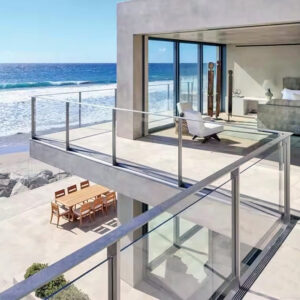
For projects where a barandilla de cristal para balcón system is being adapted for interior use, confirming those environmental conditions early in design prevents the over-specification pattern that adds cost without adding function to the finished installation.
The core procurement decision for an interior glass railing is not which outdoor system to buy at a lower cost—it is which set of outdoor controls to remove and which interior-specific controls to add in their place. Removing drainage components and stepping down from 316 to 304 stainless are legitimate savings when the environment supports them, but those savings are most defensible when the specification simultaneously tightens finish protection, sets realistic maintenance expectations, and confirms dimensional tolerances at every stair and mezzanine interface before fabrication begins.
Before finalizing any interior glass railing specification, confirm the occupancy pattern and cleaning method for each installation zone, verify that the climate conditions genuinely exclude the stressors that justify exterior hardware, and review the dimensional coordination at stair openings and adjacent handrail transitions as a discrete design task rather than a field assumption. Those three confirmations, completed at design development stage, prevent the rework patterns that most consistently erode project margin on interior glass railing installations.
Preguntas frecuentes
Q: Does this guidance apply if the interior space has an indoor pool, commercial kitchen, or high-humidity mechanical room adjacent to the railing?
A: No — those environments should be evaluated individually before stepping down the alloy grade or removing weatherproof components. Spaces with persistent humidity, chloride exposure from pool chemistry, or acidic cleaning products used in food service or healthcare introduce stressors that are functionally equivalent to exterior conditions. The lighter hardware spec is only defensible when the space is genuinely climate-controlled and free of those specific exposures.
Q: At what project stage should the stair opening and adjacent handrail interface be confirmed to avoid re-fabrication?
A: Design development — not shop drawing review. By the time shop drawings are being reviewed, dimensions and system selections are often already committed. Confirming the transition detail between the glass railing and any opposite-side handrail at the landing during design development is the check that most consistently prevents the custom bracketing and field modification costs that appear late in the project when this interface is left unresolved.
Q: If full glass panels introduce re-fabrication risk on a sloped stair run, when is that risk actually worth accepting over glass balusters?
A: When the design intent depends on an uninterrupted visual plane that only full panels can deliver. Full panels provide a continuous glass surface that balusters cannot replicate, and for certain hospitality, residential, or high-visibility commercial applications that visual outcome justifies the tighter measurement rigor and fabrication lead time exposure. Where the stair geometry is complex, the construction schedule is tight, or measurement access is limited, the aesthetic case for full panels should be weighed directly against the re-fabrication cost if the one-quarter-inch tolerance is exceeded.
Q: Is a brushed stainless finish ever appropriate in a high-contact interior zone, or should it be avoided entirely?
A: It can be appropriate, but only when the cleaning protocol is confirmed to be non-abrasive before the hardware is ordered. Brushed stainless in contact zones becomes a liability when maintenance staff use abrasive pads or cleaners — directional scratches from a single cleaning cycle are visible under interior lighting at close range and are not recoverable without refinishing or replacement. If cleaning method cannot be controlled or documented in advance, a satin or mirror finish with greater abrasion resistance is the lower-risk selection for those zones.
Q: If the project budget is limited, is it better to invest the savings from removed outdoor components into glass coating or into hardware finish upgrades?
A: Hardware finish protection typically delivers more durable returns than glass coating alone, because scratches on metal components in contact zones are harder to remediate than glass smudging. Anti-smudge coatings on glass extend the interval between visible degradation but do not replace a cleaning schedule, and they do not address the permanent scratch risk at mounting hardware or panel edges. Directing freed budget toward durable hardware finishes, installation-phase panel edge protection, and post-installation protocols reduces the most costly failure mode — visible surface damage that requires component replacement rather than cleaning.