| Specification | Our Stainless Steel System | Hot-Dip Galvanized Competition | Carbon Steel Competition |
|---|---|---|---|
| Material Grade | 304/316 Marine Grade SS | Hot-Dip Galvanized Carbon Steel | Plain Carbon Steel |
| Tensile Strength | 75-90 ksi (517-621 MPa) | 58-80 ksi | 60-80 ksi |
| Yield Strength | 30-40 ksi (207-276 MPa) | 36-50 ksi | 36-50 ksi |
| Corrosion Resistance | 50+ years marine exposure | 15-25 years before coating failure | 5-10 years before rust |
| Temperature Range | -423°F to 1200°F | -40°F to 400°F | -40°F to 500°F |
| Load Capacity Retention | 100% over lifetime | 70-80% after coating degradation | 50-60% after corrosion onset |
| Anchor Diameters | 1/4″ to 1″ available | Limited sizes due to coating thickness | Standard sizes available |
| Installation Torque | Precise specifications maintained | Variable due to coating inconsistency | Standard specifications |
| Chemical Resistance | Excellent against acids/bases | Poor after coating breach | None |
| Maintenance Requirements | Zero maintenance | Periodic inspection/recoating | Frequent replacement needed |
Superior Material Performance
Our stainless steel anchoring systems manufactured from ASTM A193 Grade 8BM 316 stainless steel deliver exceptional advantages over conventional materials. Unlike galvanized systems that experience coating degradation and subsequent base metal corrosion, our anchors maintain full structural integrity throughout their service life without performance deterioration.
Advanced Expansion Technology
The precision-engineered wedge design creates maximum bearing surface contact within concrete substrates, generating superior holding strength compared to alternative anchor types. The controlled expansion mechanism ensures consistent performance across varying concrete strengths while preventing over-expansion that can damage substrate materials.
Corrosion Immunity
Stainless steel anchoring systems resist pitting, crevice corrosion, and stress corrosion cracking in aggressive environments where galvanized and carbon steel anchors fail rapidly. The passive oxide layer continuously regenerates, providing permanent protection without relying on sacrificial coatings that inevitably deteriorate.
Installation Precision
Our anchors feature cold-formed threads that maintain dimensional accuracy and provide consistent torque-tension relationships throughout installation. Unlike hot-dip galvanized anchors with variable coating thickness, stainless steel anchors deliver predictable installation characteristics and reliable preload achievement.
Load Transfer Efficiency
The superior strength-to-weight ratio of stainless steel allows for optimized anchor geometry that maximizes load transfer while minimizing installation requirements. Higher yield strength enables smaller anchor diameters to achieve equivalent holding capacity, reducing drilling requirements and installation time.
Coastal Commercial Buildings
Waterfront office complexes and resort facilities require anchoring systems that withstand salt spray, humidity, and temperature cycling. Stainless steel anchors eliminate the chronic maintenance cycle of galvanized systems that corrode within 5-10 years in marine environments, reducing lifecycle costs by 60-70%.
Chemical Processing Facilities
Industrial plants handling acids, caustics, and process chemicals demand anchors that resist chemical attack. Our 316-grade stainless steel anchors maintain structural integrity when exposed to sulfuric acid, hydrochloric acid, and sodium hydroxide concentrations that destroy carbon steel anchors within months.
Hospital and Healthcare Facilities
Medical centers require anchoring systems for handrails, equipment mounting, and accessibility installations that cannot fail during emergency situations. Stainless steel anchors provide guaranteed long-term reliability without the risk of sudden failure associated with corroded conventional anchors.
High-Rise Building Facades
Curtain wall and exterior handrail installations at elevation create maintenance access challenges. Stainless steel anchoring systems eliminate the need for periodic anchor replacement at difficult-to-reach locations, providing permanent installations with 50+ year service life.
Food Processing and Pharmaceutical Manufacturing
Clean room environments and food-grade facilities require anchoring systems that won’t contaminate products or compromise sanitary conditions. Stainless steel anchors meet FDA and USDA compliance requirements while providing easy cleaning and sterilization capabilities.
Underground and Tunnel Applications
Subway systems, underground parking garages, and utility tunnels expose anchors to moisture, de-icing salts, and limited ventilation. Stainless steel systems perform reliably in these aggressive environments where galvanized anchors experience accelerated corrosion due to trapped moisture and chloride exposure.
Q: How do stainless steel anchoring systems compare in initial cost versus long-term value?
A: While stainless steel anchors cost 2-3x more initially than galvanized alternatives, they eliminate replacement costs every 10-15 years, resulting in 40-60% lower lifecycle costs. The superior corrosion resistance provides permanent installation value, especially in coastal or industrial environments.
Q: What’s the difference between 304 and 316 grade stainless steel anchors?
A: Grade 304 provides excellent corrosion resistance for most applications, while 316 grade adds molybdenum for superior resistance to chlorides and acids. For marine environments or chemical exposure, 316 grade delivers enhanced performance and longer service life.
Q: Can stainless steel anchors be used in all concrete types?
A: Yes, stainless steel anchors perform excellently in normal weight concrete, lightweight concrete, and high-strength concrete applications. The expansion mechanism adapts to varying concrete densities while maintaining specified holding values across different substrate strengths.
Q: How do installation requirements differ from galvanized anchors?
A: Installation procedures remain identical, but stainless steel anchors provide more consistent torque-tension relationships due to precise thread tolerances. The absence of coating thickness variations ensures predictable installation characteristics and reliable preload achievement.
Q: Are stainless steel anchors suitable for dynamic loading applications?
A: Absolutely. Stainless steel’s superior fatigue resistance makes these anchors ideal for applications with vibration, wind loading, or seismic movement. The material’s ductility and strength retention under cyclic loading exceed galvanized and carbon steel performance.
Q: What installation tools are required for stainless steel anchoring systems?
A: Standard installation tools work effectively: hammer drill, carbide bits, torque wrench, and safety equipment. No special tools are required, though proper hole cleaning becomes more critical for achieving maximum holding strength.
Q: How do I select the correct anchor size for my handrail application?
A: Anchor selection depends on load requirements, substrate strength, and environmental conditions. Generally, 3/8″ anchors suit standard handrail posts, while 1/2″ or larger may be required for heavy-duty applications or reduced concrete strength.
Q: Can stainless steel anchors be removed and reinstalled?
A: Most mechanical stainless steel anchors are permanent installations, though some specialized removable designs are available. For temporary installations, consider threaded rod systems with stainless steel nuts and washers.
Q: What maintenance is required for stainless steel anchoring systems?
A: Virtually no maintenance is required beyond periodic visual inspection. Unlike galvanized systems requiring coating touch-up or replacement, stainless steel anchors maintain performance without intervention throughout their service life.
Industry Standards Compliance
Our stainless steel anchoring systems conform to ASTM A193 Grade 8BM specifications for high-strength stainless steel fasteners, ensuring consistent mechanical properties and corrosion resistance. ASTM F1554 compliance guarantees proper anchor bolt specifications for structural applications, while ICC-ES evaluation reports validate performance in building code applications.
ACI 318 Structural Requirements
Anchor design and installation follow ACI 318 Appendix D provisions for mechanical anchoring to concrete, ensuring proper edge distances, spacing, and embedment depths. Load calculations incorporate required safety factors for tension, shear, and combined loading conditions per current building codes.
Corrosion Testing Standards
All anchoring systems undergo ASTM B117 salt spray testing for 1000+ hours without pitting or performance degradation. ASTM G48 crevice corrosion testing validates performance in trapped moisture conditions typical of architectural applications. UV exposure testing per ASTM G154 ensures finish stability under continuous solar radiation.
Installation Quality Standards
Proper installation procedures follow ICC-ES acceptance criteria for mechanical anchors in concrete. ASTM E488 guidelines ensure correct hole drilling, cleaning, and anchor setting procedures. Installation inspection protocols verify embedment depth, torque values, and proof load testing where required.
Environmental Performance Certifications
Marine environment suitability confirmed through ASTM D1141 artificial seawater exposure testing without degradation. NACE MR0175/ISO 15156 compliance validates performance in sour gas environments for petrochemical applications. FDA 21 CFR 177.2600 certification ensures food-grade compatibility for processing facilities.
Load Testing and Verification
Structural performance validation follows ASTM E488 standard test methods for mechanical anchors in masonry. Ultimate capacity testing exceeds 5:1 safety factors for working loads, with proof load testing at 1.5x working load confirming installation integrity. Fatigue testing per ASTM E466 validates performance under dynamic loading conditions typical of handrail applications.

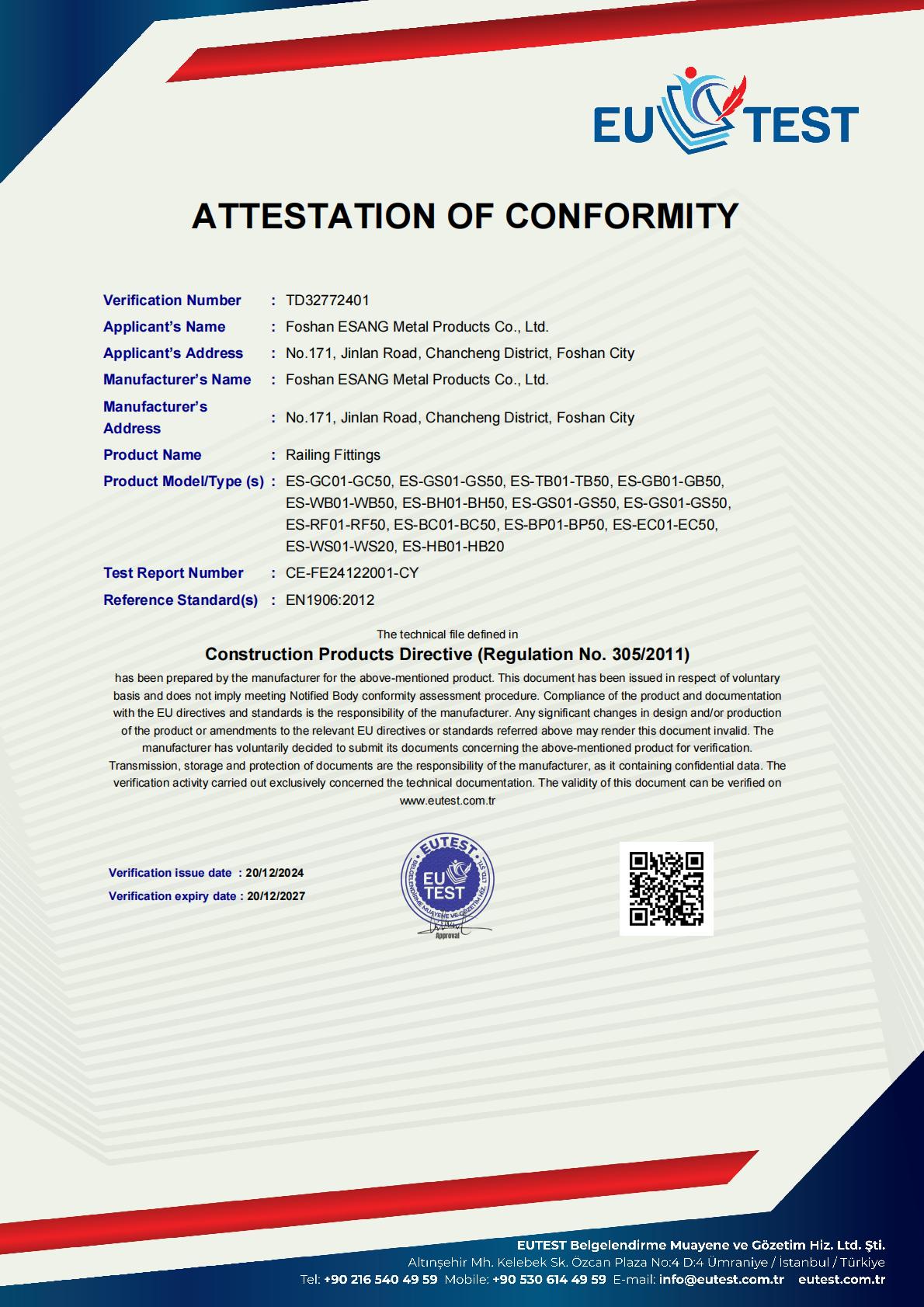
Foshan ESANG Metal Products proudly maintains CE certification (Verification No. TD32772401) under the Construction Products Directive (Regulation No. 305/2011), affirming our commitment to the highest European safety and quality standards.
Certified Product Range:
Our comprehensive railing fittings portfolio—including glass clamps, tensioners, brackets, wall mounts, base shoes, handrail fittings, cable hardware, and post components—meets EN1906:2012 standards, ensuring structural integrity and performance reliability across all installations.
What This Means for Your Project:
✓ Full regulatory compliance for European and international markets
✓ Independently verified safety and durability performance
✓ Documentation support for architectural specifications
✓ Peace of mind from third-party quality assurance
Certification valid through 2027 | Test Report: CE-FE24122001-CY